Table of Contents:
#Tunisia's Rich Cultural Heritage and Historical Influence
#Fascinating Facts About Tunisia's Artistic and Architectural Treasures
#Tunisian Culinary Culture: A Delicious Fusion
#Language, Religion, and Social Customs in Tunisia
#Tunisia's Modern Cultural Evolution and Global Recognition
#know before you go :
Tunisia presents visitors with an extraordinary cultural mosaic, where centuries of Arab, Berber, Ottoman, and French civilizations have woven together threads of tradition that continue to define this North African nation today. Across 163,610 square kilometers, 11,943,000 people call this ancient land home, where demographic patterns tell their own compelling story - 98% identify as Arab while 99% practice Sunni Islam, yet the country maintains deep-rooted traditions of religious tolerance that set it apart from neighboring regions.
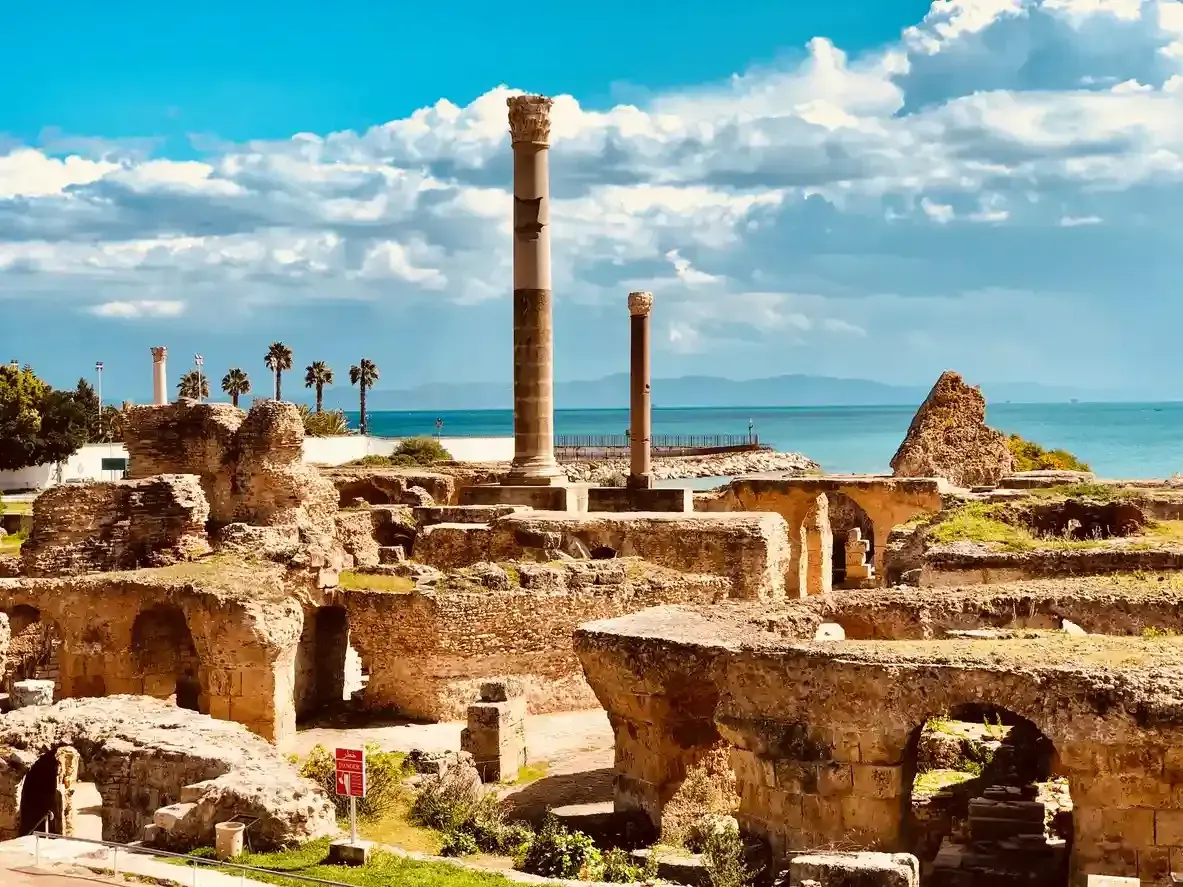
The archaeological record speaks volumes about Tunisia's historical significance. Eight UNESCO World Heritage Sites dot the landscape, each serving as testimony to civilizations that once controlled Mediterranean trade routes and shaped North African culture. Ancient Carthaginian ruins stand alongside Ottoman mosques and French colonial architecture, creating a visual timeline where visitors can trace millennia of human achievement through stone and mortar.
Modern Tunisia extends its cultural influence far beyond historical preservation. The nation ranks among the world's premier olive oil producers, with groves that have supplied Mediterranean markets since Phoenician times. Cinema enthusiasts recognize Tunisia as the backdrop for iconic Star Wars filming locations, where desert landscapes doubled as distant planets and traditional architecture provided settings for galactic adventures.
This remarkable fusion of ancient heritage and contemporary relevance establishes Tunisia as a destination where cultural exploration yields discoveries at every turn. Each medina, monument, and tradition carries stories that illuminate how diverse civilizations can blend successfully while preserving their distinctive character.
The Blend of Arab, Berber, and Mediterranean Cultures
Berber peoples established Tunisia's foundational cultural identity, their presence stretching back through prehistoric millennia across North Africa. Today, their enduring traditions flourish most vibrantly in southern communities scattered around Matmata, Tamezret, Zeraoua, Taoujout, and Toujane, where only 1% of the population continues to speak the ancestral Tamazight language. The indigenous Amazigh communities perfected remarkable architectural innovations, most notably their troglodyte dwellings carved directly into rock formations, structures that function as natural climate control systems, maintaining comfortable temperatures throughout seasonal extremes.
Mediterranean peoples arrived in successive waves, each group leaving indelible marks on Tunisia's evolving cultural identity. Phoenician traders brought maritime knowledge and commercial networks, while Greek settlers contributed artistic sensibilities and philosophical traditions. Rather than existing in isolation, these diverse cultural elements underwent a process of active synthesis, creating distinctive customs and social practices that emerged nowhere else across the North African expanse.
Ancient Civilizations That Shaped Tunisia
Carthage dominated ancient Tunisia's historical trajectory with unparalleled influence. Phoenicians from Tire established this legendary city in 814 BCE, choosing a name that simply meant "new city" in their native tongue. The founders selected their location with strategic brilliance. A triangular peninsula jutting into the Gulf of Tunis provided natural control over maritime traffic flowing between Sicily and the North African coastline, establishing Carthage as an essential Mediterranean power.
Economic prosperity followed naturally from this advantageous position. Silver mines across North Africa and southern Spain generated enormous wealth beginning around 800 BCE, funding Carthage's expansion into a dominant trade center. Merchants handled diverse commodities from Arabian spices to African treasures, including gold, ivory, and ebony, ultimately positioning Carthage as the Mediterranean's primary silver producer and exclusive manufacturer of bronze through its tin monopoly.
Modern DNA research has unveiled surprising revelations about Carthaginian demographics. Despite preserving Phoenician cultural practices, language, and religious beliefs, the Punic population demonstrated remarkably diverse genetic ancestry with surprisingly limited Levantine heritage. The strongest genetic connections traced back to populations resembling modern Sicily and Greece, indicating that Phoenicians expanded their cultural influence through local integration rather than large-scale population replacement.
The Punic Wars between Carthage and Rome spanned 265-146 BCE and culminated in Carthage's complete annihilation in 146 BCE. Roman reconstruction followed in 29 BCE with the establishment of Colonia Julia Carthago, which achieved sufficient prosperity to rival Alexandria and Antioch as a major Mediterranean metropolis. UNESCO designated the archaeological remains as World Heritage in 1979.
Ottoman and French Colonial Legacy
Ottoman control arrived during the sixteenth century, fundamentally altering political relationships by transferring ultimate authority from Tunis to Istanbul. Local administrators retained considerable autonomy under this arrangement, a system that persisted until French interference disrupted the balance. France formalized its influence through the Treaty of Bardo, signed May 12, 1881, establishing a protectorate that endured until independence in 1956.
French colonial administration initiated substantial infrastructure projects across the territory. Engineers constructed extensive railroad networks, modern highways, and expanded seaports, while geological surveys identified valuable phosphate deposits near Gafsa that became major export commodities. The European settler population expanded dramatically from 10,000 residents in 1891 to 144,000 by 1945. Colonial authorities modernized educational institutions, healthcare facilities, and sanitation infrastructure, though these improvements served French commercial interests and colonial residents more than the broader population.
How Tunisia's History Influences Modern Culture
Contemporary Tunisian society bears visible imprints of this complex historical layering. The seventh-century Arab conquest introduced Islam and the Arabic language, fundamentally transforming cultural identity while establishing Kairouan as a renowned center of Islamic scholarship and learning. Ottoman architectural principles shaped mosque construction techniques, while French urban planning concepts produced the distinctive "Rococo Tunisian" aesthetic that defines Tunis's Avenue Bourguiba. Visitors today encounter this remarkable cultural synthesis through museum collections, the picturesque architecture of Sidi Bou Said, and culinary traditions that seamlessly blend French techniques with traditional North African flavors.
Ready to explore Tunisia's fascinating cultural heritage firsthand? Our Tunisia tours bring history, traditions, and authentic experiences to life with expert local guides.
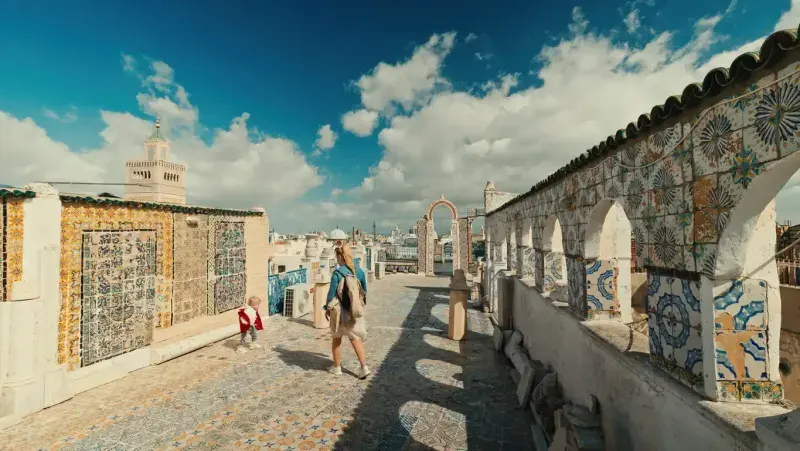
Caucasian Mother and Boy Exploring Rooftop in Historic Tunis
The Great Mosque of Kairouan: Africa's Oldest Mosque
The year 670 CE marked a pivotal moment for Islamic architecture when the Great Mosque of Kairouan emerged as Africa's first Muslim place of worship. This monumental structure established architectural principles that would influence mosque design throughout the Maghreb region, particularly through its intricate decorative motifs that became signature elements of North African Islamic art. The present edifice, reconstructed during the 9th century, occupies a quadrilateral footprint spanning 135 meters by 80 meters.
Within its southern boundary lies a remarkable hypostyle prayer hall, where 17 parallel naves create a forest of columns carved from precious marble and lustrous porphyry. The mosque's commanding three-story minaret dominates the northern edge of an expansive flagstone courtyard, its presence marking the city's skyline for miles around. The prayer hall houses 414 ancient columns, each one salvaged from the ruins of Carthage and Sousse, while the 9th-century mihrab displays exquisite tiles transported from the distant workshops of Baghdad. This sacred space stands as tangible evidence of early Islamic civilization's flourishing in Ifrîqiya.
UNESCO World Heritage Sites in Tunisia
Nine UNESCO World Heritage Sites establish Tunisia's position among nations with exceptional cultural patrimony, featuring eight locations recognized for cultural importance and one designated for natural significance. Recognition began in 1979 with the first three inscriptions, while Djerba represents the most recent addition to this prestigious list in 2023. These protected sites chronicle human achievement across millennia, spanning Roman engineering marvels to medieval Islamic masterpieces that illuminate North Africa's layered civilizational history.
The Medina of Tunis and Its 700 Monuments
Seven hundred monuments populate the historic Medina of Tunis, where palaces, mosques, mausoleums, madrasas, and ornamental fountains represent centuries of architectural evolution. This UNESCO World Heritage Site encompasses approximately 280 hectares and demonstrates every essential component of traditional Arab-Muslim urban planning. The protected area includes the 8th-century core medina alongside 13th-century suburban extensions that expanded the city's boundaries northward and southward.
Distinguished structures define the medina's character, from the venerable Zitouna Mosque to the imposing Kasbah Mosque and the elegant Youssef Dey Mosque, complemented by historic gateways Bab Jedid and Bab Bhar. The medina's strategic position facilitated architectural exchanges between the Maghreb, Southern Europe, and Eastern Islamic lands, creating a unique synthesis of building styles that evolved over many centuries.
El Jem Amphitheater: Rome's Legacy in Africa
Rising from the Tunisian landscape around 238 AD, the Amphitheater of El Jem commands attention as North Africa's most imposing Roman entertainment venue, designed to accommodate approximately 35,000 spectators. The oval structure extends 148 meters along its major axis and 122 meters across its minor axis. Constructed entirely from massive stone blocks placed directly on level ground without deep foundations, it endures as one of the world's finest examples of Roman stone construction.
Three tiers of arcades rise in harmonious succession, each level displaying Corinthian or composite architectural orders. Visitors can ascend to the upper seating areas and venture into the two lengthy subterranean corridors where wild animals and gladiators await their dramatic entrances into the arena.
Sidi Bou Said: The Blue and White Paradise
Perched dramatically above the Mediterranean, Sidi Bou Said enchants visitors with its signature palette of cobalt blue and pristine white that adorns every surface throughout this clifftop village. The town bears the name of Sufi mystic Abu Said Ibn Khalef, while its cobblestone pathways wind past artisan workshops and traditional cafés that preserve centuries-old atmosphere. A protective decree issued in 1915 safeguarded the distinctive architectural style that local families had developed, utilizing lime-based whitewash for cooling effects and blue pigments to withstand harsh sun and salt air. Baron Rodolphe d'Erlanger's former residence, the palatial Ennejma Ezzahra, now serves as a museum showcasing traditional musical instruments from across North Africa.
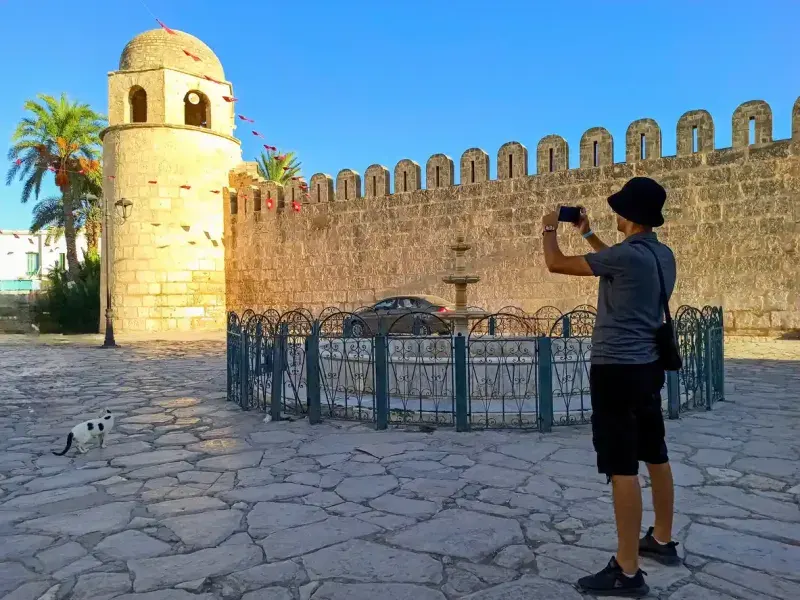
A tourist photographs the Great Mosque in Sousse, Tunisia
Customize Your Dream Vacation!
Get in touch with our local experts for an unforgettable journey.
Plan Your Trip
The Spiciest Couscous in North Africa
Kosksi, as Tunisians call their beloved couscous, occupies a central position in national culinary identity, gracing tables at weddings, funerals, and festive celebrations. UNESCO's 2018 recognition of couscous as Intangible Cultural Heritage acknowledged its profound cultural significance across North Africa. These tiny granules emerge from steamed and dried durum wheat, prepared in specialized double boilers known as kiska:s in Arabic or couscoussière in French.
Heat distinguishes Tunisian cuisine from its Maghreban neighbors, primarily through generous applications of harissa, the region's signature fiery condiment. Moroccan and Algerian kitchens certainly embrace spice, yet Tunisian cooks push flavor boundaries considerably further. The resulting couscous displays vibrant orange to crimson hues, its intensity determined by the quantity of meat broth and harissa incorporated during preparation. Traditional recipes combine meat, vegetables, chickpeas, and chili peppers into a piquant tomato-based stew that sets Tunisian couscous apart from regional variations.
Tunisia's French-Influenced Daily Cuisine
Colonial heritage manifests clearly in contemporary dining patterns. Morning meals might feature French-style coffee and pastries, or embrace distinctly local traditions with steaming bowls of lablabi. Lunch assumes prominence as the day's principal meal, typically beginning with salads or soups before the main course arrives.
Pasta preparations showcase this cultural synthesis particularly well. Despite geographical proximity to Italy, Tunisian pasta dishes feature substantially thicker, spicier sauces topped with mixtures of fried ingredients. This culinary adaptation demonstrates how external influences merged with local tastes while preserving distinctive regional character.
Lablabi: The Winter Street Food Sensation
Few dishes command the devotion that Tunisians reserve for lablabi, their cherished chickpea soup consumed at breakfast or as street food. Historical records trace its origins to the Ottoman occupation period around the 16th century, when cooks prepared this nourishing soup for soldiers and citizens during times of conflict. Lablabi vendors operate throughout Tunisia, creating gathering places where truck drivers share tables with business executives, all united by appreciation for this garlic-infused chickpea broth.
The foundation combines chickpeas, rustic bread, harissa, garlic, cumin, and fresh lemon. Diners personalize their servings with various toppings, including poached eggs, tuna, pickled turnips, or preserved lemons. Local custom involves using two soup spoons to thoroughly mix ingredients before consumption. This warming dish provides essential comfort during colder months, maintaining exceptional popularity across metropolitan areas throughout winter seasons.
Tunisia as a Global Olive Oil Producer
Olive groves create verdant carpets across the Tunisian landscape, where approximately 82 million trees cover roughly 30% of available arable land. The nation consistently maintains its position among the world's leading olive oil exporters. Production forecasts for the 2025-2026 season anticipate yields between 380,000 and 400,000 tons, with optimistic projections reaching 500,000 tons. Such volumes would establish unprecedented national production records.
The 2022-2023 harvest yielded 217,000 tons, securing Tunisia's fifth-place global ranking. Olive oil constitutes the country's primary agricultural enterprise, representing over 50% of annual agricultural exports. This industry sustains more than 309,000 producers across rural communities. Olive cultivation extends back through millennia to the Phoenician and Roman eras, establishing these ancient groves as integral components of national identity and economic foundation.
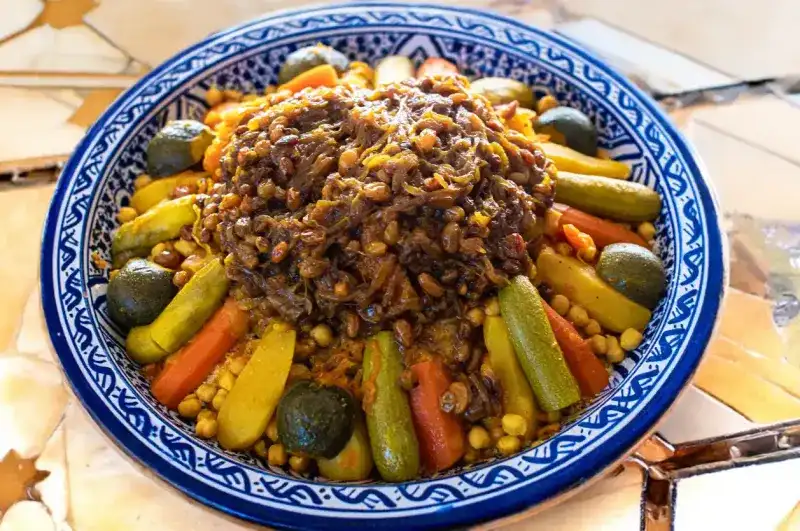
Couscous dishes and its assortment of vegetables.
Arabic, French, and Linguistic Diversity
Language patterns across Tunisia reveal the practical evolution of communication in a culturally diverse society. Arabic functions as the official language, with Tunisian Arabic spoken by nearly 100% of the population, while only around 88% speak or understand Standard Arabic. This distinction reflects the natural adaptation of classical Arabic to local needs and expressions that emerged over centuries of cultural exchange.
French maintains a remarkable influence throughout society, with 6.36 million people or 63.6% of the population speaking it, almost entirely as a second language. Urban centers showcase this bilingual reality most clearly, where business meetings might switch between Arabic and French mid-conversation, and administrative documents appear in both languages without confusion.
The cultural Arabization process reached its zenith by the end of the 12th century, leaving only small pockets in southern regions where Berber languages survive. Visitors who learn basic Tunisian Arabic phrases discover immediate warmth in local interactions. Essential greetings include "As-salamuʿalaykum" or "Ass-lema" for hello, "bess-lama" for goodbye, "brabbi" for please, and "Ayshek" for thank you.
Tunisia's Welcoming Spirit and Hospitality
Hospitality occupies a sacred position within the Tunisian social fabric, where guest treatment follows ancient traditions that transcend economic circumstances. Invitations to Tunisian homes come with an expectation of royal treatment, where hosts take personal pride in demonstrating generosity through abundant food and attentive service.
Declining refreshments, particularly the ubiquitous mint tea, signals disrespect that can strain relationships. Cultural wisdom suggests accepting at least a symbolic taste, even when appetite or dietary restrictions apply. This small gesture acknowledges the host's honor and preserves social harmony.
Tea or meal offerings to unexpected visitors represent standard protocol rather than special occasions. Proper etiquette for impromptu visits includes bringing modest gifts - pastries, seasonal fruits, or flowers serve as appropriate tokens. These gestures demonstrate recognition of the host's time and generosity while honoring traditional courtesies.
Religious Tolerance and Coexistence
Islam in its Mālikī Sunni form claims nearly universal practice and serves as the state religion, yet Tunisia's approach to religious diversity distinguishes it within the region. The nation balances deep Islamic tradition with openness that allows minority faiths to flourish alongside the Muslim majority.
Christianity and Judaism maintain a visible presence through active churches in Tunis and thriving synagogues on Djerba. The Jewish community on Djerba, numbering approximately 1,200 individuals, concentrates in Hara Sghira and Hara Kbira neighborhoods where families have lived for generations.
Interfaith relationships demonstrate remarkable harmony, with Muslims and Jews exchanging visits during religious celebrations and sharing joy at weddings. Government policies actively support this religious diversity, creating legal frameworks that protect minority religious practices.
Traditional Tunisian Gestures and Etiquette
Social greetings function as essential expressions of respect that establish the tone for all subsequent interactions. Close friends and family members typically exchange two cheek kisses, particularly among women or male relatives with strong bonds. New acquaintances navigate more formal territory - men generally offer handshakes, while women choose between nods, smiles, or handshakes based on personal comfort levels.
Elder respect forms a cornerstone of Tunisian social order, where age commands automatic deference. Proper upbringing shows itself through gestures like offering seats to older individuals or ensuring they receive food service before younger family members. Friday holds particular significance as the Islamic holy day, when business activity slows during noon prayers, and families gather for weekly traditions.
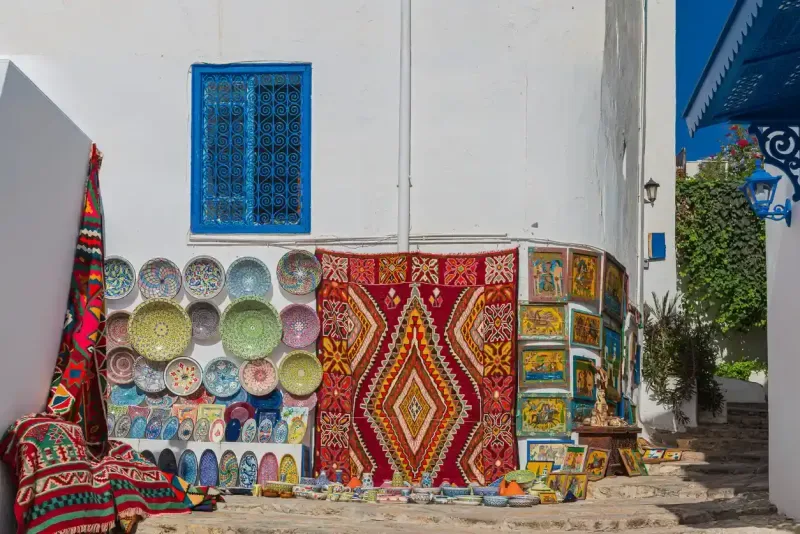
Streets with typical Tunisian architecture and souvenirs for tourists, Sidi Bou Said, Carthage, Tunisia
Pioneering Women's Rights in the Arab World
Tunisia's 2014 constitution established unprecedented gender equality provisions that position the nation as a regional leader in women's rights. Article 46 guarantees parity between men and women in all elected assemblies, creating a more progressive framework than most Western constitutions. This constitutional foundation enabled women to achieve 31% representation in parliamentary seats, surpassing levels found in the United States, Britain, and Canada.
Parliament's 2017 landmark legislation criminalizing domestic violence against women marked another significant milestone. The comprehensive law addressed moral, psychological, economic, and political gender-based violence for the first time in the nation's history. Electoral reforms ensured vertical parity on candidate lists, requiring men and women to alternate positions. The 2018 local elections demonstrated the effectiveness of these measures, achieving 47% female representation through horizontal parity provisions.
Desert Landscapes That Became Galactic Worlds
Director George Lucas selected Tunisia's diverse terrain for numerous iconic Star Wars sequences, establishing the country as home to the second-largest collection of filming locations from the franchise globally. The fictional planet Tatooine draws its name directly from the Tunisian city of Tataouine, while twelve distinct filming sites scattered across 500 kilometers of southern desert appear throughout the four Skywalker saga movies.
Hotel Sidi Driss in Matmata continues to showcase the original interior decorations from Luke Skywalker's childhood home. Near Tozeur, the complete Mos Espa set remains on the Chott el-Gharsa salt flat, where dedicated locals and international fans collaborate to protect the structures from advancing desert dunes.
The Jasmine Revolution That Changed History
December 17, 2010, became a watershed moment in modern Arab history when Mohamed Bouazizi set himself ablaze in Sidi Bouzid following police confiscation of his fruit cart. His death on January 4 ignited nationwide demonstrations against corruption, poverty, and political repression. President Zine al-Abidine Ben Ali's flight from the country on January 14, 2011, ended his 23-year rule.
This Jasmine Revolution sparked uprisings throughout the Middle East and North Africa, destabilizing established regimes across the region. Tunisia's new constitution, adopted in January 2014, earned international praise as a successful compromise between secular and Islamist political movements.
Accessible Cultural Treasures for Every Budget
Tunisia presents exceptional value for cultural enthusiasts, combining UNESCO World Heritage Sites, cinematic locations, and Mediterranean coastlines at remarkably affordable prices. Visitors can secure overnight accommodations at Hotel Sidi Driss for modest rates, while exploring historic sites like Ksar Hadada requires only minimal entrance fees. This accessibility ensures that Tunisia's rich cultural heritage remains within reach for travelers seeking authentic experiences without premium costs.
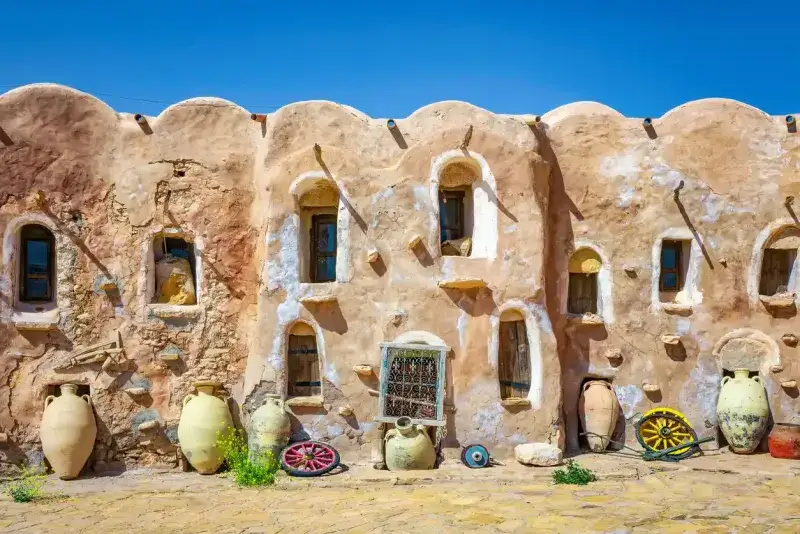
Ksar Ouled Debbab is a fortified granary in Tataouine Governorate - southern Tunisia
Tunisia's cultural landscape stands as a testament to how civilizations can merge while preserving their essential character. Carthaginian merchants, Ottoman artisans, and French administrators each left indelible marks on a society that absorbed their contributions without losing its North African soul. The result defies simple categorization - Africa's oldest mosque rises beside Roman amphitheaters, while traditional couscous carries heat levels that challenge even seasoned spice enthusiasts.
The nation's appeal extends beyond its historical monuments and architectural treasures. Eight UNESCO World Heritage Sites await exploration alongside film locations where galactic sagas unfolded against desert backdrops. Traditional markets sell handcrafted goods steps away from olive groves that have supplied Mediterranean tables since ancient times. Progressive social policies coexist with time-honored customs of hospitality that welcome visitors as honored guests.
Tunisia accomplishes what few destinations achieve - offering profound cultural experiences at accessible prices. The country's welcoming character and remarkable ability to balance tradition with modernity create opportunities for discovery that resonate long after departure. Each interaction, whether examining Carthaginian ruins or sharing tea with local families, reveals layers of cultural richness that reward curious travelers seeking authentic encounters with living history.
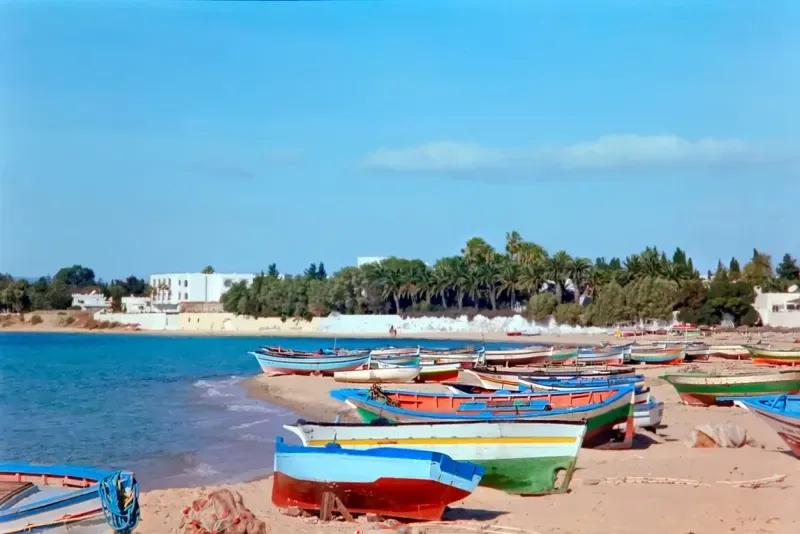
Beach with ltraditional fishing boat. Hammamet, Tunisia