
Some destinations tick boxes. And then there is Turkey — a country that rewrites your entire understanding of what travel can feel like.
Activities
Top 9 Experiences You Can Only Have in Turkey
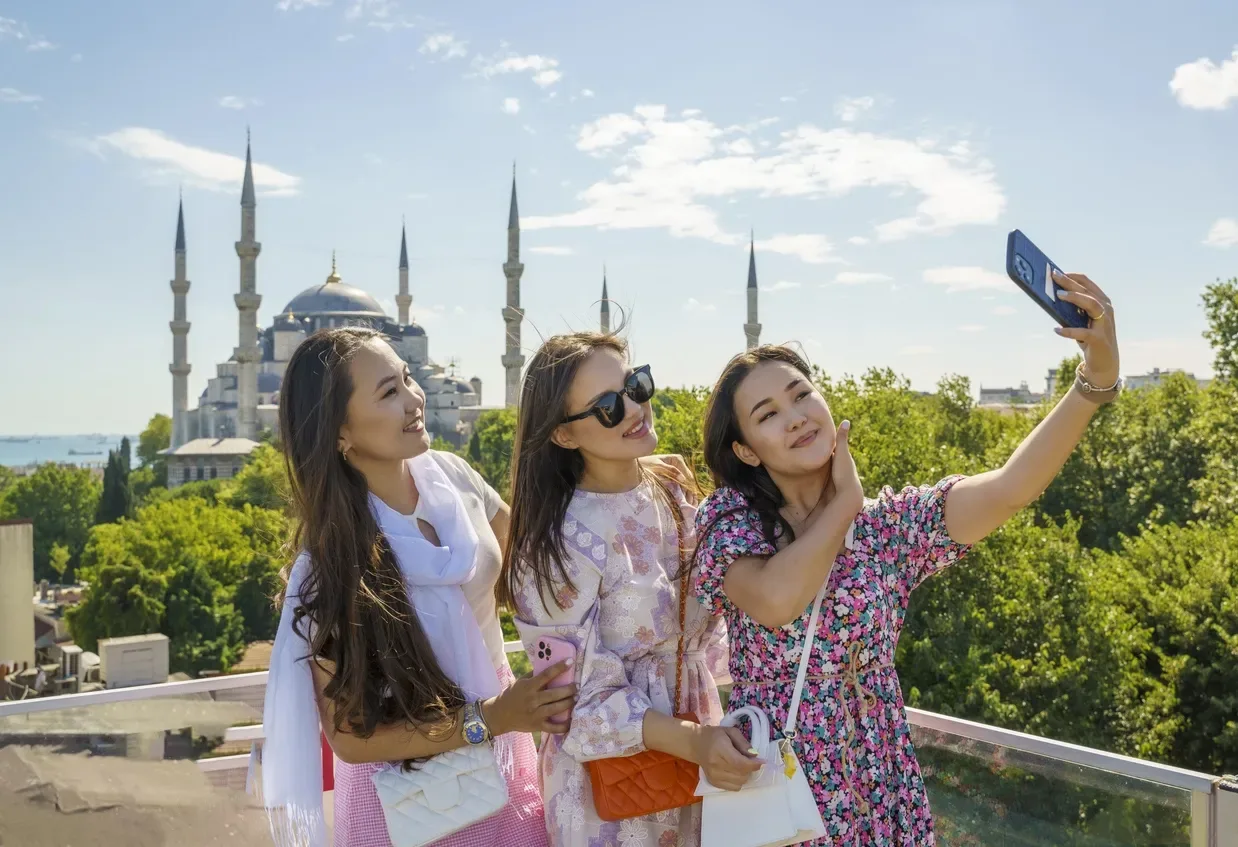
three-women-taking-selfie-rooftop-blue-mosque-sultanahmet-istanbul-turkey
Turkey is one of those rare places where history is not behind glass in a museum — it is under your feet, carved into the cliffs above you, floating in the thermal water you are swimming in, and echoing in the call to prayer drifting across a city that has been continuously inhabited for thousands of years. It is a country where you can have breakfast in Europe and dinner in Asia on the same day, where a single week of travel can take you from one of the world's greatest cities to a landscape that looks like it belongs on another planet entirely.
We have traveled Turkey extensively — from the chaotic, electric streets of Istanbul at midnight to the silent, snow-dusted valleys of Cappadocia at dawn — and what strikes us every single time is how many of its greatest experiences exist nowhere else on earth. Not a version of them. Not something similar. The real thing, in the only place on earth where it exists.
Here are the nine experiences you can only have in Turkey.
1. Float Above Cappadocia in a Hot Air Balloon at Sunrise
Let us start with the one that makes grown adults cry.
The alarm goes off at 4:30 am. It is dark, it is cold, and every instinct tells you to go back to sleep. Do not listen to those instincts. Pull on your warmest layers, climb into the minibus that arrives at your cave hotel, and make your way to the launch site where dozens of balloons are slowly, silently inflating in the pre-dawn darkness like giant paper lanterns being coaxed to life.
You climb into the basket. The burner roars. And then, almost imperceptibly, the ground falls away.
As the sun rises over the Cappadocian landscape — painting the fairy chimneys gold, filling the valleys with light, setting the rock formations glowing in a hundred shades of amber and rose — you will look around at the other passengers in your basket and realize that every single one of them has tears in their eyes. Including, quite possibly, you.
This is not hyperbole. It is simply what Cappadocia does to people.
Hot air ballooning exists in many parts of the world. But nowhere does the landscape below match what Cappadocia offers — millions of years of geological artistry compressed into a single breathtaking panorama that you will carry in your memory for the rest of your life.
Practical tip: Book your balloon flight at least two to three months in advance, especially for spring and autumn travel. Flights are sometimes cancelled due to wind — if this happens, most operators will offer a refund or reschedule. April, May, September, and October offer the most reliable conditions.
2. Sleep Inside a Cave in Cappadocia
Turkey offers some extraordinary places to stay — Ottoman palaces converted into boutique hotels, clifftop villas overlooking the Aegean, timber mansions on the Bosphorus. But nothing quite compares to spending the night inside a cave.
Cappadocia's cave hotels are not a novelty act. Carved directly into the ancient volcanic rock that defines the region's extraordinary landscape, they are genuinely beautiful, surprisingly luxurious, and utterly unique spaces where thick stone walls maintain a natural temperature year-round, keeping rooms cool in summer and wonderfully warm in winter.
Waking up in a cave in Cappadocia — stepping out onto your private terrace as the first balloons of the morning rise above the valley ridgeline, cradling a glass of strong Turkish tea, watching the light change across the fairy chimneys — is one of those travel moments that reminds you why you left home in the first place.
Where to stay: Göreme and Urgup offer the widest range of cave accommodation, from budget guesthouses to five-star luxury properties with private plunge pools and panoramic terraces.
Customize Your Dream Vacation!
Get in touch with our local experts for an unforgettable journey.
Plan Your Trip
3. Walk Barefoot on the Travertines of Pamukkale
Imagine a mountainside covered in what appears to be freshly fallen snow — except it is 35 degrees outside, and the snow is warm to the touch. That is Pamukkale.
Turkey's "Cotton Castle" is one of the world's most extraordinary natural phenomena — a cascade of white travertine terraces formed over thousands of years by calcium-rich thermal waters flowing down the hillside, creating a series of naturally sculpted pools that glow a luminous, almost impossibly beautiful shade of turquoise against the white rock.
You remove your shoes at the entrance — it is mandatory, and rightly so — and walk barefoot across the warm white surface, stepping into pools of mineral-rich water that the Romans were already soaking in two thousand years ago. Above you, the ruins of the ancient city of Hierapolis stretch across the hilltop, a reminder that this has been a place of pilgrimage, healing, and wonder for as long as human civilization has existed in this part of the world.
There is nothing in the world that looks like Pamukkale. Nothing that feels like it either.
Practical tip: Visit early in the morning or late in the afternoon to avoid the worst of the crowds and experience the terraces in the most beautiful light. Stay overnight in the town of Pamukkale to enjoy the site at its most peaceful.
4. Take a Turkish Bath in a 500-Year-Old Hamam
The Turkish bath — the hamam — is one of the great civilizing institutions of the Ottoman world, and experiencing one in a historic Istanbul bathhouse is an encounter with a tradition that has been at the heart of Turkish social life for five centuries.
You are shown to a private changing cubicle, handed a thin cotton wrap called a pestamal, and led into the main bathing hall — a domed marble chamber where steam rises from the central platform and light filters through star-shaped skylights cut into the dome above. You lie on the warm marble. Time slows. The world outside ceases to exist.
Then the tellak — your bath attendant — arrives. What follows is an experience that is equal parts exfoliation, massage, and mild surrender to the complete authority of another human being. A kese mitt removes several layers of skin you did not know you were carrying. Buckets of warm water are poured over you. Clouds of soapy foam are worked across your entire body. By the time it is over, you emerge into the cool air feeling approximately twenty years younger and entirely reborn.
Historic Istanbul hamams like Cemberlitas, Suleymaniye, and Cagaloglu have been operating continuously since the 16th century. Walking through their doors is not just a spa experience — it is a genuine encounter with living Ottoman history.
Practical tip: Opt for a hamam that has been operating for centuries rather than a modern spa imitation. The architecture, atmosphere, and authenticity are part of the experience.
5. Cruise the Turquoise Coast on a Traditional Gulet
The Turkish coastline between Fethiye and Antalya is one of the most beautiful stretches of water in the world — a dramatic, pine-fringed shore of hidden coves, ancient ruins tumbling into the sea, and water so clear and so impossibly blue that it gives the region its name: the Turquoise Coast.
The only proper way to experience it is from the water, aboard a traditional wooden gulet — a broad, sturdy sailing vessel that has been the vessel of choice along this coastline for generations. You sail from cove to cove, dropping anchor in secluded bays accessible only by sea, swimming off the back of the boat into crystal-clear water, eating fresh fish grilled on deck as the sun sets behind the pine-covered hills.
Days on a gulet follow a beautifully simple rhythm: wake with the sun, swim before breakfast, sail to the next bay, swim again, eat, nap, watch the stars appear over the water. The Blue Voyage, as it is known, strips away every unnecessary thing and leaves only the essential — sea, sun, good food, and the extraordinary beauty of the Turkish coast.
This is not something you can replicate anywhere else. The combination of this specific coastline, this specific style of boat, and this specific way of traveling is entirely and uniquely Turkish.
Practical tip: The classic Blue Voyage route runs between Fethiye and Marmaris or Fethiye and Olympos. May, June, and September offer the best combination of warm weather, calm seas, and manageable crowds.
6. Explore an Ancient City That Predates Rome by Centuries
Turkey has more ancient ruins than almost any country on earth — and the sheer scale and quality of what survives is genuinely staggering.
Ephesus alone — the ancient Greek and Roman city near the modern town of Selcuk — would be enough to make Turkey one of the world's great historical destinations. Walking down the marble-paved Curetes Street, past the colonnaded facades of ancient libraries and temples, toward the magnificent Library of Celsus — one of the largest and best-preserved Roman buildings anywhere in the world — you feel the full, vertiginous weight of history pressing down on you in the most extraordinary way.
But Ephesus is just the beginning. Troy, where the legendary Trojan War unfolded. Hierapolis, the Roman spa city perched above the terraces of Pamukkale. Perge and Aspendos near Antalya. The extraordinary temples of Didyma and Priene on the Aegean coast. The ruins of ancient Lycia are scattered along the Mediterranean shoreline like the scattered pages of a history book nobody has finished writing yet.
In Turkey, you do not visit ancient history. You walk through it.
Practical tip: A knowledgeable local guide transforms a visit to any of Turkey's major archaeological sites. The stories, context, and detail they provide bring these ancient places to life in a way no guidebook can fully replicate.
7. Drink Tea in a Traditional Turkish Çay Garden
This one requires no planning, no booking, and no special effort. But do not underestimate it.
The Turkish tea garden — the çay bahçesi — is one of the most important social institutions in the country, and sitting in one for an hour or two is one of the most genuinely pleasurable things you can do in Turkey.
Picture a shaded garden, strings of lights overhead, the gentle clinking of tulip-shaped glasses, the sweet smell of apple tobacco from a nearby nargile pipe, and the unhurried murmur of conversation from tables of old men playing backgammon and families sharing a quiet afternoon. A waiter arrives with a small tray bearing two glasses of strong, deep-red Turkish çay and a couple of sugar cubes. You take a sip.
It costs almost nothing. It lasts as long as you want it to. And it is, in its own quiet way, one of the most authentically Turkish experiences you will have.
The best çay gardens in Istanbul overlook the Bosphorus or are tucked into the courtyards of historic mosques. In Cappadocia, find one with a valley view. On the coast, look for one where the fishermen go.
Practical tip: Never rush a Turkish çay garden. The entire point is to slow down completely. Order a second glass. Watch the world go by. This is exactly what locals do.
8. Explore an Underground City Beneath Cappadocia
Somewhere beneath the streets of Cappadocia — beneath the fairy chimneys and cave hotels and vineyards — entire cities are carved into the earth.
The underground cities of Derinkuyu and Kaymakli are among the most astonishing archaeological discoveries in human history — vast subterranean networks descending up to eight stories below ground, with stables, wineries, churches, kitchens, communal living quarters, ventilation shafts, and rolling stone doors designed to seal off entire sections of the city from invaders.
Thousands of people lived down here — entire communities who retreated underground during times of invasion and persecution, bringing their livestock with them, sealing the entrances with enormous circular stones that could only be moved from the inside. Walking through the low, narrow tunnels, ducking through ancient doorways, emerging into underground chambers where early Christian communities once prayed and cooked and slept — it is one of the most genuinely extraordinary historical experiences that Turkey — or anywhere — has to offer. Nothing else in the world compares to it.
Practical tip: Derinkuyu is the deeper and more dramatic of the two main underground cities. Combine a visit to both in a single day trip from Göreme, and consider hiring a local guide to fully appreciate what you are seeing.
9. Stand at the Crossroads of Two Continents in Istanbul
Istanbul is the only city in the world built on two continents simultaneously — its European side facing its Asian side across the shimmering waters of the Bosphorus Strait, connected by bridges and ferries that carry millions of people back and forth every single day.
Standing on the Galata Bridge at dusk, watching the ferries cut across the water as the minarets of the old city light up against the darkening sky and the call to prayer rises from a dozen mosques at once — this is a moment that compresses thousands of years of human civilization into a single, overwhelming experience.
Take the ferry from Eminönü to Kadıköy on the Asian side. It costs almost nothing. It takes twenty minutes. And somewhere in the middle of the Bosphorus, as Europe recedes behind you and Asia grows larger ahead, you realize that you are crossing something far more significant than a stretch of water.
You are crossing history itself.
Explore these extraordinary experiences and so much more with our expertly crafted Turkey Tours — designed to bring the very best of this incredible country to life.
What makes Turkey unique as a travel destination?
Turkey is unique because it sits at the intersection of Europe, Asia, and the Middle East — geographically, culturally, and historically. Nowhere else on earth can you experience Byzantine churches, Ottoman palaces, ancient Greek ruins, Mediterranean beaches, and surreal volcanic landscapes all within a single country. Turkey also offers an extraordinary combination of world-class historical sites, breathtaking natural beauty, genuinely warm hospitality, and outstanding food at prices that represent exceptional value for international travelers.
When is the best time to visit Turkey for these experiences?
April to June and September to October are the ideal months for most of Turkey's signature experiences. The weather is warm and pleasant, crowds are more manageable than in peak summer, and prices are more affordable. Hot air ballooning in Cappadocia and sailing the Turquoise Coast are both at their best during these shoulder months. July and August are best for beach experiences on the Aegean and Mediterranean coasts, while winter in Cappadocia offers a magical snow-covered landscape that is stunning in its own right.
How many days do I need to experience the best of Turkey?
A minimum of 10 to 14 days is recommended to experience Turkey's highlights comfortably. A well-planned two-week itinerary can include Istanbul, Cappadocia, Ephesus, Pamukkale, and a coastal destination such as Bodrum or Fethiye. If you only have one week, prioritize Istanbul and Cappadocia — the two destinations that best capture the extraordinary range of what Turkey has to offer.
What should I absolutely not miss on a first visit to Turkey?
On a first visit, the absolute non-negotiables are a hot air balloon flight at sunrise over Cappadocia, exploring the Hagia Sophia and Grand Bazaar in Istanbul, walking the white travertines of Pamukkale, taking a Bosphorus cruise in Istanbul, experiencing a traditional hamam, and wandering the ancient streets of Ephesus. If time allows, add a gulet sailing trip along the Turquoise Coast — it is one of the most memorable and distinctly Turkish experiences the country has to offer, and one that many first-time visitors immediately begin planning to repeat.
Related Articles
Keep the inspiration going with these handpicked travel reads.