
 Home
Home
Tucked in the dry-zone heart of Sri Lanka, Polonnaruwa is one of the most spellbinding archaeological cities in South Asia, a sprawling open-air museum of toppled stupas, giant Buddha statues, and royal palaces swallowed and then rescued from the jungle. As Sri Lanka's second ancient capital, Polonnaruwa is a non-negotiable stop on almost every serious Sri Lanka tours itinerary, especially those covering the famous Cultural Triangle alongside Sigiriya, Dambulla, and Kandy.
Designated a UNESCO World Heritage Site in 1982, Polonnaruwa tells the story of a golden age, a 12th-century kingdom of engineers, monks, and kings who built reservoirs the size of small seas and carved Buddhas from solid granite. If you're planning your trip that blends history, architecture, and wildlife into one easy day trip, Polonnaruwa belongs at the top of the list.
History of Polonnaruwa
Early Beginnings
Polonnaruwa existed as a minor settlement during the earlier Anuradhapura era, overshadowed by the grander capital to the northwest. It rose to prominence only after repeated invasions from South India weakened Anuradhapura, pushing Sri Lankan rulers to seek a more defensible seat of power further inland.
The Golden Age Under Parakramabahu I
King Vijayabahu I formally made Polonnaruwa the capital in the 11th century after driving out Chola invaders from South India. The city truly flourished under his successor, King Parakramabahu I (1153–1186 AD), remembered as "Parakramabahu the Great." His reign launched sweeping irrigation, religious, and architectural projects, transforming Polonnaruwa into a showcase capital whose ruins still dominate the site today.
Decline and Rediscovery
After Parakramabahu I's death, the kingdom gradually weakened under renewed invasions, internal strife, and the slow collapse of its irrigation systems. The capital was effectively abandoned by the 13th century and reclaimed by dense jungle for hundreds of years. British colonial surveyors, and later Sri Lankan archaeologists, eventually uncovered and restored the site, culminating in its UNESCO recognition in 1982.
Walk through 800 years of history yourself, discover Polonnaruwa's ruins on our Treasures of Sri Lanka package!
Geography and Location
Regional Setting
Polonnaruwa sits in the North Central Province of Sri Lanka, within the country's dry zone, roughly 216 km (134 miles) northeast of Colombo. It occupies a central position in the Cultural Triangle, making it easy to combine with visits to major attractions.
The Parakrama Samudra Reservoir
The ancient city was built around an enormous man-made reservoir, the Parakrama Samudra ("Sea of Parakrama"), constructed to irrigate the surrounding farmland in an otherwise arid region. This reservoir remains the defining feature of the landscape and still supports local agriculture today.
Customize Your Dream Vacation!
Get in touch with our local experts for an unforgettable journey.
Plan Your Trip
Major Attractions in Polonnaruwa
Royal and Administrative Sites
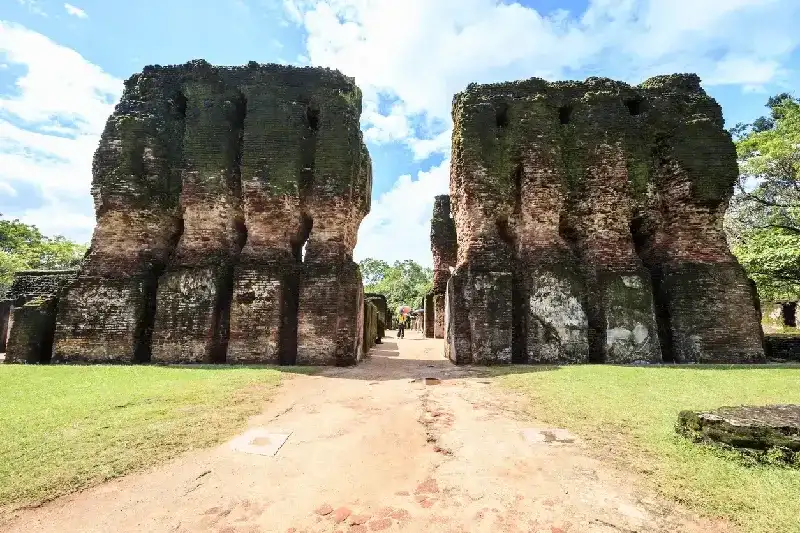
- Royal Palace of Parakramabahu I: Once a seven-story royal residence with massive walls, showcasing the grandeur of 12th-century Polonnaruwa.
- Council Chamber and Audience Hall: Notable for their carved stone pillars, lion-throne base, and royal architectural design.
- Statue of the Sage: A striking stone figure believed to represent either King Parakramabahu I or a revered Buddhist scholar.
Buddhist Monuments
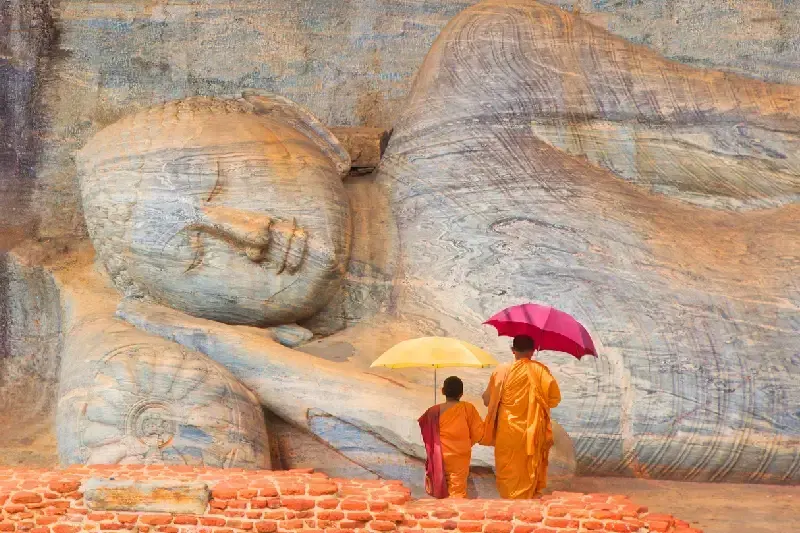
- Gal Vihara: Four colossal Buddha statues carved from a single granite rock face, considered a masterpiece of Sinhalese rock art.
- Rankoth Vehera: The largest stupa in Polonnaruwa, inspired by the great stupas of Anuradhapura.
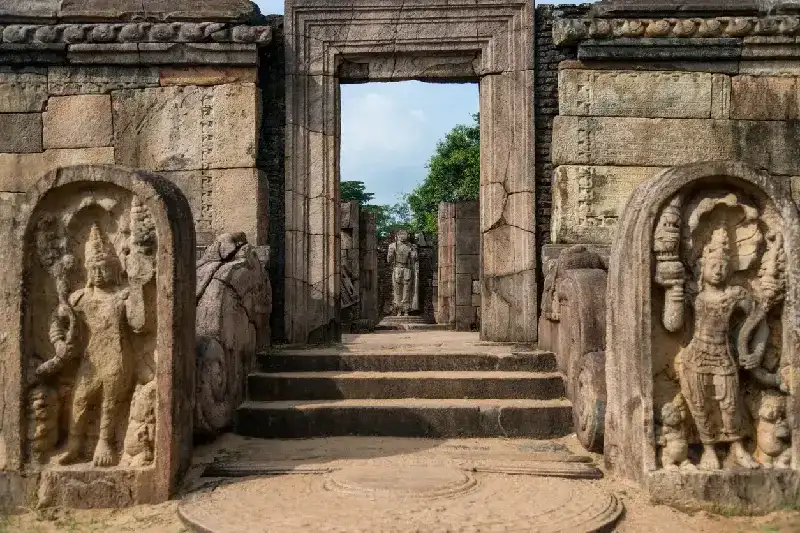
- Vatadage: A circular relic house known for its stone terraces, guard stones, and intricate moonstone carvings.
- Lankatilaka Temple: Features towering brick walls surrounding a large standing Buddha statue.
- Thuparama: One of the best-preserved image houses in the ancient city.
Hindu and Dravidian Sites
- Shiva Devale Temples: Hindu shrines built during the Chola period in a distinct South Indian Dravidian style.
- Dravidian Architecture: Characterized by ornate carvings and temple designs that reflect the cultural exchange between Sri Lankan and South Indian civilizations.
Architecture and Urban Planning
Architectural Style
Polonnaruwa's architecture reflects a unique fusion of Sinhalese Buddhist and South Indian Hindu (Dravidian) styles, a legacy of Chola occupation before the Sinhalese reclaimed the city. Builders relied on brick, granite, and limestone, decorating sacred entrances with elaborately carved moonstones, guard stones, and balustrades. Beyond aesthetics, the city demonstrates advanced hydraulic engineering, with canals, sluices, and the vast Parakrama Samudra reservoir showcasing the technical sophistication of its planners.
City Layout
The ancient city was organized into distinct zones. The Royal Citadel housed the king's palace, audience halls, and administrative buildings. The Sacred Quadrangle (Dalada Maluwa) gathered the city's most important religious monuments into one compact cluster, including the Vatadage and Hatadage, which once housed the sacred Tooth Relic. The Alahana Pirivena formed a vast monastic university complex anchored by Lankatilaka and Rankoth Vehera, while the Outer City spread scattered shrines, ponds, and minor stupas toward the reservoir's edge.
Wildlife and Natural Surroundings
Flora and Fauna Among the Ruins
The ruins sit within open parkland dotted with frangipani trees, palms, and grazing deer, giving the site a relaxed, almost pastoral atmosphere. Toque macaques roam freely among the ancient stones, often stealing the show for photographers, while the Parakrama Samudra reservoir draws herons, storks, cormorants, and other water birds throughout the year.
Nearby National Parks
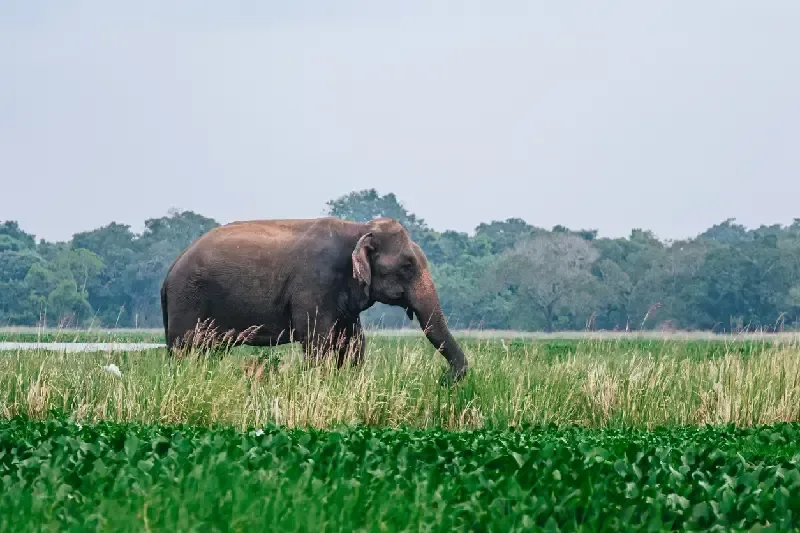
Just beyond the archaeological park, dry-zone forests connect to Minneriya and Kaudulla National Parks, famous for "The Gathering", one of Asia's largest seasonal congregations of wild elephants, drawing nature lovers from across the world.
Visiting Polonnaruwa
Tickets and Museum
A single combined entrance ticket grants access to the full archaeological park, including the on-site Polonnaruwa Archaeological Museum, which offers helpful context before exploring the ruins themselves.
Getting Around the Site
Because the park is flat and shaded, bicycles are by far the most popular and enjoyable way to get around. Tuk-tuks and guided van tours are widely available for travelers who prefer not to cycle in the heat. Most visitors should plan for half a day to a full day to see the major monuments without rushing.
Etiquette and Dress Code
As with any active religious site, modest dress covering shoulders and knees is required when approaching temples and shrines, and footwear must be removed before entering any sacred structure.
How to Get There
Polonnaruwa is a key stop for most Sri Lanka tours, easily combined with Sigiriya, Dambulla, and Kandy.
- From Colombo: The journey covers roughly 216 km. By car or private driver, expect 4–5 hours via the A6 highway through Kurunegala and Dambulla. Trains run a scenic but longer route via Habarana, requiring onward transport to the site, while regular intercity buses take around 5–6 hours.
- From Kandy: At about 140 km away, Polonnaruwa is roughly 3–3.5 hours by car through Matale and Dambulla, or around 4 hours via frequent bus services.
- From Sigiriya: This is the shortest and easiest leg, covering just 50–55 km, about 1–1.5 hours by car or tuk-tuk.
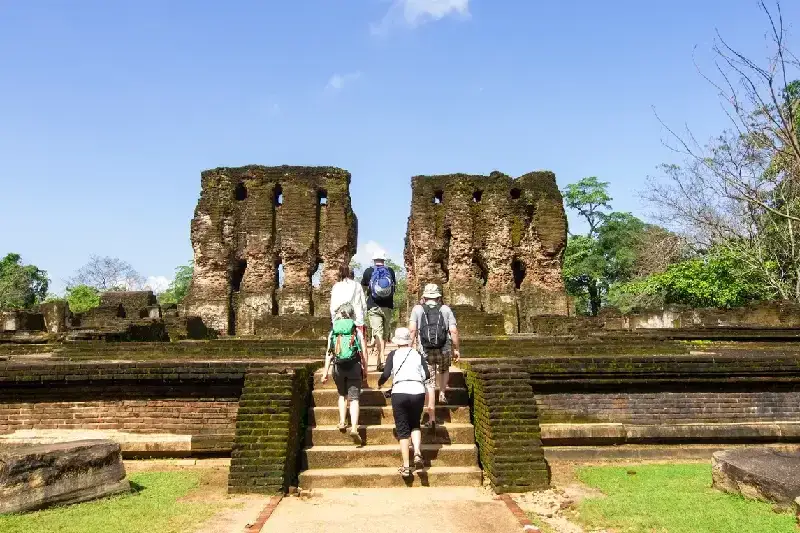
Best Time to Visit Polonnaruwa
Dry Season Advantage
The North Central dry zone enjoys its sunniest, driest weather from May to September, making this the most comfortable window for cycling between monuments. Early morning visits are recommended to avoid the midday heat.
Peak Tourist Season
December to March is also pleasant and aligns with Sri Lanka's broader peak tourist season, while the October–January monsoon period brings the heaviest rainfall to the region.
Nearby Attractions
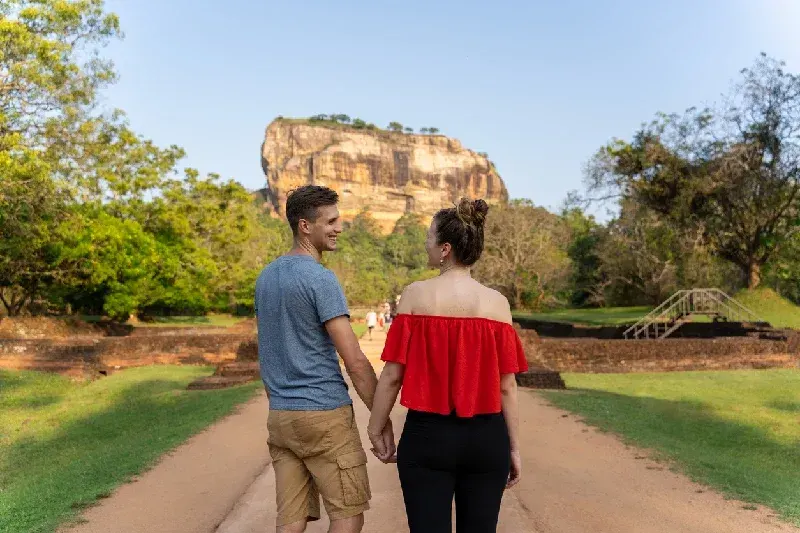
- Sigiriya Rock Fortress: Located about 50 km from Polonnaruwa, this UNESCO World Heritage Site is one of Sri Lanka's most iconic landmarks.
- Dambulla Cave Temple: Approximately 65 km away, featuring ancient cave shrines, Buddhist murals, and statues.
- Minneriya National Park: Famous for elephant safaris and the seasonal gathering of large elephant herds.
- Kaudulla National Park: Another excellent wildlife destination known for elephant sightings and birdwatching.
- Anuradhapura: Sri Lanka's first ancient capital, located around 100 km northwest of Polonnaruwa and home to some of the country's most important archaeological sites.
Experience it all firsthand with our Sri Lanka tours!
Fun Facts About Polonnaruwa
- Parakrama Samudra is so vast that it has long been referred to as a "sea" rather than a reservoir.
- Gal Vihara's Buddha statues were carved from a single continuous granite rock face.
- The Sacred Tooth Relic of the Buddha was once housed in Polonnaruwa during its time as the capital.
- Ancient irrigation systems built during the kingdom's golden age are still partially used today.
- UNESCO World Heritage Site status was granted to Polonnaruwa in 1982, recognizing its outstanding historical and cultural significance.
Why Visit Polonnaruwa?
Unlike Anuradhapura's sprawling ruins, Polonnaruwa is compact and walkable, making it easy to explore thoroughly in a single day. It's photogenic at every turn, from giant rock-cut Buddhas to monkey-dotted stupas set against bright blue skies. As a perfect midpoint on classic Sri Lanka tours, it bridges Sigiriya and Kandy effortlessly, and its proximity to Minneriya and Kaudulla means history and wildlife can be combined in a single trip. Many travelers also find it less crowded than Sigiriya, offering a more relaxed and immersive archaeological experience.
FAQS
Most visitors can comfortably explore the main archaeological sites of Polonnaruwa in half a day to a full day. A full day allows enough time to visit highlights such as Gal Vihara, the Royal Palace, Rankoth Vehera, and the Quadrangle at a relaxed pace.
Yes, the two sites are very different. Sigiriya is a single dramatic rock fortress, while Polonnaruwa is a vast ancient city with diverse architecture spread across a wide, walkable park.
Renting a bicycle is the most popular and enjoyable option, though tuk-tuks and guided tours are also available.
A guide isn't essential but adds valuable historical context, especially around the Sacred Quadrangle and Gal Vihara.
Yes, it's a core stop on nearly all Cultural Triangle itineraries, often paired with Sigiriya, Dambulla, and Kandy.
Modest clothing covering shoulders and knees is required at religious sites, and shoes must be removed before entering shrines.
Yes, nearby Minneriya and Kaudulla National Parks offer excellent elephant-watching opportunities, especially during the dry season "Gathering."
Sigiriya, roughly 50 km away, is the closest major attraction and pairs perfectly for a combined day trip.
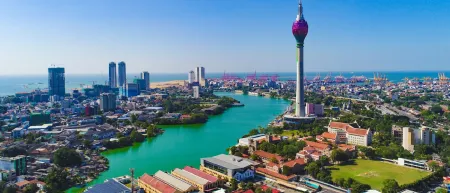
Your complete guide to Colombo, Sri Lanka: discover sights, food, nightlife, guided tours, weather, and travel tips for every visitor.
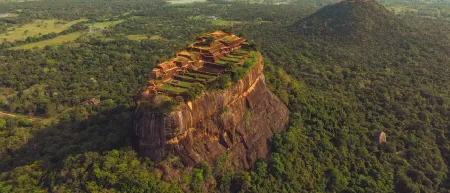
Sigiriya Lion Rock is Sri Lanka’s legendary rock fortress, known for its history, frescoes, and unforgettable panoramic scenery.
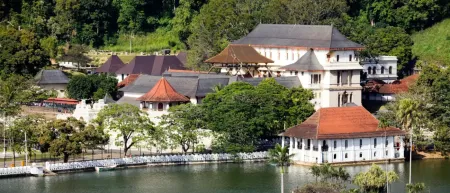
Discover Kandy with our guide to temples, scenic lake, cultural shows, and top attractions for an unforgettable visit.
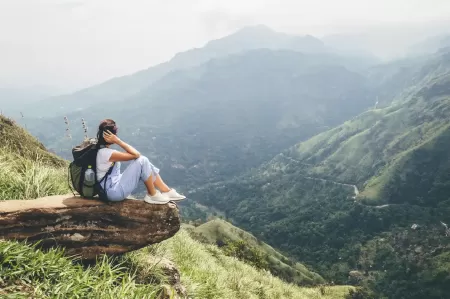
Experience Ella, Sri Lanka, lush landscapes, scenic train rides, and peaceful vibes. Your complete guide to things to do and when to visit.
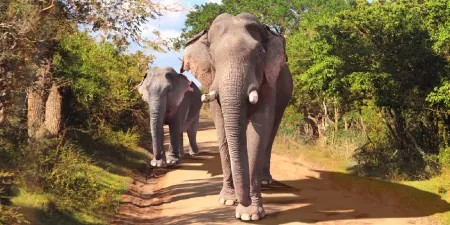
Plan your visit to Yala National Park in Sri Lanka. Discover wildlife, safari experiences, best seasons, and travel tips for this iconic nature reserve.
Discover Galle, Sri Lanka: historic Fort, beautiful beaches, vibrant streets, and unforgettable coastal charm.
Find the best things to do in Nuwara Eliya, from tea plantations to scenic parks and mountains in Sri Lanka’s charming hill station.
Udawalawe National Park offers incredible elephant sightings, wildlife safaris, and beautiful scenery. Learn the best time to visit and travel tips.
Negombo is more than an airport stopover. Explore its fishing culture, Little Rome churches, Dutch canals, and fresh seafood. Full guide inside.
Weligama, Sri Lanka's Sandy Village, your complete guide to beaches, surfing, things to do, and travel tips on the southern coast.
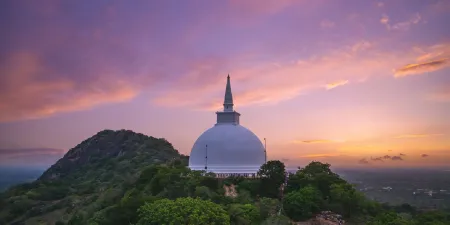
Explore Anuradhapura in Sri Lanka, home to sacred Buddhist sites, ancient ruins, massive dagobas, and unforgettable cultural experiences.
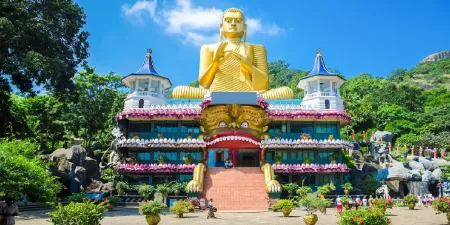
Plan your visit to Dambulla Cave Temple with top highlights like cave murals, Buddha statues, panoramic views, plus useful visitor tips.
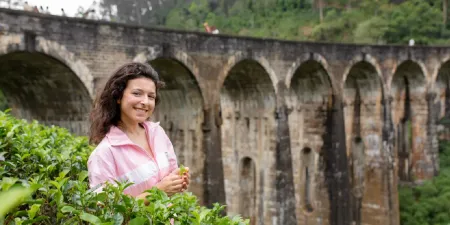
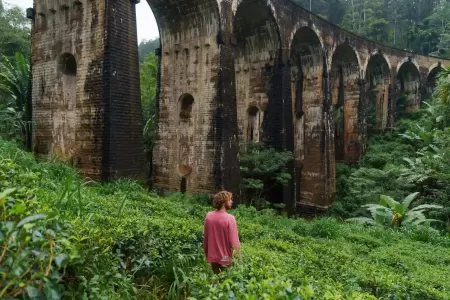
Visit Nine Arch Bridge and enjoy stunning views, scenic train crossings, hiking trails, and one of the country’s top attractions.
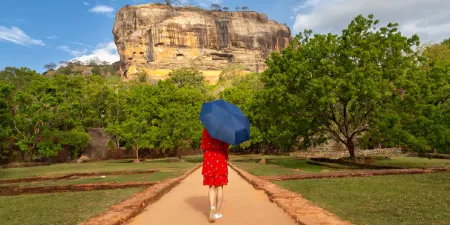
Explore the best things to do in Habarana, from jeep safaris and birdwatching to visiting nearby temples and ancient Sri Lankan cities.
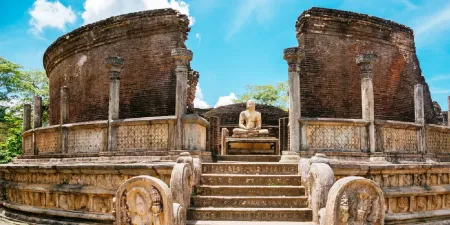
Once the royal capital of Sri Lanka, Polonnaruwa showcases impressive ruins, sacred monuments, and remarkable ancient engineering.