 Home
HomeMamanuca Islands, Fiji: What Are the Mamanuca Islands Known For ?
What Are the Mamanuca Islands ?
The Mamanuca Islands (pronounced ma-ma-NU-tha) are a volcanic archipelago of about 20 islands lying west of Nadi on Fiji's main island of Viti Levu, and south of the Yasawa Islands. Around seven of them disappear beneath the Pacific at high tide, which is why island counts vary between sources.
They are, in short, the Fiji most visitors actually see. The nearest islands sit roughly 12 km from Port Denarau, and the furthest Tokoriki and Monuriki only around 30 km out. That proximity, combined with a sheltering barrier reef that keeps the lagoons calm, has made the Mamanucas Fiji's most developed and most photographed island group.
If you have seen a picture of Fiji, there is a good chance it was taken here.

History of the Mamanucas
Early Settlement
Like the rest of Fiji, the islands were settled by Lapita voyagers more than 3,000 years ago, and later organised under the chiefly systems of the Malolo and Yaro districts. Several islands remain home to traditional villages — Solevu and Yaro on Malolo among them — where land is still held communally under customary tenure. That matters practically: most Mamanuca resorts lease their land from village landowners.
The Battle of Malolo, 1840
The archipelago's most consequential encounter with the outside world came in 1840, when the United States Exploring Expedition under Charles Wilkes surveyed these waters. After two American officers — including Wilkes's nephew — were killed in a dispute on Malolo, the expedition retaliated with a destructive assault on the island's villages. Wilkes's charts, however, were the first accurate survey of the group, and his name survives today on Wilkes Passage, one of Fiji's better-known surf breaks and dive sites.
The Birth of Island Tourism
Modern Mamanuca tourism began in the 1960s and 1970s, when small operators started running basic beach camps on islands like Beachcomber (Tai) and developing Musket Cove on Malolo Lailai — the latter becoming a legendary South Pacific yachting stop. Because the islands were close to Nadi's international airport, they scaled quickly.
The turning point for global recognition came in 2000, when Cast Away was filmed on Monuriki. The reality series Survivor has since filmed extensively in Fiji, cementing the archipelago's image as the definitive desert-island backdrop.
What Are the Mamanuca Islands Known For ?
1. Being the Easiest Islands to Reach
Their defining practical advantage. Catamaran transfers from Port Denarau take 15 minutes to about an hour, versus half a day or more for remote groups. You can land at Nadi in the morning and be on a beach by lunchtime.
2. Cast Away and Monuriki
Monuriki is the uninhabited island where Tom Hanks's character was marooned. It is now a popular day-trip destination, reachable by cruise or private boat, with a short climb to a lookout.
A common confusion worth clearing up: Castaway Island — properly Qalito — is a different island with a long-established resort. The film was shot on Monuriki. Booking one expecting the other is a genuine and frequent mistake.
3. Cloudbreak and World-Class Surfing
The Mamanucas are a pilgrimage site for serious surfers. Cloudbreak, a powerful left-hand reef break off Tavarua, ranks among the finest waves on Earth and has hosted elite professional competition. Namotu Left, Restaurants, Wilkes Passage and Swimming Pools complete an exceptional cluster. Beginners aren't excluded — surf schools operate around Malolo on gentler breaks.
4. Cloud 9 and Floating Bars
Cloud 9 is a two-tier floating bar and wood-fired pizzeria moored over Ro Ro Reef near Malolo, reachable in about 15 minutes from Port Denarau. Swim, snorkel the reef, or jump off the top deck. Malamala Beach Club, roughly 25 minutes out, bills itself as the world's first island beach club, with a large pool and day-club atmosphere.
5. Resorts for Every Budget
Few island groups anywhere span this range. At the top sits Likuliku Lagoon Resort, home to Fiji's first overwater bures, alongside adults-only properties like Tokoriki and Matamanoa. In the middle are family stalwarts such as Plantation Island, Treasure Island and Mana. At the budget end, Beachcomber and similar islands run dorms and simple beachfront rooms.
6. Snorkelling and Calm Lagoons
The Malolo Barrier Reef shelters the group, producing the flat, clear, turquoise water the Mamanucas are known for. Coral gardens, reef sharks, turtles and vast schools of reef fish are accessible straight off the beach at many resorts — no boat required.
7. Family-Friendly Everything
Shallow protected lagoons, kids' clubs, short transfers and genuinely child-loving Fijian staff make this Fiji's most family-oriented region. Several resorts run nanny services and dedicated children's programmes.
8. Diving Beyond the Reef Flats
Beyond the easy snorkelling, the group holds serious dive sites. Wilkes Passage and Supermarket draw divers for reef sharks, and the surrounding channels see manta rays and pelagic species moving through on the currents. Several islands run PADI schools, making this a common place for first-time divers to certify in warm, calm, forgiving water.
9. Village and Culture Experiences
Half-day visits to Solevu or Yaro typically include a *kava (sevusevu) ceremony, a school visit and craft demonstrations. Resorts also run weekly lovo earth-oven feasts paired with meke* song-and-dance performances.
Inner vs Outer Mamanucas
A useful distinction when choosing where to stay:
Inner Mamanucas — Beachcomber, Treasure, Bounty, South Sea, Castaway (Qalito). Closest to Nadi, cheapest transfers, busier, best for short stays and day trips.
Outer Mamanucas — Mana, Matamanoa, Tokoriki, Vomo, Likuliku, Monuriki. Longer transfers, smaller resorts, quieter and more remote in feel.
Key islands at a glance:
Malolo — Largest in the group; villages, surf access, several resorts.
Malolo Lailai — Musket Cove, Plantation Island and an airstrip.
Mana — Three excellent beaches, a good spread of accommodation.
Tokoriki & Matamanoa — Adults-only, honeymoon-focused, sunset-facing.
Vomo & Wadigi — Ultra-luxury; Wadigi is available as a private-island buyout.
Tavarua & Namotu — Small surf-dedicated islands.
Monuriki — Uninhabited; day trips only.
Customize Your Dream Vacation!
Get in touch with our local experts for an unforgettable journey.
Plan Your TripBest Time to Visit the Mamanuca Islands
| Season | Months | Conditions | Best For |
|---|---|---|---|
| Dry / Winter | May – Oct | 24–29°C, low humidity | Peak. Snorkelling, diving, sailing |
| Peak dry | Jul – Sep | Sunny, breezy, driest | Best weather; highest prices |
| Shoulder | Apr & Nov | Warm, occasional showers | Best value |
| Wet / Summer | Dec – Apr | 26–31°C, humid, cyclone risk | Lowest prices, greenest islands |
The verdict: May to October is the best time to visit the Mamanucas. Humidity drops, seas are calm, visibility peaks and cyclone risk is minimal. July to September offers the finest conditions and the highest rates.
April and November are the sweet spot for value: still warm and largely dry, noticeably cheaper and quieter.
Surfers should note a different calendar: the biggest, most consistent swells at Cloudbreak arrive roughly March through October, with the season's peak in the middle months.
Wet season brings humidity: afternoon downpours and real cyclone risk from November to April. Prices fall sharply and the sea stays warm — a fair trade if you are flexible and properly insured.
Practical Travel Information
Getting There
Ferry: South Sea Cruises' Mamanuca Express runs multiple daily departures from Port Denarau, stopping at most islands. Awesome Adventures serves the group as well.
Bula Pass: A hop-on, hop-off ferry pass — good value if you plan to visit several islands.
Air: Seaplanes and helicopters transfer from Nadi in minutes; Malolo Lailai has an airstrip with short scheduled flights.
Day trips: Combined tours pairing Monuriki, a resort lunch stop and Cloud 9 are efficient if you only have one day.
Costs & Booking
Transfers are a real line item — budget for them separately from your room rate, as outer-island boats cost meaningfully more.
Village visits run roughly FJD 80–120; sunset cruises around FJD 90–150 per person.
Book ferries and rooms in advance during the May–October peak; popular resorts sell out.
Most island resorts run meal plans, which are worth taking, since there are few independent dining options once you are on a small island.
On the Islands
Currency: Fijian Dollar. Resorts take cards; carry cash for villages and tips.
Pack reef-safe sunscreen, water shoes for coral, and a dry bag.
Cover shoulders and knees for village visits; swimwear is for the beach only.
Connectivity varies — some resorts have strong Wi-Fi, others deliberately do not.
Bring any specific medication with you; island pharmacies are limited.
How Long to Stay
Four to five nights in the Mamanucas is a comfortable stay. A popular structure is one or two nights near Nadi or Denarau on arrival, then four or more on an island. Many travellers combine the Mamanucas with the Yasawas on a single ferry pass for a fuller two-week trip.
Plan Your Mamanuca Escape
Ready to be on a white-sand island 30 minutes after leaving the mainland?
Explore our Mamanuca Islands holidays and Fiji travel packages today — including Mamanuca island-hopping with the Bula Pass, Cloud 9 and Malamala Beach Club day trips, Monuriki Cast Away cruises, Cloudbreak surf charters, Likuliku overwater bure honeymoons and family-friendly Fiji resorts across the inner and outer islands.
Book your Mamanuca Islands Fiji trip now and travel in the dry season.
White-sand beaches and calm lagoons, easy access from Nadi, world-class surf at Cloudbreak, the Cloud 9 floating bar, Cast Away's Monuriki island, and resorts spanning backpacker to ultra-luxury.
About 20, though roughly seven are submerged at high tide. Counts differ between sources for this reason.
On Monuriki, an uninhabited island in the outer Mamanucas. It is not the same place as Castaway Island Resort, which sits on Qalito.
By catamaran ferry from Port Denarau near Nadi — 15 minutes to about an hour depending on the island — or by seaplane, helicopter or short flight to Malolo Lailai.
May to October, the dry season. July to September has the best weather; April and November offer similar conditions at lower prices.
Mamanucas are closer, easier to reach and have more resort choice and infrastructure. Yasawas are more remote and rugged with a stronger backpacker scene. Many travellers do both.
Yes, if you enjoy a social day on the water. It is a floating bar and pizzeria over Ro Ro Reef, about 15 minutes from Port Denarau, with snorkelling on site.
Very. Sheltered shallow lagoons, short transfers and dedicated kids' clubs at resorts like Plantation Island and Treasure Island make it Fiji's most family-friendly group.
Yes. Cloudbreak is for experienced surfers only, but surf schools around Malolo teach on gentler breaks suited to beginners.
Four to five nights on an island is comfortable. Add nights near Nadi on arrival and departure, or extend into the Yasawas.
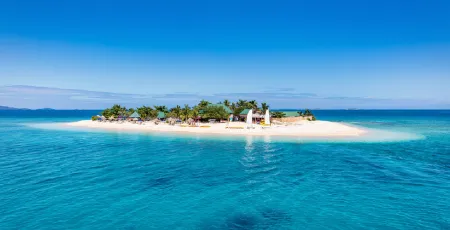
The Mamanuca Islands are Fiji's most accessible island group 20 volcanic isles west of Nadi known for resorts, Cloud 9, Cloudbreak surf and Cast Away.

Fiji's dry season runs May to October with sunshine and low humidity. The wet season is cheaper and greener, but carries real cyclone risk from November.