 Home
Home
Article index
- 1. What Are Fiji's Two Seasons?
- 2. When Is the Best Weather in Fiji?
- 3. What Is Fiji Like Month by Month?
- 4. How Bad Is Cyclone Season, Really?
- 5. When Is the Cheapest Time to Visit Fiji?
- 6. When Should You Go for Specific Activities?
- 7. Does It Matter Which Island You Choose?
- 8. So When Should You Actually Book?
- 9. What Should You Know Before You Book
Ask ten people when to visit Fiji and you'll get the same answer: May to October. And they're not wrong — but that's only useful if you know why, and whether it actually applies to your trip.
Here's the honest version. Fiji has two seasons, and the difference between them isn't really temperature. It's humidity. You can have the same 29°C on paper in July and February and have a completely different holiday, because one feels like a breeze off the reef and the other feels like a sauna.
So the real question isn't "when is Fiji nicest?" It's "what are you optimising for?" Weather, price, mantas, surf, or an empty beach — because those don't all point to the same month.
1. What Are Fiji's Two Seasons?
Fiji is tropical, which means the year splits neatly in two — and the split matters more than the thermometer suggests.
1.1 What are the basics?
Dry season: May to October. Sunny, lower humidity, cooler nights, minimal rain.
Wet season: November to April. Hotter, far more humid, heavy afternoon downpours.
Temperature range: rarely below 18°C or above 32°C, all year.
Water temperature: warm enough to swim in any month.
1.1.1 Why does humidity matter more than heat?
Because it changes how the day feels. Dry season humidity sits around 60–70%, with trade winds doing the cooling. In the wet season, the air is thick, the afternoons are sticky, and a downpour leaves everything steaming.
Same beach. Same temperature reading. Completely different experience.
2. When Is the Best Weather in Fiji?
2.1 The short answer
May to October, and within that, June to September for the most dependable dry-season pattern.
Lower rainfall and far fewer washed-out afternoons.
Cooler nights — genuinely pleasant for sleeping.
Best underwater visibility for snorkelling and diving.
Trade winds providing natural air conditioning.
2.2 The nuance worth knowing
The two-season model is a planning guide, not a forecast. Fiji Meteorological Service summaries regularly show one station getting below-normal rain in the wet season while another gets above-normal in the same month.
So: dry season stacks the odds heavily in your favour. It doesn't guarantee anything, and wet season doesn't doom you.
Customize Your Dream Vacation!
Get in touch with our local experts for an unforgettable journey.
Plan Your Trip3. What Is Fiji Like Month by Month?
|
Months |
Season |
What to expect |
Verdict |
|
Jan – Mar |
Peak wet |
Hottest, wettest, peak cyclone risk |
Cheapest; highest risk |
|
April |
Late wet |
Rain easing, humidity dropping |
Underrated value |
|
May |
Early dry |
Warm, drying out, quieter |
Sweet spot |
|
Jun – Aug |
Peak dry |
Sunniest, driest, coolest nights |
Best weather, priciest |
|
Sep – Oct |
Late dry |
Warm, dry, mantas still around |
Sweet spot |
|
Nov – Dec |
Early wet |
Humidity building, cyclone season opens |
Deals, except Christmas |
3.1 Which months do people underrate?
April — Late wet season with decreasing rainfall and cyclone risk, temperatures still warm, humidity starting to drop. A good compromise on both weather and price.
May and October — Dry-season conditions without July's crowds or rates.
November — Often still lovely, with wet-season pricing already kicking in.
4. How Bad Is Cyclone Season, Really?
Let's deal with this properly, because it's the thing that puts people off.
4.1 What are the actual facts?
Cyclone season runs 1 November to 30 April.
Peak risk is December through March, with January to March the sharpest window.
Cyclones typically give five to seven days' advance warning.
Many form without ever directly affecting tourist areas.
Fiji has a well-developed early warning system and resorts are experienced at managing it.
4.2 So can you still go?
Yes — plenty of people do, successfully. But go in with your eyes open.
4.2.1 How to travel wet season sensibly
Book flexible rates with free cancellation rather than the cheapest non-refundable option.
Take travel insurance that actually covers weather disruption. This is non-negotiable in this window.
Build slack into your itinerary — don't schedule tight island transfers before a flight home.
Accept the trade-off honestly: you're buying a 30–50% discount in exchange for real uncertainty.
5. When Is the Cheapest Time to Visit Fiji?
5.1 How much do prices actually move?
Peak dry season (July–August): highest rates of the year. Luxury oceanfront can exceed US$1,500 a night.
Shoulder (May–June, September–October): roughly 15–25% cheaper with barely worse weather.
Wet season: 30–50% below peak, the biggest savings available.
February and March: the lowest prices of all — and peak cyclone risk.
5.1.1 The one exception
Christmas and New Year. It sits squarely in wet season but prices spike anyway, because Australian and New Zealand school holidays land right on top of it. You get wet-season weather at dry-season prices — the worst of both.
5.2 Where's the value sweet spot?
Shoulder season, without much argument. May and October give you 85–90% of peak weather for meaningfully less money, with fewer people on the beach and better availability at the resorts that fill first
6. When Should You Go for Specific Activities?
This is where "best time" stops being one answer.
6.1 Diving and snorkelling
Best visibility: dry season, May to October.
Manta rays in the Yasawas: roughly May to October — conveniently the same window.
Water is warm year-round, so it's clarity you're timing, not temperature.
6.2 Surfing
Consistent swell runs April through November, with April and May often especially good.
Some Coral Coast breaks work better December to March, so wet season isn't a write-off for surfers.
6.3 Hiking and waterfalls
Dry season for walking — trails are less muddy and river crossings more predictable.
Wet season for scenery — fuller waterfalls and greener rainforest, but slippery paths and flash-flood risk.
6.3.1 What about culture and festivals?
Fiji's calendar reflects its iTaukei, Indo-Fijian and Pacific communities, with events spread across the year.
Diwali falls in the wet season and is genuinely worth experiencing.
Village life, kava ceremonies and meke nights run year-round regardless of season.
7. Does It Matter Which Island You Choose?
More than most people expect.
7.1 Why do the big islands have wet and dry sides?
Trade winds hit the southeast coasts, dropping rain there first.
Windward (southeast) coasts are wetter; leeward (northwest) areas are drier and sunnier.
Suva, on the east coast, receives almost twice the rainfall of Nadi in the west.
7.2 What does that mean for your booking?
Nadi, Denarau, the Mamanucas and Yasawas sit on the drier western side — which is exactly why the resorts are there.
Suva and the eastern side are lusher and wetter year-round.
If you're travelling in the wet season, staying west matters more than usual.
8. So When Should You Actually Book?
Here's the decision, stripped down.
8.1 Match the month to your priority
Best possible weather: June to September. Pay for it.
Best value with good weather: May or October. This is what I'd book.
Cheapest trip, accepting risk: February or March, with flexible rates and insurance.
Diving, snorkelling, mantas: May to October, no debate.
Surfing: April and May.
Avoid: Christmas and New Year, unless you have no choice.
8.1.1 How far ahead should you book?
Peak season (July–August): island resorts, cruises and transfers sell out well before mainland hotels.
Shoulder: three to six months is generally comfortable.
Wet season: you can book later, but prioritise flexibility over the lowest rate.
9. What Should You Know Before You Book?
9.1 A few practical points
Check the cancellation policy before the price — especially November to April.
Sun is intense year-round. UV doesn't drop in the cooler months; reef-safe sunscreen is essential.
Sunday is a day of rest across Fiji, with reduced activities and transfers.
Ferry transfers depend on sea conditions, which are calmer in the dry season.
9.1.1 What is the one-line summary?
If you want the easy answer: book May, June, September or October. You'll get dry-season weather without paying peak-season prices, and every major activity is in season.
Book your Fiji holiday package now and travel in the window that actually suits your trip — best weather, best value, or best wildlife.
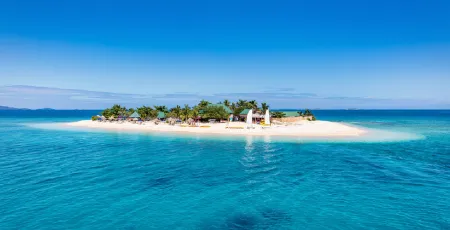
The Mamanuca Islands are Fiji's most accessible island group 20 volcanic isles west of Nadi known for resorts, Cloud 9, Cloudbreak surf and Cast Away.

Fiji's dry season runs May to October with sunshine and low humidity. The wet season is cheaper and greener, but carries real cyclone risk from November.