
What are the Silk Road cities of Uzbekistan, and what can you see in each?
Article Indexes:
#Why Is Uzbekistan the Heart of the Silk Road?
#What Can You See in Samarkand, the Crown Jewel of the Silk Road?
#What Can You See in Bukhara, the Living Museum?
#What Can You See in Khiva, the Open-Air Fairy Tale?
#What Can You See in Tashkent, the Gateway City
#Why Should You Visit Shahrisabz, Tamerlane's Hometown?
#Which Silk Road City Is Right for You?
#How Do You Travel Between the Silk Road Cities?
#Why Is Uzbekistan the Heart of the Silk Road?
Close your eyes and picture this: a camel caravan loaded with Chinese silk, Persian spices, and Indian gems, trudging across endless desert toward a city of turquoise domes shimmering on the horizon. That city? It's in Uzbekistan and the best part is, you can still stand in the exact squares where those merchants haggled over a thousand years ago.
Uzbekistan sits at the heart of the ancient Silk Road, the legendary trade network that connected China to Europe for centuries. Although the caravans are long gone, the cities they built Samarkand, Bukhara, Khiva, Tashkent, and Shahrisabz remain breathtaking destinations, filled with UNESCO World Heritage sites, dazzling blue-tiled madrasahs, and lively bazaars. For roughly 1,500 years, merchants crossing Central Asia traded silk, paper, glass, spices, and ideas between East and West, making Uzbekistan’s oasis cities fabulously wealthy. Rulers like Amir Timur invested these riches in magnificent mosques, madrasahs, and mausoleums that continue to amaze visitors today.
So, which Silk Road cities should be on your Uzbekistan itinerary, and what exactly can you see in each one? Let's take the journey together, city by city.
#What Can You See in Samarkand, the Crown Jewel of the Silk Road?
If you only have time for one Silk Road city, make it Samarkand. Over 2,700 years old and once the glittering capital of Tamerlane's (Amir Timur's) empire, Samarkand is where Silk Road grandeur reaches its peak.
What to see in Samarkand:
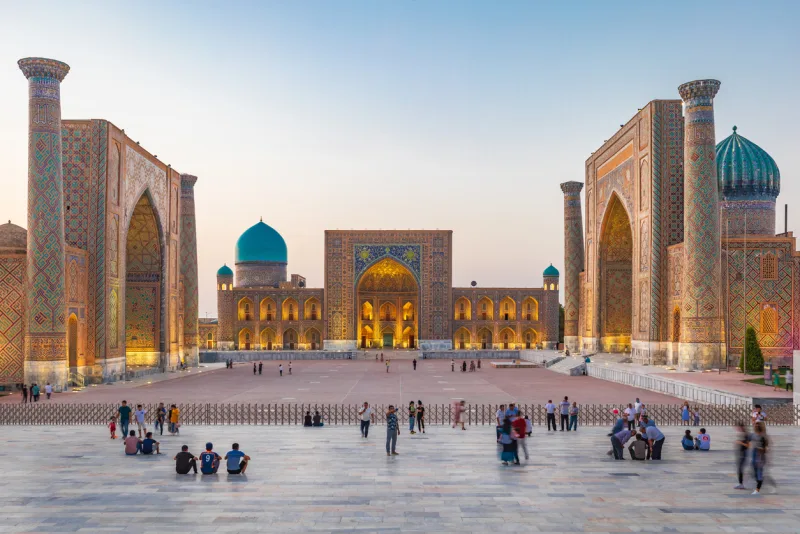
- Registan Square: The showstopper. Three towering madrasahs (Ulugh Beg, Sher-Dor, and Tilya-Kori) face each other across a vast plaza, covered in intricate blue and gold tilework. Come in the morning for photos and return at night for the light show.
- Shah-i-Zinda Necropolis: A narrow avenue of mausoleums so richly tiled it feels like walking through a jewelry box. Many travelers call it the most beautiful spot in all of Uzbekistan.
- Gur-e-Amir Mausoleum: The resting place of Tamerlane himself, crowned by a ribbed turquoise dome and a dazzling gold-leaf interior.
- Bibi-Khanym Mosque: Once one of the largest mosques in the Islamic world, built by Tamerlane for his favorite wife.
- Siab Bazaar: Right next to Bibi-Khanym, this is the place to sample Samarkand's famous non bread, dried fruits, and halva.
- Ulugh Beg Observatory: The remains of a 15th-century observatory built by Tamerlane's astronomer grandson, far ahead of its time.
Beyond the big monuments, give yourself time for Samarkand's smaller pleasures. Watch master craftsmen make silk paper by hand at the Meros paper mill in Konigil village, linger over green tea in a leafy chaikhana, or simply return to the Registan after dark, when the floodlit tilework glows against the night sky and the crowds thin out. Food lovers should also try Samarkand plov — every region of Uzbekistan claims its version is the best, and this is a delicious place to start the debate.
Customize Your Dream Vacation!
Get in touch with our local experts for an unforgettable journey.
Plan Your Trip#What Can You See in Bukhara, the Living Museum?
Where Samarkand dazzles, Bukhara charms. This 2,000-year-old city is often called a "living museum" because its old town home to over 140 protected monuments is still a working neighborhood where people live, trade, and sip tea exactly as they have for centuries. Everything is walkable, which makes Bukhara wonderfully easy to explore on foot.
What to see in Bukhara:
- Poi Kalyan Complex: The heart of the city, featuring the 47-meter Kalyan Minaret. Legend says Genghis Khan was so impressed by it that he spared it from destruction.
- Ark Fortress: A massive royal citadel that housed Bukhara's rulers for over a millennium. Climb the ramparts for sweeping views of the old town.
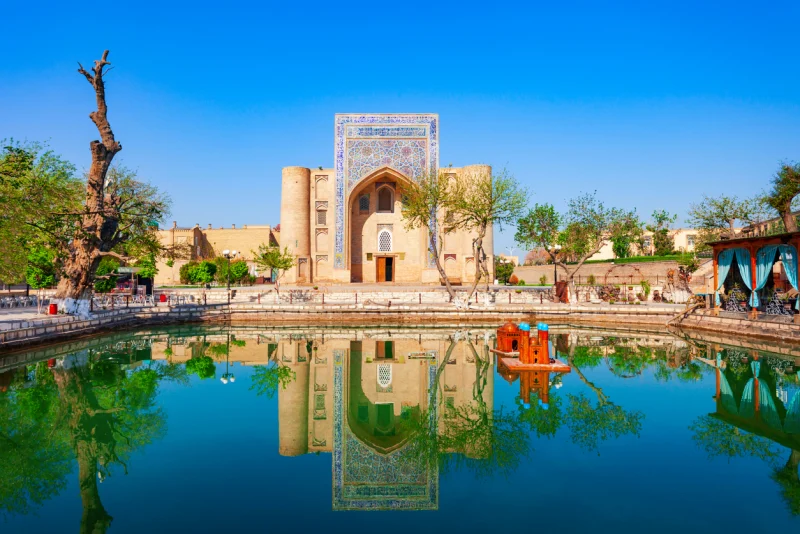
- Lyab-i Hauz: A tranquil plaza built around a 17th-century pond, shaded by ancient mulberry trees. Perfect for an evening meal at an open-air teahouse.
- The Trading Domes (Toki bazaars): Domed crossroads markets where merchants once sold silk, spices, and carpets. Today they're full of artisans selling embroidery, miniature paintings, and handmade knives.
- Chor Minor: A quirky, much-photographed gatehouse with four turquoise-topped towers.
- Sitorai Mokhi-Khosa: The last emir's summer palace, a fascinating blend of Russian and Central Asian styles just outside town.
Bukhara is also the best city in Uzbekistan for slow, atmospheric evenings. As the day-trippers leave, the old town turns golden, storks' nests crown the rooftops, and the plov houses and rooftop cafés fill with locals. If you're a shopper, this is your city too: suzani embroidery, Bukhara carpets, miniature paintings, and hand-forged stork-shaped scissors make wonderful souvenirs and bargaining over tea is half the fun.
#What Can You See in Khiva, the Open-Air Fairy Tale?
Stepping through the gates of Khiva's walled inner city feels like walking onto a film set except everything is real. Tucked in the far west near the Turkmen border, Khiva was the final stop for caravans before they braved the Karakum Desert, and its old town is so perfectly preserved that the entire thing is a UNESCO World Heritage site.
What to see in Khiva:
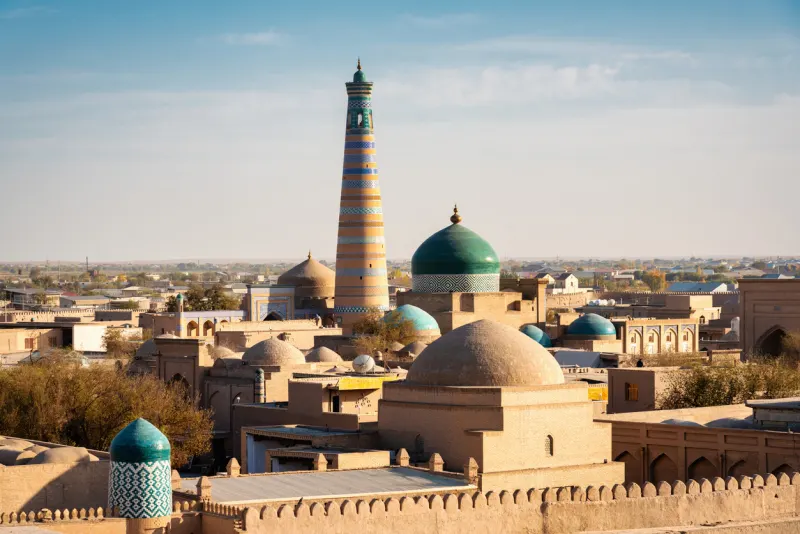
- Itchan Kala: The walled old city itself, encircled by 10-meter mud-brick walls and packed with more than 50 monuments. You can explore most of it with a single entrance ticket.
- Kalta Minor Minaret: Khiva's turquoise-banded icon. It was meant to be the tallest minaret in Central Asia, but construction stopped in 1855, leaving a gloriously stubby, unforgettable tower.
- Kunya Ark: The khans' fortress-within-a-fortress, with a stunning tiled throne room and a watchtower offering the best sunset view in Uzbekistan.
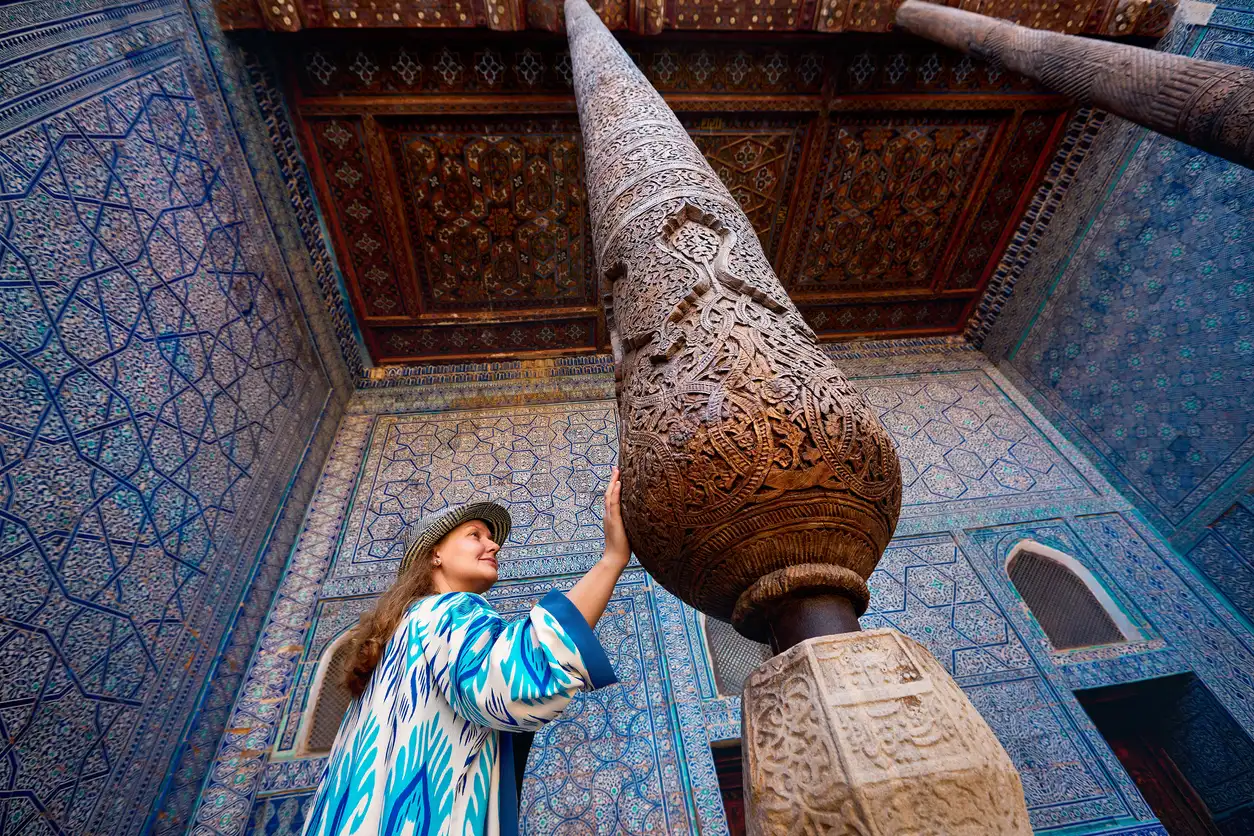
- Juma Mosque: A hauntingly beautiful prayer hall held up by 200+ carved wooden columns, some over 1,000 years old.
- Islam Khodja Minaret: Climb its steep internal staircase for a panoramic view over the rooftops of Itchan Kala.
- Tash Hauli Palace: The lavishly decorated palace of the Khiva khans, famous for its harem courtyard.
Khiva is compact one full day covers the highlights, but staying overnight lets you experience the magical, crowd-free old town at dawn and dusk. If you have extra time in the region, pair Khiva with the ancient desert fortresses of Karakalpakstan crumbling mud citadels like Ayaz-Kala and Toprak-Kala rising dramatically out of the Kyzylkum sands, less than two hours away.
#What Can You See in Tashkent, the Gateway City
Most journeys begin and end in Tashkent, Uzbekistan's modern capital and it's worth more than a quick stopover. Rebuilt after a major 1966 earthquake, the city blends Soviet-era boulevards, gleaming new towers, and pockets of genuine Silk Road history.
What to see in Tashkent:
- Khast Imam Complex: Home to the 7th-century Uthman Quran, believed to be one of the oldest Quran manuscripts in the world.
- Chorsu Bazaar: A giant turquoise-domed market overflowing with spices, dried fruit, fresh bread, and local life.
- Tashkent Metro: Each station is a work of art, from chandelier-lit halls to cosmonaut-themed mosaics. It's one of the cheapest sightseeing tours you'll ever take.
- Amir Timur Square & museums: The symbolic heart of modern Uzbekistan, surrounded by museums dedicated to Tamerlane and Uzbek history.
#Why Should You Visit Shahrisabz, Tamerlane's Hometown?
An easy day trip from Samarkand over a scenic mountain pass, Shahrisabz is where Amir Timur was born and where he built monuments meant to outshine even Samarkand.
What to see in Shahrisabz:
- Ak-Saray Palace: The ruined gateway of Tamerlane's "White Palace" still soars 38 meters high, hinting at its once-staggering scale.
- Dorut Tilovat & Dorus Saodat complexes: Elegant mausoleums and mosques tied to Timur's family, including the crypt he built for himself (though he was buried in Samarkand instead).
#Which Silk Road City Is Right for You?
|
City |
Known For |
Top Sight |
Time Needed |
Best For |
|---|---|---|---|---|
|
Samarkand |
Tamerlane's imperial capital |
Registan Square |
2 days |
First-time visitors, architecture lovers |
|
Bukhara |
Best-preserved living old town |
Poi Kalyan Complex |
1–2 days |
Walkers, history buffs, shoppers |
|
Khiva |
Fully walled fairy-tale city |
Itchan Kala |
1 day (overnight ideal) |
Photographers, atmosphere seekers |
|
Tashkent |
Modern capital & gateway |
Khast Imam Complex |
1 day |
Foodies, museum & metro fans |
|
Shahrisabz |
Tamerlane's birthplace |
Ak-Saray Palace ruins |
Half-day trip |
Day-trippers from Samarkand |
#How Do You Travel Between the Silk Road Cities?
Getting around Uzbekistan is far easier than most travelers expect. The comfortable, high-speed Afrosiyob train is the backbone of any Silk Road itinerary, linking Tashkent, Samarkand, and Bukhara in just a few hours, while domestic flights and private drivers fill in the gaps including the memorable desert run out to Khiva.
|
Route |
Distance |
Best Option |
Approx. Travel Time |
|---|---|---|---|
|
Tashkent → Samarkand |
~300 km |
Afrosiyob high-speed train |
2–2.5 hours |
|
Samarkand → Bukhara |
~270 km |
Afrosiyob high-speed train |
1.5–2 hours |
|
Bukhara → Khiva |
~440 km |
Train or private car via the desert |
5–7 hours |
|
Tashkent → Urgench (for Khiva) |
~1,000 km |
Domestic flight |
~1.5 hours |
|
Samarkand → Shahrisabz |
~90 km |
Private car over the mountain pass |
1.5–2 hours |
One thing to know: trains sell out quickly in spring and autumn, so book your seats as soon as your dates are fixed or let a tour operator secure them for you as part of a complete package.
Ready to Walk the Silk Road?
The turquoise domes of Samarkand, the lantern-lit lanes of Bukhara, and the walled wonder of Khiva are waiting and they're easier to reach than you think.
Book your Uzbekistan tour package with Memphis Tours today and let our travel experts craft your perfect Silk Road itinerary. From Samarkand tours and Bukhara city tours to complete Uzbekistan travel packages with expert local guides, hand-picked hotels, and seamless train transfers, we handle every detail so you can simply soak up the magic.
The four essential Silk Road cities are Samarkand, Bukhara, Khiva, and Tashkent, with Shahrisabz as a worthwhile day trip. Together they hold the country's most important UNESCO World Heritage sites.
A comfortable classic route takes 7–8 days: one day in Tashkent, two in Samarkand, two in Bukhara, one to two in Khiva, plus travel time. With 10 days you can add Shahrisabz and desert fortresses.
Spring (April–May) and autumn (September–October) offer the most pleasant weather for sightseeing. Summers are extremely hot, especially around Khiva and Bukhara.
The high-speed Afrosiyob train connects Tashkent, Samarkand, and Bukhara quickly and comfortably. Khiva can be reached by train, domestic flight to nearby Urgench, or a scenic desert drive.
Yes, Uzbekistan is widely considered one of the safest destinations in Central Asia, with welcoming locals and well-developed tourist infrastructure in the main cities.
Citizens of many countries can enter visa-free for short tourist stays, while others can apply for a simple e-visa online. Check the current requirements for your nationality before traveling.
It's the classic traveler's debate! Samarkand wins for monumental, jaw-dropping architecture; Bukhara wins for atmosphere and its intact, walkable old town. The honest answer: visit both.
Related Articles
Keep the inspiration going with these handpicked travel reads.
