
The Philippines is not a country you can wander into and figure out as you go. It is 7,641 islands scattered across 1,100 miles of ocean, connected by a web of domestic flights, ferries and small wooden boats that runs on weather as much as on schedules. First-timers who arrive expecting the easy overland rhythm of Thailand or Vietnam are often surprised pleasantly, once they adjust, but surprised.
Traveler Stories
20 Things to Know Before Your First Time in the Philippines
By : Passant Fadel
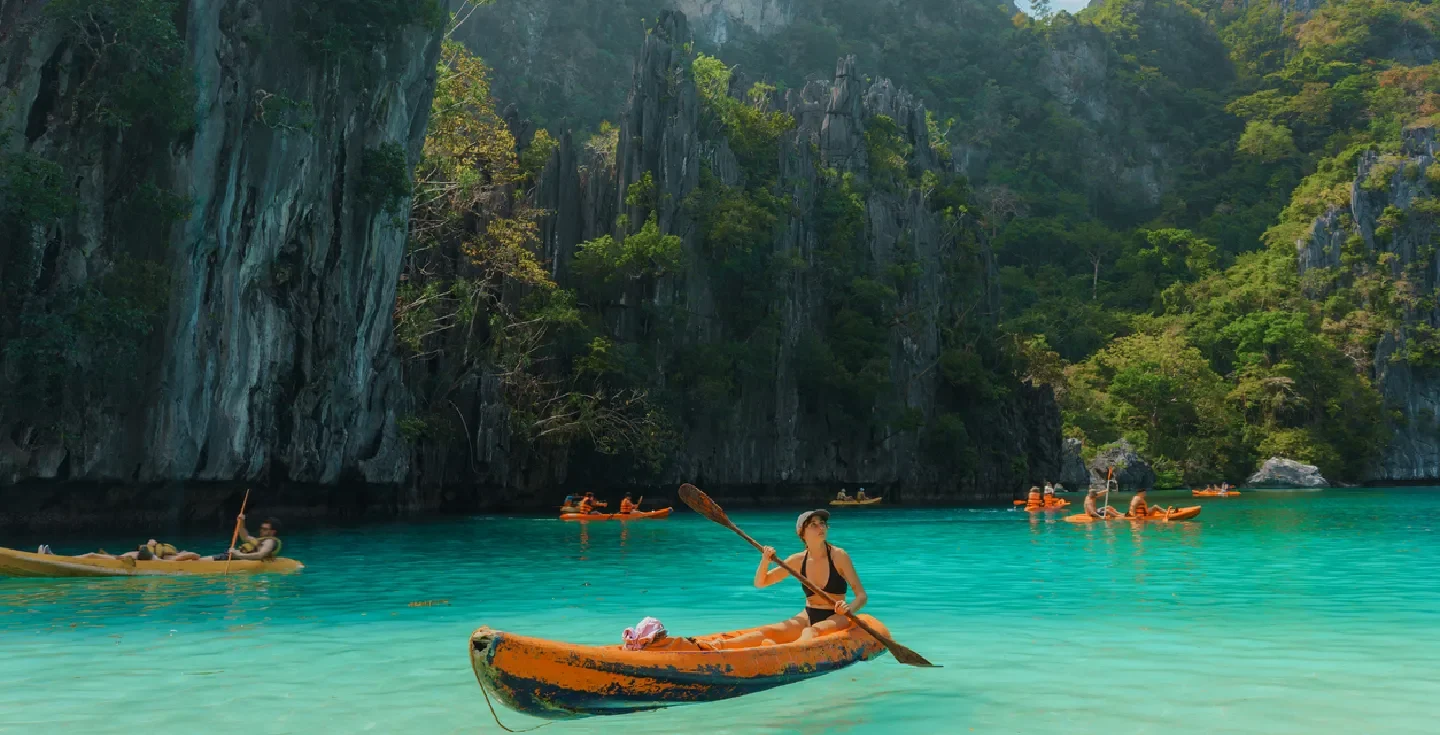
Woman kayaking on the turquoise waters of El Nido in Palawan, Philippines, with towering limestone cliffs and tropical scenery.
First Time in the Philippines: What Makes It Different
1. You cannot "see the Philippines" you choose a piece of it
Only about 2,000 of the country's islands are inhabited, and no itinerary covers more than a fraction. First-timers who try to fit Palawan, Boracay, Bohol, Siargao and the northern mountains into two weeks spend most of their trip in airports. The travelers who come home happiest picked two or three destinations and gave each one real time.
2. The three regions that matter
Luzon is the north Manila, the Spanish colonial core of Intramuros, and the Cordillera mountains with their ancient rice terraces. The Visayas sit in the middle: Cebu, Bohol, Boracay, Siquijor, Dumaguete, a dense cluster of islands connected by short flights and ferries. Palawan stretches down the country's western edge and holds El Nido, Coron and the Puerto Princesa Underground River. Most first trips combine two of the three.
3. Ten to fourteen days is the sweet spot
A week is enough for a single region Palawan on its own, or a Visayas loop. Ten to fourteen days lets you pair a cultural start in Manila or Cebu with two island destinations, without spending every third day in transit. Below eight days, the travel time starts eating the trip.
4. Distances are longer than the map suggests
Bohol and Palawan look close together on a map. In practice, getting between them means a flight back through Manila or Cebu, because there is no direct route. Inter-island geography here rarely follows intuition, and this single fact reshapes more itineraries than anything else.
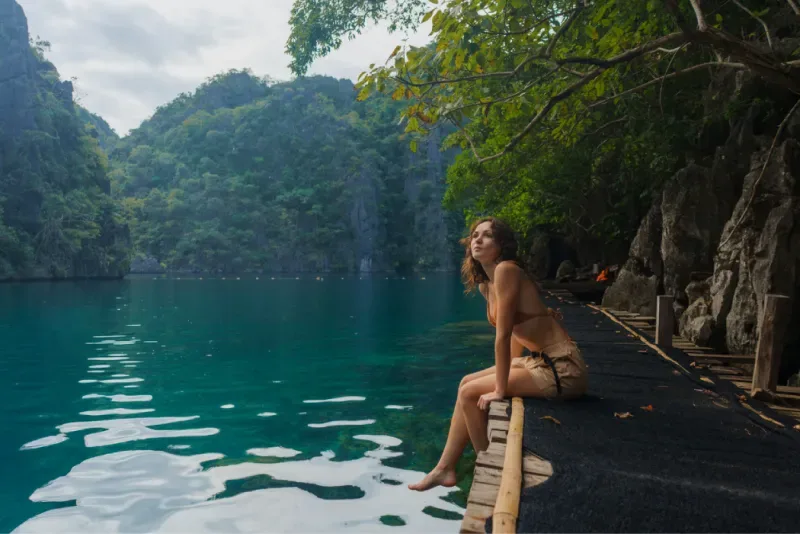
Woman enjoying the peaceful turquoise waters of Kayangan Lake in Coron with tropical forests and towering limestone cliffs.
Philippines Time: Time Zone, Seasons, and When to Go
5. Philippines Time is UTC+8, with no daylight saving
Philippine Standard Time (PHT) sits eight hours ahead of GMT and thirteen ahead of New York in winter. The clocks never change, so the offset from home shifts twice a year, not here. Most long-haul arrivals land in Manila late at night worth building a soft first morning into your plans rather than an early departure.
6. Dry season runs roughly November to May
This is when the Philippines is at its best: sunny days, calm seas, reliable boat schedules. December through February brings the amihan, the cool northeast monsoon, and the most comfortable temperatures of the year. March to May is hotter and increasingly humid, but still dry and excellent for the water.
7. Typhoon season is real, and it is regional
The wet season runs from around June to November, driven by the habagat southwest monsoon, with typhoon activity peaking between August and October. This does not mean constant rain tropical downpours are often short and intense. But storms can cancel ferries and small-boat island hopping for days at a time, and the eastern seaboard is hit harder than the west. Palawan, sheltered on the western side, often stays usable when the Visayas do not.
8. "Filipino Time" is a genuine cultural quirk
Locals say it themselves, usually with a smile: schedules here are flexible. A boat leaves when it's full, a guide arrives a little after the agreed hour, a restaurant runs on its own rhythm. Fighting it will ruin your mood. The exception is domestic flights, which are punctual and unforgiving.
9. Book two to three months ahead for high season
Between November and May, the best hotels in El Nido, Coron and Boracay fill early, and the small aircraft serving island airports have limited seats. Booking well ahead is not just about availability peak-season pricing climbs sharply as the dates approach.
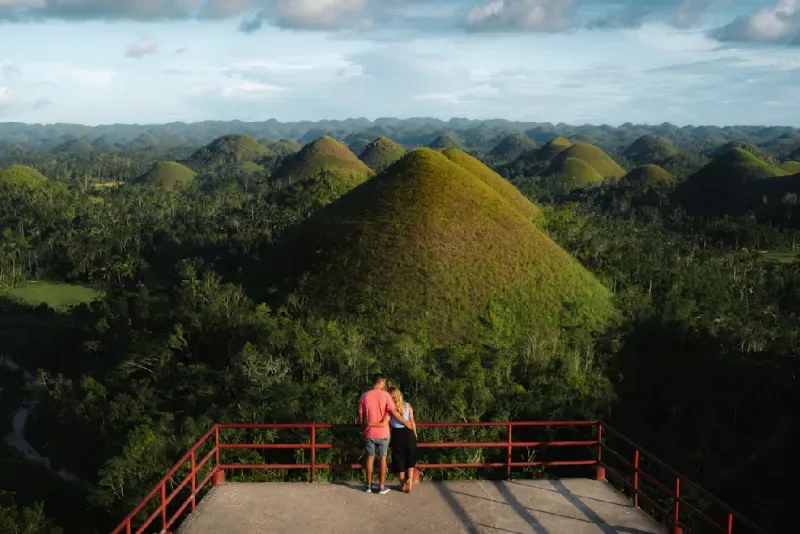
Panoramic view of the Chocolate Hills in Bohol, Philippines, with visitors overlooking the unique cone-shaped hills.
Customize Your Dream Vacation!
Get in touch with our local experts for an unforgettable journey.
Plan Your TripChoosing Your Islands: Palawan, Boracay, Bohol, Cebu, Siquijor
10. Palawan is the one that turns skeptics into believers
El Nido is the headline: hidden lagoons enclosed by limestone walls, reachable only by kayak through gaps in the rock, with island-hopping bancas running four established tour routes labeled A through D. Coron, further north, is a different proposition Japanese WWII shipwrecks lying in clear water, thermal springs, and the almost surreal Kayangan Lake.
Puerto Princesa is the gateway to the Underground River, a navigable cave system and UNESCO World Heritage Site explored by paddleboat.
11. Bohol delivers something no other island does
The Chocolate Hills are over a thousand near-identical grass mounds that turn brown in the dry season a landscape with no real equivalent anywhere. Nearby, in sanctuaries around Corella, live Philippine tarsiers: nocturnal primates small enough to sit in a palm, with enormous eyes and a nervous disposition. They are also easy to reach Panglao's international airport is on the same island, and Panglao's own beaches are excellent.
12. Boracay came back better than it was
The island closed for six months in 2018 for environmental rehabilitation and reopened under strict rules: no permanent structures on the sand, no beach parties, no single-use plastics, a rebuilt drainage system. White Beach today is cleaner and calmer than the version that made its reputation, and the sand genuinely lives up to the photographs. Access is via Caticlan airport plus a short boat, or Kalibo with a longer land transfer.
13. The Visayas reward travelers who look past the famous names
Cebu combines heritage churches and Spanish-era history with world-class diving. Siquijor, long associated with Filipino folk healing, has waterfalls, caves and almost no crowds. Apo Island, off Dumaguete, is one of the country's oldest community-managed marine sanctuaries, with resident sea turtles and reefs in genuinely good condition. These islands sit close enough together for a satisfying multi-stop loop.
14. The rice terraces are a different country entirely
In the Ifugao Cordillera of northern Luzon, Batad and Banaue hold stone-and-mud rice terraces carved into near-vertical mountainsides, often cited as around 2,000 years old and still actively farmed. They are a UNESCO World Heritage Site, they require a long journey from Manila, and they look nothing like the rest of the country. Travelers who make the effort rarely regret it.
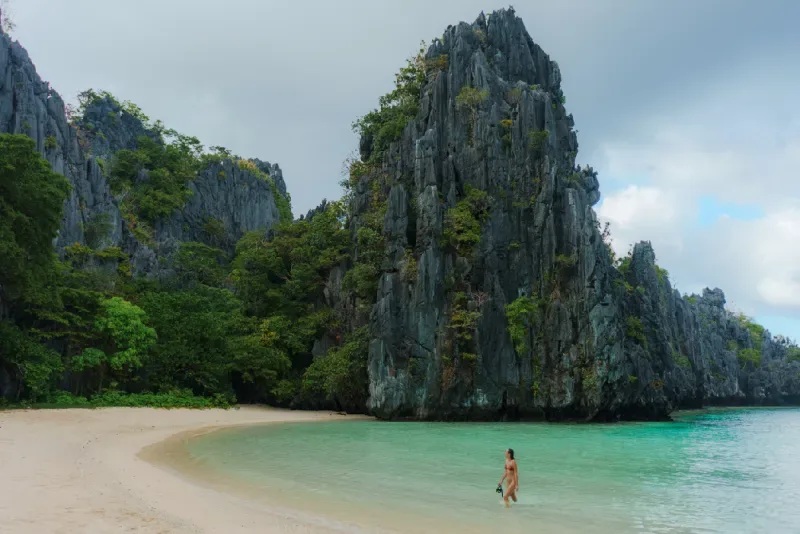
Scenic view of Hidden Beach in El Nido, Palawan, featuring white sand, turquoise water, and dramatic limestone rock formations.
Getting Between Islands: The Part Most First-Timers Underestimate
15. Domestic flights are the backbone and they route through hubs
Philippine Airlines, Cebu Pacific and AirAsia connect the major islands, with AirSWIFT serving El Nido's small airstrip directly. Most routes pass through Manila or Cebu, which means a Bohol-to-Palawan move is two flights and most of a day. Manila's NAIA has multiple terminals that are not connected airside a terminal change means exiting, taking ground transport, and re-checking in. Build in far more connection time than you think you need.
16. Ferries and bancas run on the sea's terms
Short hops between islands use ferries and outrigger bancas, and both are subject to cancellation when the sea gets rough a routine occurrence in the wet season and not unheard of in the dry. Small aircraft to island airstrips also carry tight baggage limits, well below what international carriers allow.
17. Manila traffic is its own logistical category
The capital's congestion is severe enough that locals plan their entire day around it. A trip that looks like twenty minutes on a map can take ninety in the late afternoon. Any itinerary treating Manila transfers as trivial will start unraveling on day one.
18. This is where a private guided tour changes the trip
None of the above is insurmountable but stacked across a two-week itinerary, inter-island logistics can consume days that should have been spent in the water. This is the reason so many first-timers choose a private, tailor-made tour: Memphis Tours handles the domestic flights, ferry bookings, boat charters and hotel transfers as a single connected operation, with English-speaking guides on the ground in each destination. The difference is not comfort. It is how many days of your trip actually get spent somewhere beautiful.
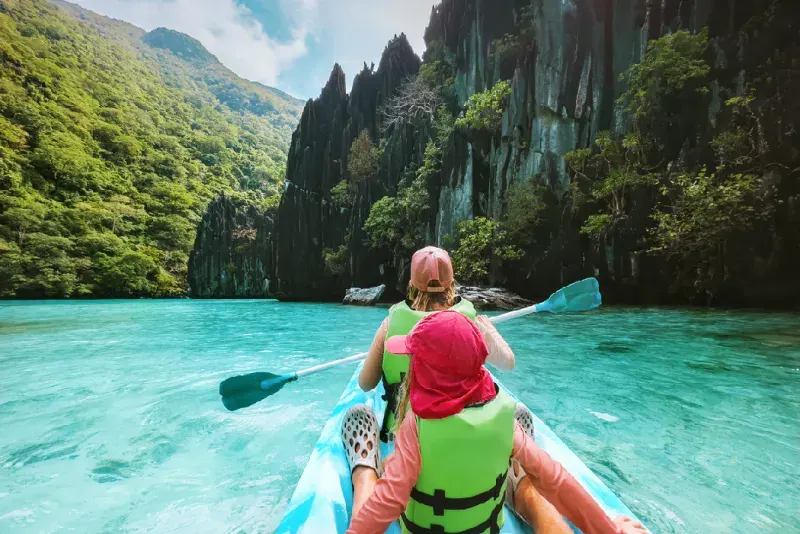
Two travelers kayaking through the emerald lagoon of El Nido, Palawan, with dramatic limestone formations and tropical scenery.
Money, Entry Rules, and Practical Prep
19. Entry is straightforward but there is paperwork before you fly
Citizens of the United States, United Kingdom, Canada, Australia and most EU countries can enter visa-free for up to 30 days, with an onward or return ticket. Separately, all arriving travelers must complete the eTravel registration online shortly before departure. It is free and takes minutes, but it is not optional, and it catches people out at check-in. Requirements change, so confirm the current rules for your nationality before travel.
A few more practicalities worth knowing:
- Cash still rules. The peso is the only currency you will use day to day. Hotels, malls and larger restaurants take cards; boatmen, tricycle drivers, island entrance fees and small local eateries do not. ATMs are common in cities and scarce on small islands withdraw before you leave the mainland, and expect per-transaction limits and fees.
- Environmental and terminal fees are charged at many island destinations and are almost always cash-only.
- Connectivity is decent in cities and patchy on remote islands. Globe and Smart both sell tourist SIMs at arrival airports, and eSIM options are widely available.
- Health basics: drink bottled or filtered water, use serious reef-safe sun protection, bring mosquito repellent, and travel with insurance that covers boat activities and diving if you plan to do either.
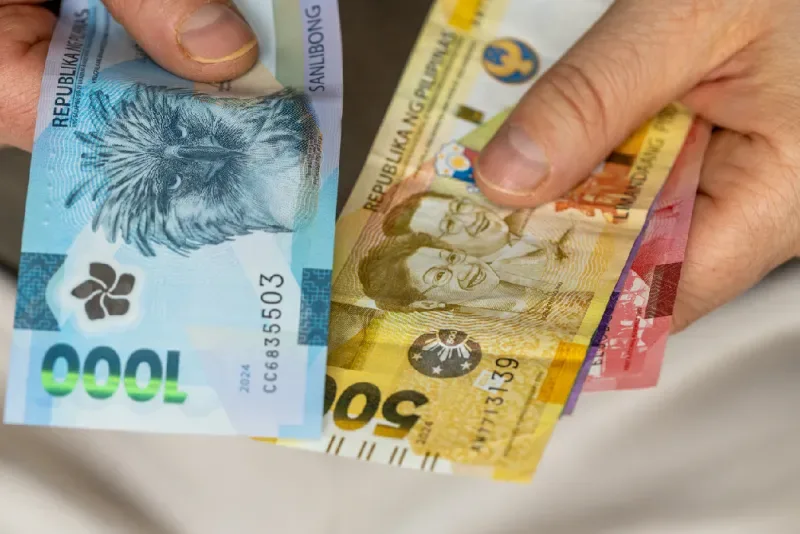
Philippine peso bills in different denominations, the official currency of the Philippines for tourists and local transactions.
Culture, Food, and Experiences You'll Remember
20. The warmth is the thing people actually remember
Ask anyone who has been, and they rarely lead with the beaches. English is an official language and is spoken almost everywhere, which makes the Philippines one of the easiest countries in Asia to travel as a foreigner but the ease is cultural as much as linguistic. Filipinos are quick to help, quick to laugh, and genuinely pleased that you came.
- Learn a few words anyway. Salamat po (thank you, respectfully), magandang umaga (good morning), kumusta (how are you). The particle po signals respect toward elders and strangers, and using it correctly earns real goodwill.
- Eat everything. Adobo, the vinegar-and-soy braise that functions as a national dish. Sinigang, a sour tamarind soup. Lechon, whole roast pig, at its best in Cebu. Kare-kare, oxtail in peanut sauce. And halo-halo, a chaotic shaved-ice dessert that makes more sense with every spoonful. Tipping around 10% is appreciated; check whether a service charge has already been added.
- Save room for the water. Moalboal's sardine run millions of fish moving as a single organism, visible from a snorkel a few meters offshore is one of the great free spectacles in diving. Whale shark encounters near Oslob are popular but involve feeding, which many marine biologists criticize; travelers who prefer a non-provisioned encounter should look at Donsol instead.
- If it's a honeymoon, El Nido, Coron and Boracay are as good as this region gets private lagoons, overwater sunsets, and resorts that know exactly what they're doing.
The Philippines rewards travelers who understand it before they arrive the seasons, the distances between islands, and the fact that getting from one paradise to the next is the hardest part of the trip. Get that right, and everything else is pure reward: limestone lagoons, hand-carved rice terraces, and some of the warmest hospitality in Southeast Asia. Check Philippines Travel Packages, choose yours and just Let Memphis Tours handle the ferries and island transfers on a private, tailor-made journey so your only decision is which island comes first.
Do I need a visa to visit the Philippines?
Most travellers don't. US, UK, EU, Canadian and Australian passport holders get 30 days visa-free. You just need a passport valid for six months, a return ticket, and the free online eTravel registration.
When is the best time to visit the Philippines?
December to April. It's dry, sunny, and the seas are calm for island hopping. June to October is rainy and typhoon season.
How many days do you need in the Philippines?
At least 10 to 14 days. Travel between islands takes time, so two or three destinations is plenty for a first trip.
Is the Philippines safe for tourists?
Yes. Tourist areas are safe and locals are very friendly. Watch your bags in crowded city spots, and keep an eye on the weather.
Do people speak English in the Philippines?
Yes. English is an official language, so signs, menus and directions are easy to follow.
Can I use my card, or do I need cash?
Bring cash. Cities and resorts take cards, but small islands, tricycles and markets are pesos only.
Do you tip in the Philippines?
It's optional but appreciated. Many restaurants add 10% already; otherwise ₱50–100 for guides and drivers is normal.
What should I pack?
Light clothes, sunscreen, insect repellent, water shoes, and a dry bag for boat trips and sudden rain.
What's the best way to get around?
Fly between big islands, then use boats, jeepneys and tricycles locally. Always allow extra time for delays.
Are there extra fees to budget for?
Yes. Places like El Nido, Coron and Boracay charge small environmental or terminal fees, and tour entrance fees are often separate.
Related Articles
Keep the inspiration going with these handpicked travel reads.