
 Home
Home
Article Indexes:
#Samarkand City Culture, Crafts & Food
What Is Samarkand?
Samarkand is the most famous city on the Silk Road and the architectural high point of Central Asia. Founded around the 7th century BCE, it is one of the oldest continuously inhabited cities on Earth, roughly contemporary with Rome and Babylon, and today serves as the capital of Uzbekistan's Samarqand Region, with a population of over half a million.
Its reputation rests on a single, overwhelming visual signature: turquoise domes and towering portals covered in glazed tilework, set against the dry plains of the Zarafshan Valley. UNESCO inscribed the city in 2001 as "Samarkand – Crossroads of Cultures," recognising 2,500 years of exchange between Persian, Indian, Turkic, Mongol, Chinese and Islamic civilisations.
For travellers, Samarkand is the anchor of any Uzbekistan itinerary,reachable from Tashkent in just over two hours by high-speed train, and easily combined with Bukhara and Khiva on a classic Silk Road route.
#History of Samarkand
1. Afrasiab and the Sogdians
The original city stood on the Afrasiab plateau north of today's centre. Known to the Greeks as Marakanda, it was the capital of Sogdiana, a civilisation of merchant-diplomats whose traders dominated Silk Road commerce and whose language became the lingua franca of the route. Murals from the 7th century CE, now in the Afrasiab Museum, show ambassadors from China, Korea and Persia arriving at the Sogdian court.
2. Alexander the Great
In 329 BCE, Alexander captured Marakanda and, according to his biographers, remarked that it was even more beautiful than he had imagined. He married the Bactrian noblewoman Roxana in this region, tying Samarkand to the story of the Hellenistic east.
3. Arab Conquest and the Paper Revolution
Arab forces took Samarkand in 712 CE, bringing Islam to the region. One consequence changed world history: Chinese papermaking, reportedly obtained after the Battle of Talas in 751, took root here. Samarkand became the first major paper centre outside China, and the technology travelled on to Baghdad and then Europe.
4. Genghis Khan and Total Destruction
In 1220, Genghis Khan's army besieged and destroyed the city. Irrigation channels were wrecked, the population massacred or deported, and Afrasiab abandoned permanently. Samarkand was later rebuilt on a new site to the south.
5. The Timurid Golden Age
Everything Samarkand is famous for dates from what followed. In 1370, Timur (Tamerlane) made the city capital of an empire stretching from Anatolia to northern India, deporting the finest architects, tilemakers and calligraphers from every conquered city to build a capital meant to humble the world.
The result was the Timurid style: monumental portals, double-shelled ribbed domes, and vast surfaces of blue, turquoise and gold tile. Bibi-Khanym Mosque and Timur's own tomb, the Gur-e-Amir, both date from this era.
6. Ulugh Beg: The Astronomer King
Timur's grandson Ulugh Beg (ruled 1409–1449) was a scientist before he was a ruler. His observatory, equipped with a 40-metre marble sextant, produced the Zij-i Sultani — a catalogue of 1,018 stars that remained the world's most accurate for two centuries. His Registan madrasah taught astronomy alongside theology. He was assassinated in 1449 and the observatory destroyed, rediscovered only in 1908.
7. Decline, Russia and Independence
As maritime routes displaced the overland Silk Road, Samarkand declined, and for much of the 18th century was nearly deserted. The Russian Empire annexed it in 1868, and a European quarter grew west of the old city. Under Soviet rule it briefly served as capital of the Uzbek SSR (1925–1930), and restoration of the monuments began. Since independence in 1991, extensive — and sometimes debated — restoration has continued, and tourism has become central to the economy.
#Top Attractions in Samarkand
Samarkand is one of the most fascinating cities along the ancient Silk Road, where magnificent Timurid architecture, Islamic heritage, bustling markets, and centuries of history come together. From grand monuments and ancient observatories to traditional bazaars and artisan workshops, the city offers travelers a remarkable journey through Uzbekistan's cultural and historical heritage.
1. Ulugh Beg Observatory & Afrasiab Museum
The Ulugh Beg Observatory provides an opportunity to discover the remarkable scientific achievements of medieval Samarkand. Built in the 15th century by Ulugh Beg, the Timurid ruler and accomplished astronomer, the observatory contained a massive astronomical instrument that allowed scholars to make highly accurate observations of celestial bodies. Ulugh Beg's scientific work helped establish Samarkand as an important center of astronomy and learning.
Nearby, the Afrasiab Museum explores the history of ancient Samarkand and the archaeological remains of the city's predecessor, Afrasiab. One of its most important treasures is a collection of remarkable Sogdian murals depicting foreign ambassadors and diplomatic scenes. These artworks provide valuable insight into the international connections, trade, and cultural exchanges that shaped Samarkand during the Silk Road era.
2. Siab Bazaar
Located close to Bibi-Khanym Mosque, Siab Bazaar is one of the best places in Samarkand to experience the city's everyday life. The lively market is filled with colorful stalls selling traditional non bread, dried fruits, nuts, spices, sweets, fresh produce, and other local specialties. The sounds, aromas, and activity of the market create an authentic atmosphere that contrasts beautifully with Samarkand's monumental historical sites.
A visit to Siab Bazaar is also an excellent opportunity to discover the flavors of Uzbek cuisine and observe local traditions. Look for the famous round Samarkand bread, sample dried apricots and raisins, browse colorful spice displays, and watch vendors serving local customers. Combining the bazaar with nearby Bibi-Khanym Mosque makes it an easy and rewarding stop during a walking tour of the historic city.
Customize Your Dream Vacation!
Get in touch with our local experts for an unforgettable journey.
Plan Your Trip3. Gur-e-Amir Mausoleum
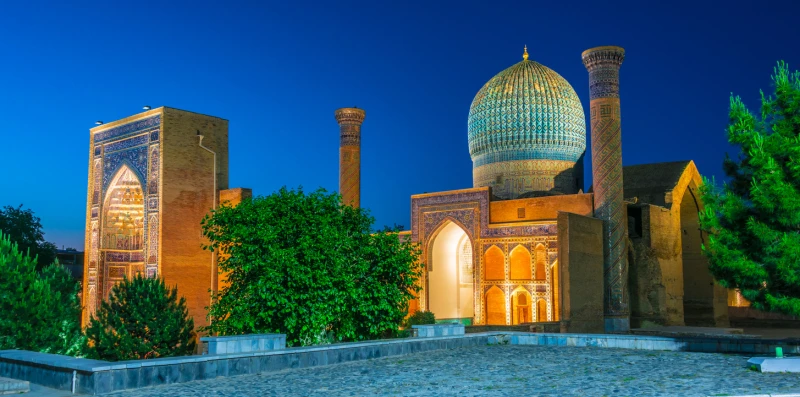
The Gur-e-Amir Mausoleum is one of Samarkand's most important Timurid monuments and the final resting place of Timur, also known as Tamerlane, alongside members of his family, including his sons and grandson Ulugh Beg. The mausoleum is instantly recognizable by its imposing fluted azure dome, monumental entrance, and richly decorated interior featuring intricate geometric patterns, inscriptions, marble surfaces, and ornate details.
Beyond its connection with Timur, Gur-e-Amir is important for its influence on later Islamic architecture. Its distinctive dome and decorative style influenced Mughal architecture in India, including monuments associated with the Taj Mahal. The site also became famous after Soviet archaeologist Mikhail Gerasimov opened Timur's tomb in 1941 and used his remains to reconstruct his facial appearance.
4. Bibi-Khanym Mosque
The Bibi-Khanym Mosque was commissioned by Timur as one of the most ambitious religious and architectural projects of his empire. Built between 1399 and 1404, the enormous complex was designed to demonstrate the power and wealth of the Timurid dynasty. Its monumental entrance, towering arches, enormous domes, and elaborate decorative elements give visitors an impressive sense of the scale of medieval Samarkand.
Historical accounts suggest that craftsmen and materials were brought from different parts of Timur's empire, including India, while elephants were reportedly used during the construction process. The mosque suffered major structural problems and gradually fell into ruin, but its partially restored monumental architecture remains captivating. Standing beneath its enormous structures offers a powerful glimpse into the ambition of Timurid Samarkand.
5. Registan Square
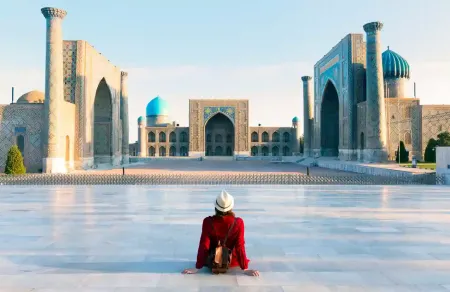
The iconic heart of Samarkand, Registan Square is one of Central Asia's most spectacular architectural landmarks. The vast plaza is framed by three magnificent madrasahs built over more than two centuries. The Ulugh Beg Madrasah, completed in 1420, is the oldest, while the Sher-Dor Madrasah, completed in 1636, is recognized for its striking tiger-and-sun decorations. The Tilya-Kori Madrasah, completed in 1660, is particularly famous for its richly decorated, gold-leafed mosque interior.
Visit Registan early in the morning to enjoy its courtyards and architectural details in a quieter atmosphere. Look closely at the geometric patterns, colorful mosaics, Arabic inscriptions, and enormous entrance portals that showcase the sophistication of Timurid and later Central Asian architecture. Return after sunset to see the square illuminated, when evening lighting and cultural performances can create an entirely different atmosphere.
6. Shah-i-Zinda
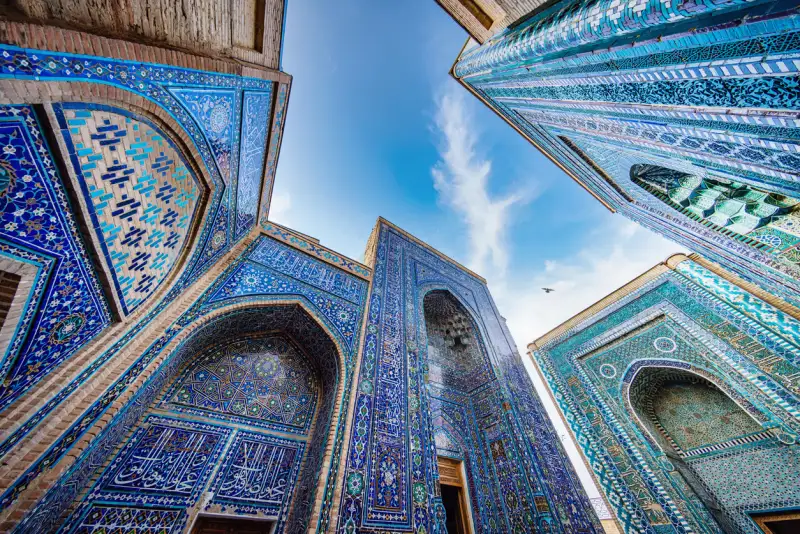
Shah-i-Zinda is one of Samarkand's most beautiful and atmospheric historical complexes, consisting of a narrow avenue lined with magnificent mausoleums that climb the hillside. The ensemble developed over several centuries around the shrine of Qusam ibn Abbas, traditionally regarded as a cousin of the Prophet Muhammad. Its long history and religious importance have made it one of the city's most significant pilgrimage sites.
Walking through Shah-i-Zinda feels like entering an open-air gallery of Central Asian tilework. The mausoleums feature intricate turquoise, cobalt-blue, white, and patterned ceramics, with each structure displaying distinctive architectural details. Take time to explore the passageways and examine the elaborate façades, domes, mosaics, and inscriptions while respecting the site's continuing religious significance.
More to See
- Hazrat Khizr Mosque: Hillside mosque with the best free viewpoint over the old city; also the burial site of Islam Karimov.
- Rukhabad and Aksaray Mausoleums: Quieter Timurid tombs near Gur-e-Amir.
- Konigil Village Paper Mill: Watch silk paper made by hand using the medieval Samarkand method.
- Silk Road Samarkand: A large modern tourism complex with the Eternal City cultural park, opened in 2022.
#Samarkand City Culture, Crafts & Food
Samarkand City is a vibrant crossroads of cultures shaped by centuries of Silk Road trade, where Uzbek and Tajik traditions continue to influence everyday life. Tajik is widely spoken alongside Uzbek, while Russian is also commonly understood. The city's artistic heritage is equally impressive, with local artisans preserving traditional crafts such as suzani embroidery, silk carpets, ceramics, wood carving, and handmade Samarkand silk paper.
Food is another essential part of the Samarkand experience. The city is particularly famous for Samarkand plov, prepared by layering rice, carrots, and meat rather than mixing the ingredients together. Visitors should also try shashlik, tandoor-baked samsa, lagman noodles, shurpa soup, and the city's famous round non bread. Green tea is traditionally served throughout the day and is an important part of local hospitality.
What to Experience in Samarkand City
- Samarkand Plov: Try the city's distinctive version of Uzbekistan's famous rice dish.
- Non Bread: Taste traditional Samarkand bread, often considered among Uzbekistan's finest.
- Suzani Embroidery: Discover colorful handmade textiles featuring traditional patterns.
- Samarkand Silk Paper: See how artisans preserve the centuries-old paper-making tradition.
- Local Ceramics: Explore handcrafted pottery featuring traditional Uzbek designs.
- Tandoor Samsa: Enjoy savory pastries baked in traditional clay ovens.
- Shashlik: Try skewered, grilled meat served with fresh vegetables and bread.
- Green Tea: Experience a central part of Uzbek hospitality and everyday dining.
#Best Time to Visit Samarkand
|
Season |
Months |
Conditions |
Best For |
|
Spring |
April – May |
20–28°C, blossom, green |
Peak season. Ideal sightseeing |
|
Summer |
June – August |
35–40°C, very dry |
Early mornings only; low rates |
|
Autumn |
September – October |
20–28°C, harvest |
Peak season. Best bazaars |
|
Winter |
November – March |
0–10°C, occasional snow |
Empty monuments, dramatic photos |
The verdict: April–May and September–October are the best times to visit Samarkand. Temperatures are mild, skies are clear, and the tilework photographs beautifully in low, angled light. Autumn has an edge for food lovers, pomegranates, figs, melons and fresh walnuts fill Siab Bazaar at harvest.
Summer is punishing, with little shade at the monuments. Winter is cold but rewarding: snow against turquoise domes is spectacular, crowds vanish and prices drop. Navruz (21 March) is the major festival.
#Practical Travel Information
1. Getting There
- Afrosiyob high-speed train — The best option from Tashkent, covering 344 km in roughly 2 hours 10 minutes in economy, business and VIP classes. Tickets open around 45 days before departure on the official railway site and sell out fast in peak season, so book the moment the window opens. Third-party platforms accept international cards more reliably.
- Samarkand International Airport (SKD) — Domestic flights plus international connections including Istanbul.
- Onward by rail — Samarkand to Bukhara takes roughly 1.5 hours by Afrosiyob.
- Note: Samarkand station sits 10–12 km from Registan Square, so budget for a short taxi at each end.
2. Fees, Money & Access
- Registan entry costs around 100,000 UZS (roughly US$8), with the site open approximately 08:00–19:00 and an evening light show most nights. Shah-i-Zinda, Gur-e-Amir and Bibi-Khanym each charge separate, comparable fees.
- Currency: Uzbekistani Som (UZS). Uzbekistan is cash-heavy — carry som, plus crisp US dollars for exchange. Cards work in larger hotels but not at most sites or bazaars.
- Visas: Many nationalities enjoy visa-free entry, and an e-visa system covers most others. Rules have liberalised significantly in recent years — verify your nationality's current status before booking.
- Getting around: Yandex Go is the standard taxi app and is very inexpensive. The old-city monuments are walkable from one another.
3. Etiquette & Practicalities
Dress modestly at religious sites — covered shoulders and knees, with a headscarf for women in active mosques and shrines. Never place bread upside down; it is considered disrespectful. Photography is permitted almost everywhere, occasionally for a small extra fee.
4. How Long to Stay
Two full days covers the essential monuments without rushing. Three days allows Konigil, the observatory, a slower bazaar morning and a second visit to the Registan at a different hour — worth doing, as the light transforms it.
Samarkand is more than a collection of magnificent monuments; it is a living chapter of the Silk Road where history, culture, architecture, crafts, and local traditions continue to shape everyday life. From the grandeur of Registan Square and Shah-i-Zinda to the flavors of Siab Bazaar and the craftsmanship of Konigil Village, every experience reveals another side of this remarkable city.
Whether you're fascinated by the legacy of Timur, inspired by Islamic architecture, or simply looking to experience the heart of Central Asia, Samarkand deserves a place on your travel itinerary. Explore Uzbekistan Tours and discover Samarkand alongside Bukhara, Khiva, and Tashkent for an unforgettable journey through Uzbekistan's history and culture.
Registan Square, its Timurid architecture and turquoise domes, and its role as the greatest city on the Silk Road. It was Timur's imperial capital in the 14th century.
Two full days for the main sights; three if you want a relaxed pace, day trips or repeat visits to the Registan.
April–May or September–October, when temperatures are mild and skies are clear. Summer exceeds 40°C and winter can drop below freezing.
The Afrosiyob high-speed train takes about 2 hours 10 minutes. Book roughly 45 days ahead, as tickets sell out quickly in peak season.
Yes. Uzbekistan has a strong safety record for visitors, and Samarkand is well-policed and accustomed to tourism. Standard precautions apply.
Many nationalities are visa-free, and an e-visa covers most others. Requirements have changed frequently, so confirm your status before travelling.
Uzbek is official, but Samarkand has a large Tajik-speaking population, and Russian is widely used as a second language.
Samarkand has the grander single monuments; Bukhara has the more intact, atmospheric old town. Most travellers visit both, they are 1.5 hours apart by train.
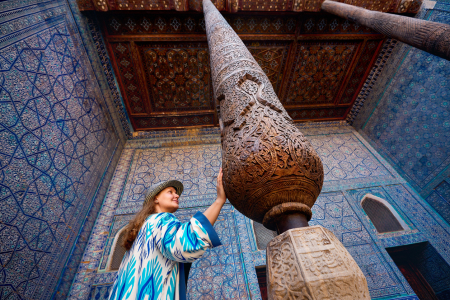
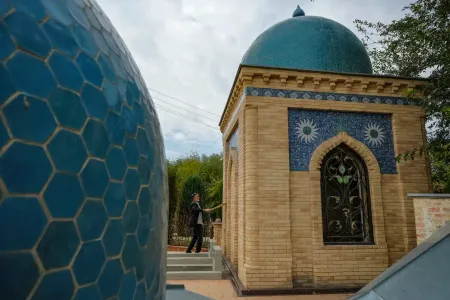
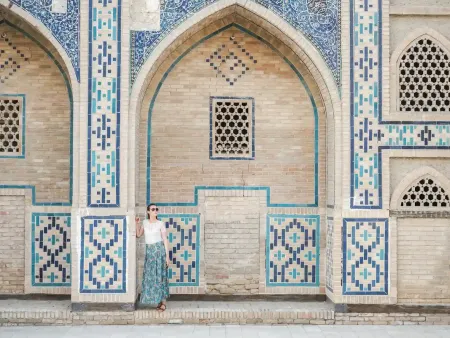
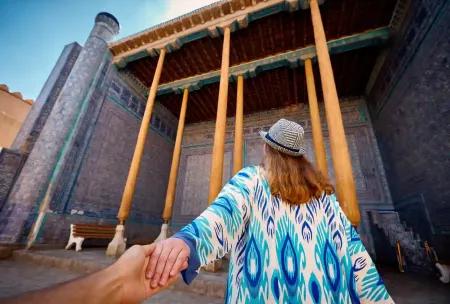
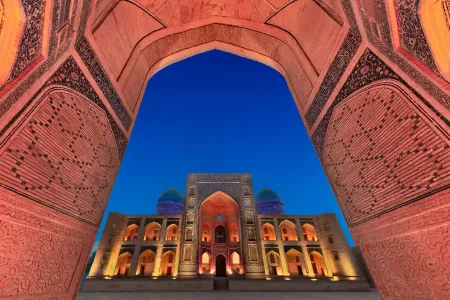
Bukhara is an ancient Silk Road city in Uzbekistan, famous for its mosques, madrassas, bazaars, and over 2,000 years of living history.
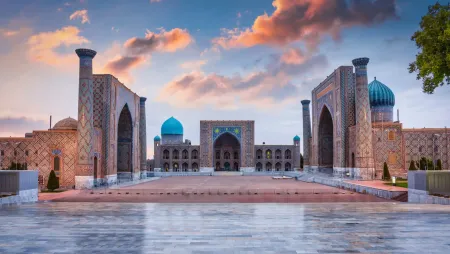
Samarkand is Uzbekistan's Silk Road crown jewel — a 2,750-year-old city of turquoise domes, Timurid architecture and the world-famous Registan Square.