
 Home
Home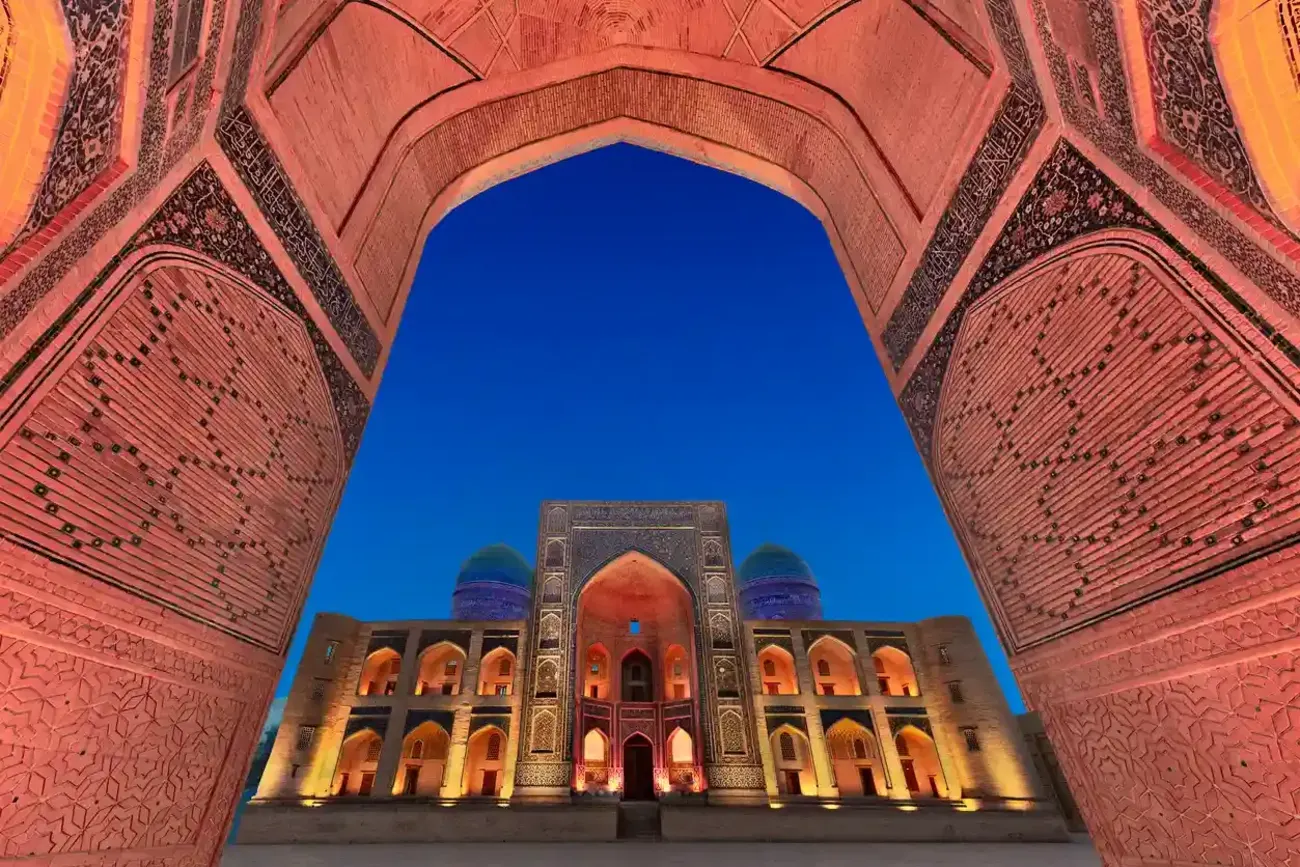
Article Indexes:
#A Quick Look Back: The History of Bukhara
#What to Eat in Bukhara: Food Guide in Bukhara
#Getting Around: Transportation in Bukhara
Bukhara City: The Living Soul of the Silk Road
If you've ever pictured the Silk Road in your mind — camel caravans, domed mosques glowing gold at sunset, narrow lanes smelling of fresh bread and spice — you were probably picturing Bukhara without even knowing it. Tucked between Khiva and Samarkand in modern-day Uzbekistan, Bukhara isn't just an old city; it's one of the best-preserved medieval towns anywhere in the world. Walking through its old town feels less like sightseeing and more like stepping backward through centuries, one archway at a time.
Let's take a conversational tour through everything that makes Bukhara so special — its history, quick facts, top attractions, food scene, transportation options, and the best time to plan your visit.
Bukhara City: The Living Soul of the Silk Road
If you've ever pictured the Silk Road in your mind — camel caravans, domed mosques glowing gold at sunset, narrow lanes smelling of fresh bread and spice — you were probably picturing Bukhara without even knowing it. Tucked between Khiva and Samarkand in modern-day Uzbekistan, Bukhara isn't just an old city; it's one of the best-preserved medieval towns anywhere in the world. Walking through its old town feels less like sightseeing and more like stepping backward through centuries, one archway at a time.
Let's take a conversational tour through everything that makes Bukhara so special — its history, quick facts, top attractions, food scene, transportation options, and the best time to plan your visit.
#A Quick Look Back: The History of Bukhara
Bukhara's story stretches back more than 2,000 years, making it one of the oldest continuously inhabited cities in Central Asia. It rose to prominence as a key stop along the Silk Road, the ancient network of trade routes connecting China, Persia, India, and Europe. Merchants, scholars, and travelers passed through Bukhara for centuries, trading silk, spices, and ideas alike.
By the 9th and 10th centuries, Bukhara had become the capital of the Samanid dynasty and blossomed into one of the great centers of Islamic scholarship, science, and art in the world — often compared to Baghdad in importance. Scholars like the physician Ibn Sina (Avicenna) called this region home, and the city earned a reputation as "Bukhara-i-Sharif," or "Noble Bukhara."
The city weathered invasions from Genghis Khan's Mongol armies in the 13th century, only to rebuild and flourish again under the Timurid and later the Shaybanid dynasties, when much of its most iconic architecture — the mosques, madrassas, and trading domes you see today — was constructed. Bukhara later became the seat of the Bukhara Khanate and then the Emirate of Bukhara, remaining an independent state until it was absorbed into the Russian Empire in the late 19th century, and eventually into the Soviet Union in the 20th century.
Today, the historic center of Bukhara is a UNESCO World Heritage Site, recognized for its remarkably intact urban fabric and centuries-old monuments.
#Quick Facts About Bukhara
- Country: Uzbekistan
- Region: Bukhara Region (capital city)
- Age: Over 2,000 years old
- UNESCO Status: Historic Centre of Bukhara, listed since 1993
- Population: Roughly 280,000–300,000 people
- Language: Uzbek and Tajik are widely spoken; Russian is common as a second language
- Currency: Uzbekistani som (UZS)
- Known For: Silk Road heritage, Islamic architecture, handicrafts, and one of the most walkable old towns in Central Asia
#Top Attractions in Bukhara
Bukhara's old town is compact enough to explore mostly on foot, which is part of its charm — you can wander from one architectural marvel to the next without ever needing a car.
1. Poi Kalon Complex
The Poi Kalon Complex is the undisputed heart of old Bukhara, and it's usually the first place travelers fall in love with the city. Dominating the skyline is the Kalon Minaret, a soaring 12th-century tower so architecturally impressive that, according to local legend, Genghis Khan himself looked up at it, let his hat fall to the ground, bent down to pick it up, and decided the tower deserved to survive his conquest. For centuries, the minaret also served a darker purpose as a place from which condemned prisoners were thrown, earning it the nickname the "Tower of Death."
Standing beside the minaret are the Kalon Mosque, one of the largest mosques in Central Asia with room for thousands of worshippers, and the Mir-i-Arab Madrasah, a stunning turquoise-domed religious school that remains an active center of Islamic education today. Together, the three structures form a harmonious architectural ensemble that's best appreciated slowly — ideally at sunset, when the tilework glows gold and the crowds thin out.
2. Ark of Bukhara
The Ark of Bukhara is a massive clay fortress that towers over the western edge of the old town, and for well over a thousand years it served as the political and administrative heart of the city. Generations of emirs ruled from within its walls, and the fortress witnessed everything from royal ceremonies to sieges, making it one of the most historically loaded sites in the entire region. Its imposing mudbrick ramparts alone are worth the visit, offering a dramatic contrast to the delicate tilework found elsewhere in the city.
Inside the Ark, several small museums now occupy the surviving structures, covering topics like Bukhara's royal history, traditional weaponry, and archaeological finds unearthed on-site. Much of the interior was damaged during the Russian conquest in 1920, so what remains is a mix of restored buildings and evocative ruins — a reminder that Bukhara's history includes hardship as well as splendor. Climbing to the top offers sweeping views over the old town's domes and minarets.
3. Lyab-i Hauz
Lyab-i Hauz is one of the most atmospheric public spaces in all of Uzbekistan, built around a rectangular pool that has served as a community gathering point since the early 1600s. Shaded by gnarled, centuries-old mulberry trees, the plaza is surrounded by historic madrassas and khanaka buildings, giving it a quiet, timeless elegance that feels worlds away from a typical city square. It's one of the few places in Bukhara where locals and tourists mingle naturally, often over a pot of tea.
By day, the square is a peaceful spot to rest between sightseeing stops, but it truly comes alive in the evening, when the surrounding cafés light up and the sound of live music drifts across the water. Vendors sell handicrafts nearby, and it's a great place to sample local snacks while watching the rhythm of daily Bukhara life unfold in front of you.
4. Chor Minor
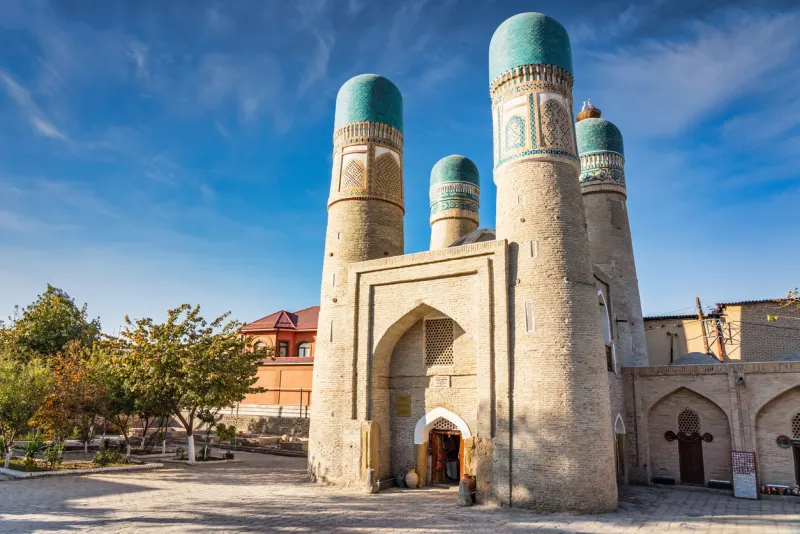
Chor Minor, meaning "Four Minarets," is a small but delightfully unusual building tucked away in a quiet residential lane just off the main tourist path. Built in the early 19th century as the gatehouse to a now-vanished madrassa, it's instantly recognizable for its four short towers, each topped with a distinct blue dome and each decorated with slightly different patterns — no two are quite alike.
Despite its modest size, Chor Minor has become one of the most photographed buildings in Bukhara, largely because it feels like a hidden discovery rather than a major monument. The surrounding neighborhood is worth a wander too, with traditional courtyard houses and a slower pace that offers a nice contrast to the busier attractions near the city center.
Customize Your Dream Vacation!
Get in touch with our local experts for an unforgettable journey.
Plan Your Trip5. Trading Domes (Toqi Bazaars)
Bukhara's historic trading domes, known locally as "toqi," were purpose-built covered marketplaces where Silk Road merchants once conducted specialized trade — one dome for jewelers, another for hat-makers, another for money-changers. Constructed mainly in the 16th century, these domed intersections allowed traders to do business in the shade, sheltered from Bukhara's fierce summer sun, while goods from across Asia changed hands beneath their arched ceilings.
Several of these domes still function as working bazaars today, filled with craftsmen selling embroidered textiles, hand-painted ceramics, miniature paintings, and metalwork. Wandering through them offers a rare chance to see a centuries-old commercial tradition still in active use, and it's one of the best places in the city to pick up an authentic, locally made souvenir directly from the person who made it.
6. Samanid Mausoleum
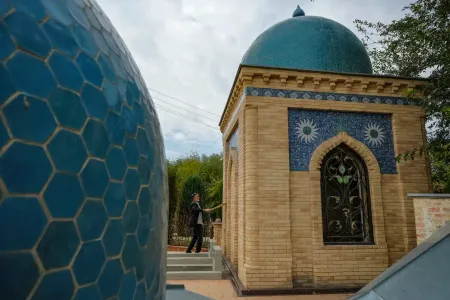
The Samanid Mausoleum is one of the oldest surviving monuments of Islamic architecture anywhere in Central Asia, built in the 9th or 10th century as the resting place of Ismail Samani, founder of the Samanid dynasty. What makes it so remarkable isn't its size — it's actually quite compact — but its intricate brickwork, which uses varying patterns and light effects to create a texture that seems to shift depending on the angle and time of day.
The mausoleum's design has influenced architects and historians for over a thousand years, and it's often cited as a masterpiece bridging pre-Islamic Central Asian building traditions with early Islamic art. It sits in a peaceful park a short walk from the old town center, making it a calm, contemplative stop away from the busier tourist crowds.
7. Bolo Hauz Mosque
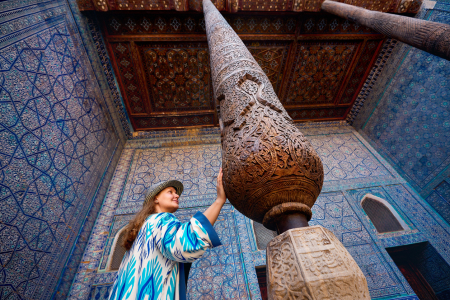
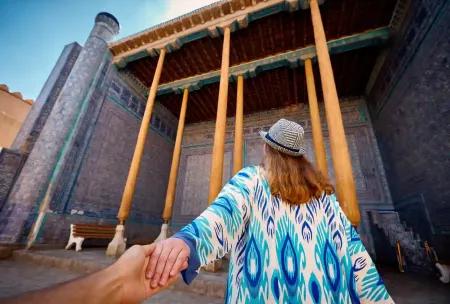
Bolo Hauz Mosque sits directly across from the Ark, and it's instantly recognizable for its striking iwan — a columned porch supported by tall, intricately carved wooden pillars that reflect beautifully in the small pool in front of the building. Built in the early 20th century, it served as the official mosque of Bukhara's emirs, allowing them to attend Friday prayers just steps from the fortress.
The mosque remains an active place of worship today, and its painted ceiling and carved woodwork make it one of the most photogenic religious buildings in the city. Because it sits right beside the Ark, most visitors pair the two together, making it an easy and rewarding stop on any walking tour of Bukhara's old town.
Bukhara Attractions at a Glance
| Attraction | Best Known For | Time Needed |
|---|---|---|
| Poi Kalon Complex | Iconic 12th-century minaret, mosque, and madrasah | 1–1.5 hours |
| Ark of Bukhara | Ancient fortress and former seat of power | 1 hour |
| Lyab-i Hauz | Historic plaza, pool, and evening atmosphere | 30–45 minutes |
| Chor Minor | Unique four-towered gatehouse | 15–20 minutes |
| Trading Domes | Historic covered bazaars and handicrafts | 1 hour |
| Samanid Mausoleum | Oldest Islamic monument in Central Asia | 20–30 minutes |
| Bolo Hauz Mosque | Carved wooden columns, active mosque | 20–30 minutes |
#What to Eat in Bukhara: Food Guide in Bukhara
No trip to Bukhara is complete without diving into Uzbek cuisine, and the city has its own delicious regional specialties layered on top of national favorites.
- Plov (Osh): Uzbekistan's national dish — rice cooked with meat, carrots, and onions — and Bukhara has its own distinct style, often a touch sweeter with the addition of dried fruits like raisins or barberries.
- Bukhara-style Lagman: A hearty noodle soup with meat and vegetables, influenced by the region's mix of cultures.
- Samsa: Flaky, oven-baked pastries filled with spiced meat, pumpkin, or onions — a perfect street-food snack.
- Shashlik: Grilled skewers of marinated meat, usually lamb or beef, cooked over an open flame.
- Non (Uzbek bread): Round, patterned flatbread baked in a clay oven, often stamped with a decorative seal unique to each bakery.
- Green tea: Served constantly and everywhere — tea culture runs deep in Bukhara, and sipping it in a shaded courtyard is part of the experience itself.
For an authentic experience, eat at a family-run guesthouse or a rooftop café overlooking Lyab-i Hauz, where many restaurants serve traditional dishes in a historic setting.
#Getting Around: Transportation in Bukhara
- Getting to Bukhara: The easiest way to reach Bukhara is by the Afrosiyob high-speed train, which connects it to Tashkent and Samarkand in just a few hours. Bukhara also has a small international airport with domestic and limited international flights.
- Getting around the city: The old town itself is best explored on foot — most major attractions sit within a 20-minute walk of each other. For longer distances, taxis and ride-hailing apps like Yandex Go are affordable and widely used. Public buses also operate but are less convenient for short-term visitors.
- Day trips: From Bukhara, it's easy to arrange short excursions to the Sitorai Mokhi-Khosa summer palace, nearby desert yurt camps near Nurata, or onward travel toward Khiva across the Kyzylkum Desert.
#Best Time to Visit Bukhara
The best time to visit Bukhara is generally April to May and September to October, when the weather is comfortable for exploring the city's historic streets, mosques, and courtyards. Spring brings pleasant temperatures of around 15–25°C, colorful landscapes, and the festive atmosphere of Navruz, celebrated on March 21. Autumn is equally inviting, with temperatures typically ranging from 21–30°C and local markets filled with seasonal fruits such as melons, grapes, and pomegranates.
Summer, from June to August, can be extremely hot, with temperatures often rising above 40°C. If you travel during this period, it's best to explore outdoor attractions in the early morning or later in the afternoon and take breaks during the hottest part of the day. Winter is colder and quieter, making it a good option for travelers looking for fewer crowds, although some outdoor activities may be less comfortable.
Travelers visiting in late May or early June may also have the chance to experience the Silk and Spices Festival, a colorful celebration showcasing Bukhara's traditional crafts, music, cuisine, and cultural heritage.
Bukhara Seasonal Guide
| Season | Months | Weather | Highlights |
|---|---|---|---|
| Spring | March–May | Mild, 15–25°C, blooming landscapes | Navruz festival (March 21), best all-round sightseeing weather |
| Summer | June–August | Very hot, often above 40°C | Fewer crowds indoors; early morning or evening sightseeing recommended |
| Autumn | September–November | Pleasant, 21–30°C, golden light | Silk and Spices Festival, fresh harvest markets, comfortable walking weather |
| Winter | December–February | Cold and quiet | Lowest prices and crowds, but many outdoor experiences are limited |
Ready to Explore Bukhara?
Bukhara isn't a city you rush through — it's one you wander, slowly, letting its centuries of history sink in one courtyard and one cup of tea at a time. Whether you're drawn by the architecture, the food, or the simple joy of walking through a living museum, Bukhara rewards travelers who take their time.
Start planning your Bukhara travel itinerary today — book your Silk Road tour, compare Bukhara hotel deals, and check the latest Bukhara travel guide to build the perfect trip through this unforgettable Uzbekistan Tours.
Bukhara is famous for being one of the oldest and best-preserved Silk Road cities, known for its historic mosques, madrassas, minarets, and its UNESCO-listed old town.
Most travelers spend 2–3 days in Bukhara, which is enough time to see the major sites and enjoy the old town's atmosphere without rushing.
Yes — Bukhara has one of the most intact medieval old towns in Central Asia, along with unique architecture, handicrafts, and food you won't easily find elsewhere.
Uzbek and Tajik are the most commonly spoken languages, with Russian widely understood as a second language, especially among older generations.
The Afrosiyob high-speed train is the most popular option, connecting Tashkent to Bukhara in a few hours, with additional stops possible in Samarkand.
April–May and September–October offer the most comfortable weather for sightseeing and exploring the city's outdoor attractions.
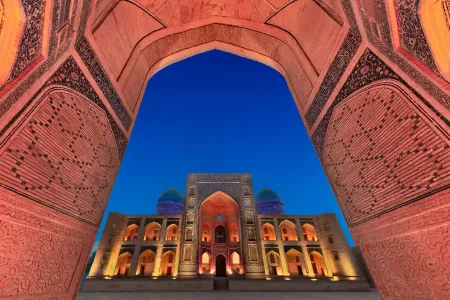
Bukhara is an ancient Silk Road city in Uzbekistan, famous for its mosques, madrassas, bazaars, and over 2,000 years of living history.
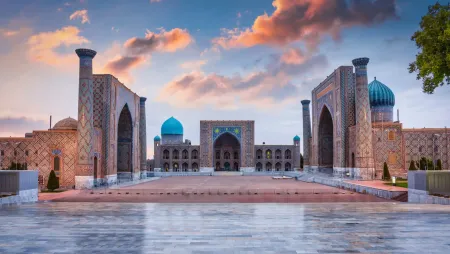
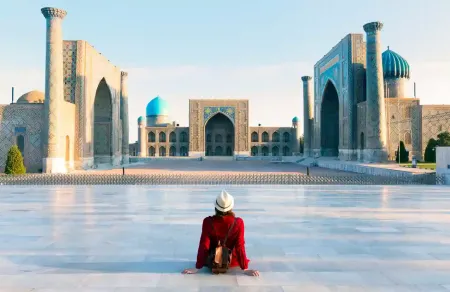
Samarkand is Uzbekistan's Silk Road crown jewel — a 2,750-year-old city of turquoise domes, Timurid architecture and the world-famous Registan Square.