Table of content
Tijuca National Park is not simply a forest with an entrance gate. The park divides into four distinct sectors, each governed by its own geography, ecology, and visitor purpose — and understanding that structure changes how you approach the place entirely.
Where Tijuca Forest sits within Tijuca National Park
Floresta da Tijuca, designated as Sector A, occupies the heart of this arrangement and stands as the largest and most frequented of the four. This sector concentrates the park's most celebrated landmarks — Cascatinha Taunay, the Mayrink Chapel, and the bulk of its historic hiking corridors. The other three sectors radiate outward with their own distinct identities: Serra da Carioca rises toward Corcovado and the Christ the Redeemer statue, Pedra Bonita/Pedra da Gávea pulls climbers and paragliders down toward the coastline, and Pretos Forros/Covanca holds intact Atlantic Forest with virtually no visitor infrastructure to speak of.
The park's total footprint reaches close to 4,000 hectares — modest by Brazilian standards, yet no national park in the country receives more visitors, with figures approaching 5 million in 2025. Official counts recorded 3,305,010 arrivals in 2016 alone, a number that has only climbed since. UNESCO recognized the area in two stages — the surrounding Atlantic Forest was designated a Biosphere Reserve in 1991, and in 2012 the broader Rio de Janeiro landscape, the park included, was inscribed as a World Heritage Site as the cultural landscape “Rio de Janeiro: Carioca Landscapes between the Mountain and the Sea.” Brazil's Chico Mendes Institute for Biodiversity Conservation, ICMBio, administers the land.
What makes this Atlantic Forest worth visiting
The forest's reputation rests on what the canopy conceals. Researchers have catalogued approximately 1,619 plant species and upward of 320 animal species within the forest sector alone, while the wider park shelters close to 230 species of birds and animals — capuchin monkeys, coatis, agoutis, marmosets, and hummingbirds among them. Threaded through that density of life run more than 200 kilometers of wooded trails, 30 waterfalls, and dozens of overlooks trained on the city and the South Atlantic beyond.
There is also a thermal dimension that surprises most first-time visitors. Temperatures inside the forest measure as much as 9 degrees Celsius below those recorded on the streets immediately outside it — a shift felt almost the instant the tree cover closes above the trail.
The stakes extend well past Rio's neighborhoods, however. Tijuca occupies the Atlantic Forest biome, a coastal rainforest system that once blanketed roughly 1,000,000 square kilometers of Brazil's shoreline. Barely 15% of that original expanse still stands. What survives ranks among the most biodiverse ecosystems anywhere on Earth, which means a walk through Tijuca is never quite a walk through just one city park. The critically endangered Annona ferruginea, for instance, grows in exactly one place in the world — here, inside this park. That single fact reframes the experience entirely.
The four sectors and the extraordinary density of life distributed across them account for why Tijuca Forest, Rio de Janeiro, draws millions every year, and why Sector A alone holds enough to fill a full day of exploration without ever stepping beyond the city's edge.
Your Tijuca adventure begins with the right plan. Discover our Brazil Trips & Vacations, crafted to suit every pace, interest, and budget.
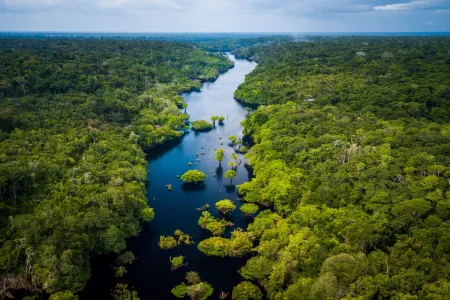
![Tijuca forest Rio de Janeiro rainforest]()
The Floresta sector accumulates its reputation landmark by landmark. Each site carries a distinct character — some tied to natural spectacle, others to history that Rio's streets have largely forgotten — and together they explain the peculiar hold this forest has on the people who visit it.
Cascatinha Taunay: A waterfall near the forest entrance
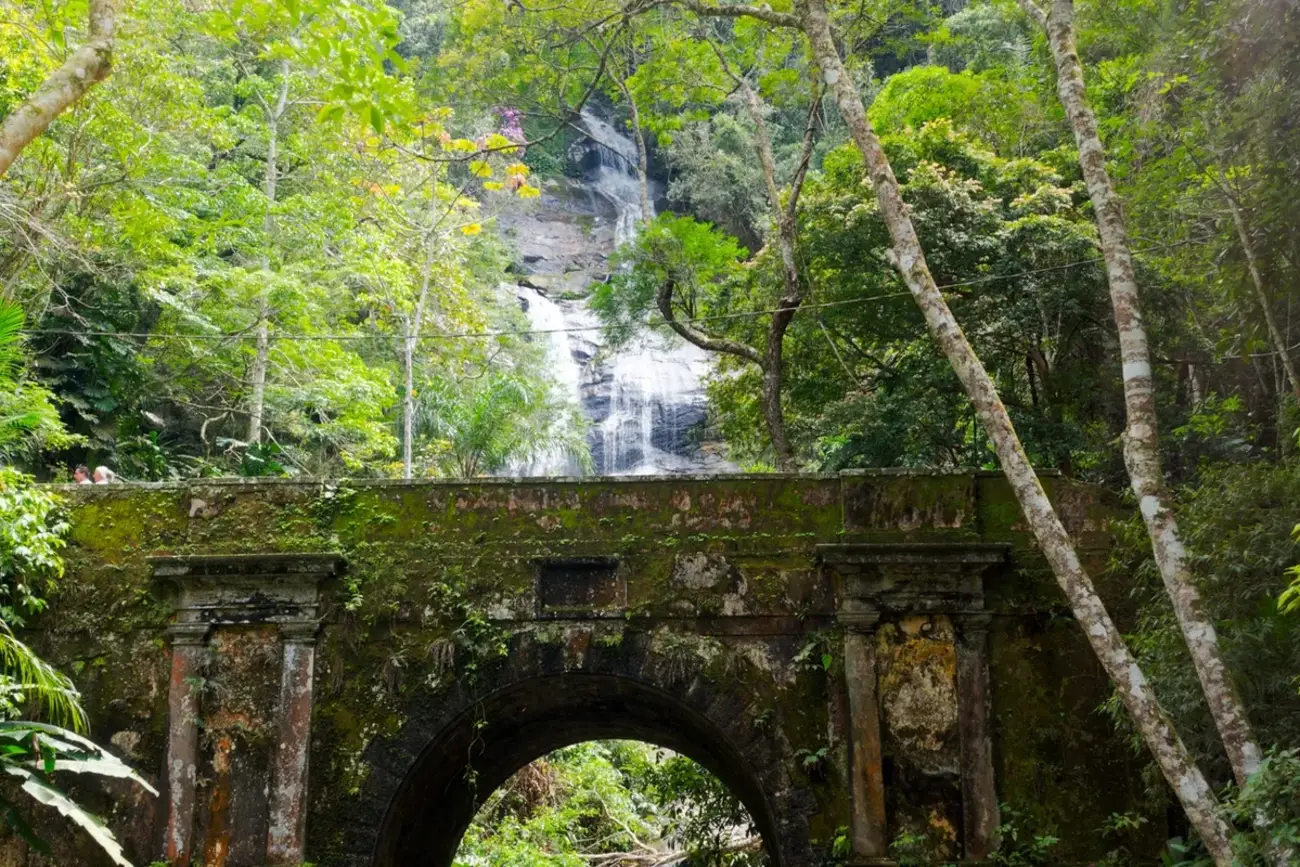
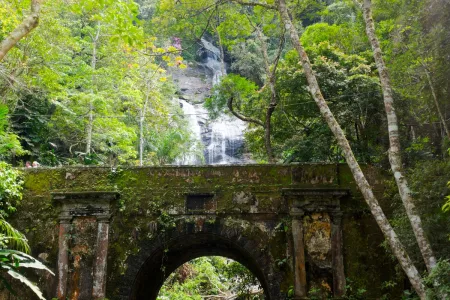
Cascatinha Taunay holds the distinction of being the tallest waterfall inside Tijuca National Park, fed by the Tijuca and Conde rivers and framed by a 19th-century stone bridge that engineer Job de Alcântara constructed on its banks. The French painter Nicolas Antoine Taunay, who lived nearby in the early 1800s, captured the scene on canvas — his presence here is precisely why the waterfall carries his name today. Swimmers cannot enter directly beneath the falls, though a natural pool positioned just below the bridge, also named after Alcântara, remains open for that purpose.
The trail demands almost nothing from the visitor. At just 0.2 miles with 22 feet of elevation gain, most people complete the round trip in under an hour. A section of the path runs on paved ground, which means sandals suffice, though the park charges a small entry fee. Weekends draw considerable numbers, so an early arrival secures the falls at their quietest.
Cachoeira das Almas: A forest walk to a smaller waterfall
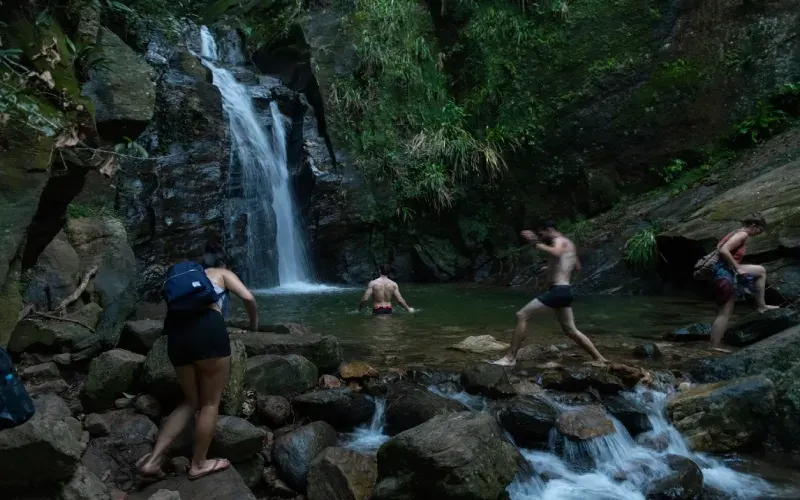
Roughly three kilometers from the main gate, Cachoeira das Almas follows the Riacho das Almas stream along predominantly flat terrain. The name itself carries historical weight — enslaved people once gathered at this spot to conduct religious ceremonies, a practice the name memorializes. That history also makes it singular in a practical sense: Cachoeira das Almas is the only waterfall within the Floresta sector where bathing is officially permitted.
The route runs 0.8 kilometers each way and gains 21 meters in elevation, with most walkers covering it in roughly 13 minutes. The rocks around the water stay wet and slippery, so shoes with grip are worth the small inconvenience. A weekday visit avoids the weekend congestion and gives the site back something of its contemplative character.
Capela Mayrink: A small chapel with a long history
Standing approximately 800 meters from Cascatinha Taunay, not far from the Visitor Center, the pink walls of Capela Mayrink date to 1855. The chapel holds four altar paintings — replicas of works by Cândido Portinari, among them Nossa Senhora do Carmo com o menino Jesus no colo and Purgatório. The originals were relocated to Brazil's National Museum of Fine Arts, which makes the replicas here something of a quiet stand-in for a collection that otherwise requires a trip across the city. The doors open daily between 8 am and 5 pm, and a midday mass takes place on the first Sunday of each month.
Beyond the forest sector: Vista Chinesa and Christ the Redeemer
Two of the park's most compelling attractions fall outside the Floresta sector proper, yet both belong to the same national park system. Vista Chinesa — a pagoda-style gazebo constructed in 1903 — was erected to honor Chinese immigrants who had attempted tea cultivation across these same hills a century earlier. The structure sits at 380 meters above sea level, and the panorama from its platform takes in the Rodrigo de Freitas lagoon, Ipanema, Leblon, and Corcovado in a single sweep. No public transport services the site, so the approach is by taxi, bicycle, or foot.
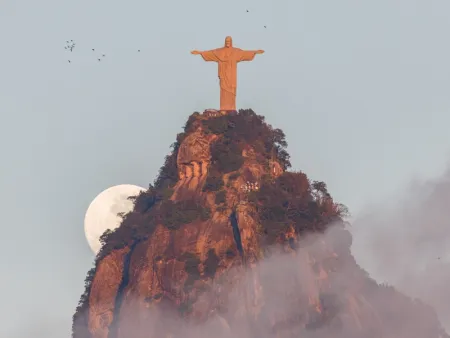
Christ the Redeemer, crowning Corcovado Mountain within the Serra da Carioca sector, generated much of the 3,305,010 visits recorded across the park in 2016. One well-worn route threads 3.8 kilometers through the forest from Parque Lage before connecting with the Paineiras trail system — a climb of two to three hours that places you inside the forest long before the statue comes into view.
![Cascatinha Taunay waterfall Tijuca]()
Is Tijuca Forest worth visiting while in Rio?
Yes. Its waterfalls, forest trails, historic chapel, and scenic viewpoints offer a refreshing escape from the city, with options for both relaxed walks and challenging hikes.
Is entry to Tijuca National Park free?
Entry to the forest itself is free. Some attractions within the wider park, including Christ the Redeemer, require separate tickets.
Can I explore Tijuca Forest without a guide?
Yes, independent visits are suitable for popular, well-marked routes. Download offline maps, arrange your return transport, and consider a guide for unfamiliar or demanding trails.
What wildlife might I see in Tijuca Forest?
The park is home to capuchin monkeys, coatis, agoutis, marmosets, and hummingbirds. Sightings are not guaranteed, and visitors should never feed the animals.
When is the best time to visit Tijuca Forest?
May to September generally offers drier weather and clearer summit views. Start early, check the forecast, and carry a light rain layer even during the dry season.
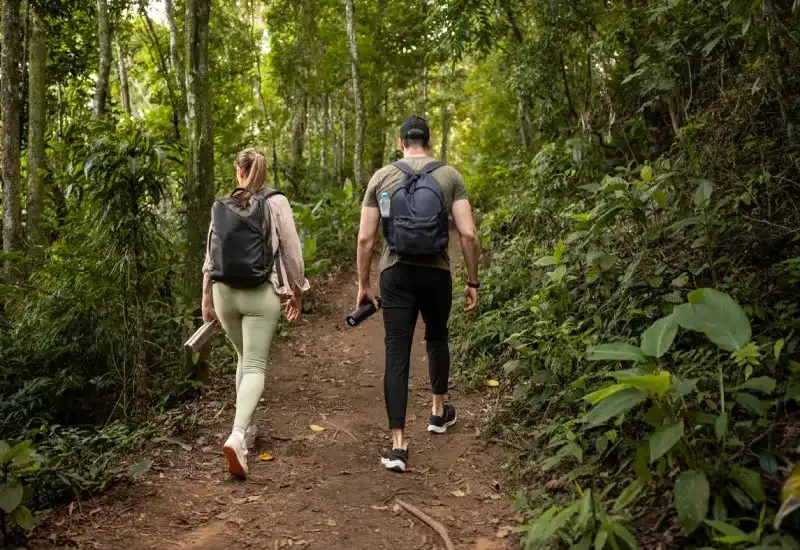
Tijuca National Park makes no assumptions about who shows up at the trailhead. More than 20 marked routes run through Tijuca Forest Rio, graded with reasonable honesty: two rank as easy, seventeen as moderate, and three as difficult, with the Pedra da Gávea Trail sitting at the far end of that spectrum. The range is wide enough that fitness level, far more than interest, tends to determine where any given visitor ends up.
Short forest walks for a relaxed visit
The Pedra Bonita Circular Trail suits those who want scenery without sustained effort — a 1.8-mile loop with 260 meters of elevation gain that most walkers finish in around an hour and fifteen minutes. Families with children tend to gravitate toward Trilha das Grutas, a gentler path that threads past caves where the rock formations hold their own quiet fascination. Those with half a day to spare can join a 6.2-kilometer guided circuit that follows paths first cut in the 1800s, when coffee cultivation still ruled these hills. The route passes waterfalls, caves, and suspension bridges over roughly three hours, and it carries the added weight of history underfoot — the same ground that plantation workers once knew as farmland, now reclaimed entirely by forest.
Pico da Tijuca: A demanding climb to the park's highest peak
Pico da Tijuca stands 1,021 meters above sea level, the highest point within the park and the second-highest peak in Rio de Janeiro, surpassed only by Pedra Branca. The full loop covers 7.7 miles with 2,486 feet of elevation gain, and five hours is a realistic estimate for most hikers. Those starting from Bom Retiro face a shorter proposition — roughly 3.2 miles round trip. What greets climbers near the summit is a staircase of 117 steps cut directly into the rock in 1920, originally prepared for a royal visit, with 120 meters of iron chain running alongside as a handhold. The ascent asks for endurance rather than technical skill, though the exposed summit and limited water sources along the route make sun protection and a full bottle non-negotiable. Rangers enforce a strict cutoff: arrive after 3 pm and access is denied.
Pedra Bonita and Pedra da Gávea: Different routes, different risks
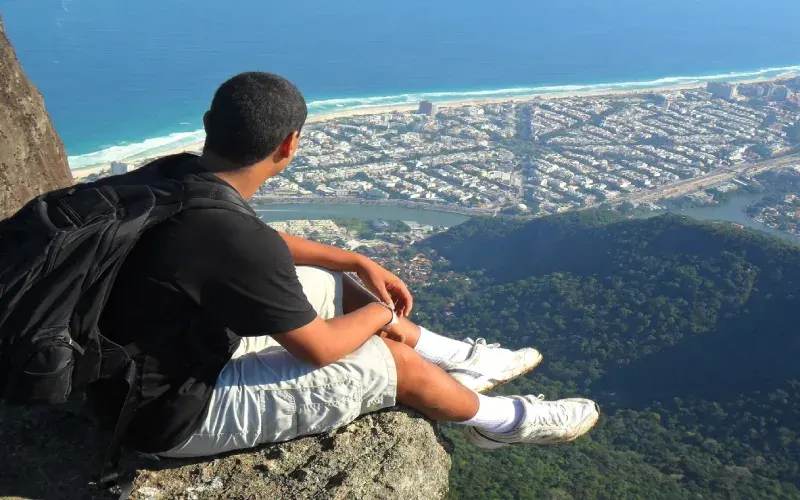
Pedra Bonita and Pedra da Gávea share a coastal setting but bear little resemblance once you're on the trail. Pedra Bonita wraps up in under two hours across a 2.3-mile route with 915 feet of gain, finishing at a launch ramp where paragliders drop toward São Conrado below. Pedra da Gávea operates on an entirely different scale. Recognized as the world's largest coastal monolith at 844 meters, its trail demands 800 meters of elevation gain across just 3 kilometers one way, with round trips typically running between 4 and 6 hours for experienced hikers.
The trail's most revealing moment comes at the Carrasqueira — a nearly vertical 30-meter rock face that stops roughly one in ten climbers cold, not because their legs have given out, but because the exposure proves too much. Official park records document injuries and fatalities on this stretch. Guides recommend a rope, a harness, and an early start by 9 am to guarantee the descent clears before dark. Pedra da Gávea rewards those who get through it, but the Carrasqueira is the kind of obstacle worth researching honestly before the trailhead comes into view.
![Pedra da Gavea hiking, Tijuca forest Rio de Janeiro]()
Customize Your Dream Vacation!
Get in touch with our local experts for an unforgettable journey.
Plan Your Trip
The difference between a rewarding visit and a frustrating one often comes down to decisions made before you leave your hotel room — which month, which entrance, which trail, and how many hours to set aside.
Best months to visit and how rain affects your plans
The dry season, May through September, rewards visitors with clear skies and sharp visibility from the summits, daytime temperatures settling between 24 and 27°C. Summer tells a different story. December through March brings sustained heat, climbing humidity, and afternoon thunderstorms that arrive with little warning and turn exposed rock and tree roots dangerously slick within the hour. Shoulder months — April, October, and November — tend to offer the most practical compromise: thinner crowds, moderating temperatures, and fewer storm-disrupted afternoons.
Getting to the right entrance and arranging your return
No public transport runs directly into the park, which means a private car, rideshare, or a guided tour with included transport are the only viable options. Each of the park's sectors operates through a separate access point: Estrada do Açude serves the Tijuca Forest sector, Cosme Velho and Paineiras serve Corcovado, and São Conrado gives access to Pedra Bonita and Pedra da Gávea. Cell coverage drops out across several stretches of forest, so settle on a pickup time and meeting point with your driver before you lose signal.
Checking current hours, closures, and attraction fees
The park opens daily from 8 am, with gates closing at sunset. Entry into the forest carries no charge, though Christ the Redeemer requires a separate ticket that includes transport by the Corcovado train or official vans — adult fares generally run about 87 to 107 reais depending on the route and season, with reduced rates for children and seniors. Vista Chinesa closes to vehicle access on weekends and public holidays.
Choosing between a guided hike, driving tour, and independent visit
A 4-hour jeep tour through Sector A or B runs between USD 63 and 78 per person, with hotel pickup included. Guided hiking packages cover a wider range: half-day options start around USD 58, while full-day itineraries spanning peaks, caves, and waterfalls run from USD 72 to 92. Independent visits hold up well on heavily trafficked routes like Cascatinha Taunay and the main forest trails, though the park's 200 kilometers of paths reward those who arrive with a guide rather than a guess.
What to pack and how to stay safe on the trails
Pack light, but don't cut corners on the essentials:
-
At least 2 liters of water per person for any outing lasting longer than an hour
-
Closed shoes with reliable grip — sandals and worn sneakers earn their regrets on wet trail sections
-
Sunscreen, insect repellent, and a hat
-
A light rain layer, regardless of what the morning sky suggests
-
Offline maps downloaded before you step out of range
An early start — 7 or 8 am — keeps you ahead of the heat and well clear of the afternoon storm window.
Planning a half-day or full-day trip around travel times
A half-day visit, running four to six hours, comfortably covers one or two highlights. A full-day circuit of eight to nine hours opens up multiple peaks, cave systems, and waterfalls spread across different sectors. Either way, factor in a 40 to 50-minute drive each way from Rio's South Zone — that time shapes the whole schedule more than most visitors expect.
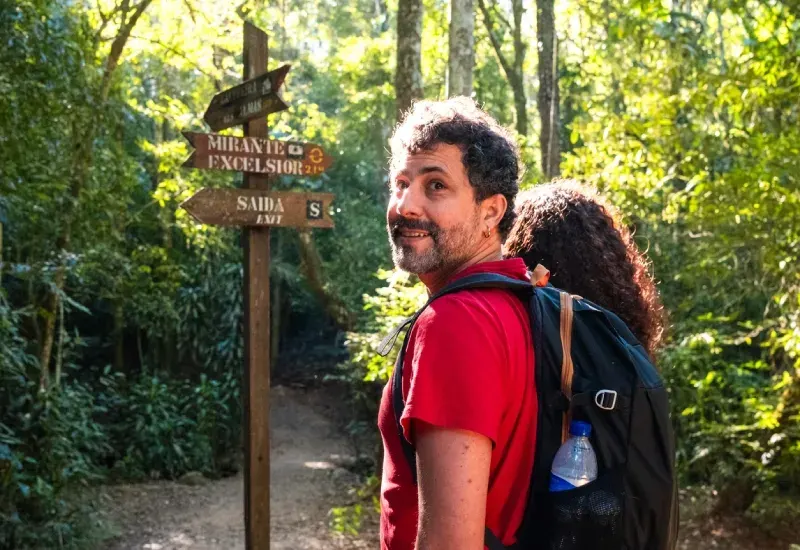
![hiking trail sign Tijuca national park]()
A restored canopy and a restored ecosystem are not the same thing. Tijuca's history makes that distinction sharper than almost anywhere else on the planet.
How coffee farming and replanting shaped today's forest
The damage began well before the replanting effort. Coffee farming across the 18th and 19th centuries stripped Tijuca's hills to bare earth, and the loss of tree cover had an immediate consequence that Rio's residents felt directly — the streams feeding the city's drinking water began to dry up. The crisis prompted Emperor Pedro II to order a full replanting of the land in 1861. What followed was one of the earliest deliberate reforestation programs in recorded history, carried out largely by six enslaved workers: Eleutério, Constantino, Manuel, Mateus, Leopoldo, and Maria, who put over 100,000 trees into the ground between 1861 and 1887. Their names appear almost nowhere in the popular accounts of Tijuca's recovery, yet the forest that millions walk through today is, in a direct and measurable sense, their work.
How animals spread seeds and help the forest grow
The trees came back. The animals did not, at least not on their own. This matters because a forest's canopy and its soil depend on fauna to function. Animals carry seeds across distances that wind and gravity cannot manage, and without that dispersal, the tall canopy trees that define a mature rainforest have no reliable mechanism for replacing themselves as they age and fall. A forest without its seed carriers is, ecologically speaking, a forest that cannot fully renew itself.
Project Refauna: Progress and challenges in bringing wildlife back
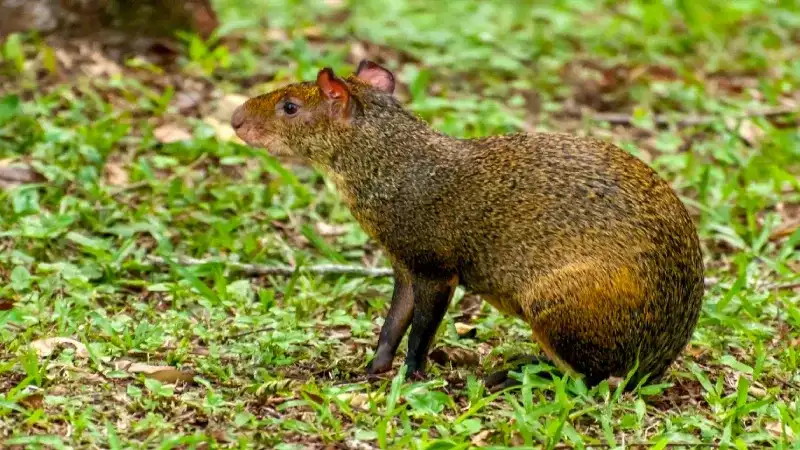
Refauna, the program designed to address exactly this problem, began reintroducing species in 2010, starting with agoutis — large, seed-dispersing rodents whose foraging habits are essential to forest regeneration. Sixty-one agoutis now live within the park. Yellow-footed tortoises followed: 56 were released into the forest, though only 30 remain today; the rest were lost predominantly to domestic dogs straying in from the surrounding city. Howler monkeys present perhaps the most complicated picture — the population fell from five individuals to two before a vaccinated group was introduced, pushing the count back up to between 12 and 14. Each of these figures tells a story of partial success measured against persistent urban pressure.
How visitors can protect wildlife, trails, and water
The pressures that Project Refauna works against are, in several cases, ones that visitors directly influence. Feeding wildlife disrupts foraging behavior and draws animals toward human activity zones where they face greater risk. Dogs introduced into the forest — as the tortoise numbers demonstrate — can dismantle years of reintroduction effort in a matter of months. Staying on marked trails protects both the soil structure and the water sources that run beneath it. None of these ask much of a visitor, but their cumulative effect on what survives inside Tijuca is considerable.
Conclusion
Tijuca Forest occupies a category of its own. Few places on the planet ask you to choose between a city skyline and a rainforest canopy and then hand you both within the same afternoon. The waterfalls, the chapel walls, the summit staircases carved into rock for a royal visit, the agoutis threading between tree roots — each piece belongs to a story that stretches back through centuries of destruction and deliberate, painstaking repair.
The forest rewards those who pay attention to it. A short walk to Cascatinha Taunay carries a different weight once you know the name of the engineer who built the bridge above it, just as the view from Pico da Tijuca means something different when you understand what once grew, and then disappeared, across these hills. That layering of history beneath the canopy is precisely what separates Tijuca from an ordinary green space.
Time your visit well, carry enough water, and move through the trails with the care the ecosystem deserves. The forest has been rebuilt once already. What happens to it next depends, in no small part, on the people who walk through it.
![agouti rodent Atlantic forest Brazil]()