
 Home
Amazon Rainforest Facts: What You Need to Know About Brazil's Natural Wonder
Few ecosystems on Earth command the attention the Amazon does once the numbers come into focus. Stretching across 2.7 million square miles in eight countries and French Guiana, with Brazil alone accounting for roughly 60% of this territory, the Brazilian Amazon rainforest shelters an estimated 10% of all known species on the planet — a density that has occupied scientists for generations and continues to yield species no one has formally recorded.
The basin beneath that canopy stores about 100 billion metric tons of carbon and channels nearly 20% of the world's freshwater, sustaining millions of lives along its banks and far beyond. What follows is a thorough account of its scale, its wildlife, the peoples who have called it home for millennia, and the forces now pushing it toward a point of no return.
.webp "Amazon Rainforest Facts: What You Need to Know About Brazil's Natural Wonder")
Table of Content
Where Is the Amazon Rainforest, and How Big Is It?
Which Plants and Animals Live in the Amazon?
Who Lives in Brazil's Amazon Rainforest?
Why Does the Amazon Matter Beyond Brazil?
What Threatens the Amazon, and What Can Protect It?
Where Is the Amazon Rainforest, and How Big Is It?
A single statistic frames everything else: the Amazon biome covers roughly 40% of South America, and almost every fact that follows traces back to that sheer territorial mass.
The Amazon across eight countries and French Guiana
The Amazon biome stretches across eight sovereign nations — Brazil, Bolivia, Peru, Ecuador, Colombia, Venezuela, Guyana, and Suriname — along with French Guiana, an overseas territory of France. Together, these territories encompass 6.7 million square kilometers, an area twice the size of India. Widen the measurement to the full Amazon basin, and the total land area comes close to that of the continental United States.
The forest's distribution across these nations is anything but equal. Measured by basin share, the breakdown runs as follows:
-
Brazil: 58.4%
-
Peru: 12.8%
-
Bolivia: 7.7%
-
Colombia: 7.1%
-
Venezuela: 6.1%
-
Guyana: 3.1%
-
Suriname: 2.5%
-
French Guiana: 1.4%
-
Ecuador: 1%
Why Brazil holds about 60% of the rainforest
Brazil's share of this territory is not simply a geographical footnote — it fundamentally determines how the entire region is governed and conserved. Roughly 60% of the Amazon rainforest falls within Brazilian borders, a proportion corroborated by basin-area calculations placing Brazil at 58.4%. Peru holds a distant second at 13%, Colombia accounts for 10%, and the remaining five nations, together with French Guiana, divide what is left.
Brazil has formalized this dominance through a designation known as the "Legal Amazon," an administrative zone covering nearly 5 million square kilometers — almost 61% of the entire Pan-Amazon region and 59% of Brazil's own national territory. This zone encompasses states including Acre, Amapá, Amazonas, Mato Grosso, Pará, Rondônia, Roraima, and Tocantins, together with more than half of Maranhão. The consequence is considerable: policy decisions made in Brasília reverberate across an entire continental system, shaping conservation outcomes for nine nations at once.
The difference between the rainforest, biome, and river basin
Three terms appear repeatedly in any serious account of the Amazon — rainforest, biome, and basin — and the distinctions between them matter more than most readers expect.
The rainforest refers to the dense tropical tree cover itself, spanning approximately 6 million square kilometers. The biome is a broader ecological classification reaching 6.7 million square kilometers, encompassing not only rainforest but also floodplain forests, savannas, grasslands, swamps, and palm forests. The basin, by contrast, defines the entire drainage zone fed by the Amazon River and its tributaries — roughly 7 million square kilometers, equivalent to about 35.5% of the South American continent's total landmass.
The Amazon River at the heart of this system runs more than 6,600 kilometers from its Andean source to the Atlantic Ocean, and its discharge into the sea accounts for roughly 20% — about one-fifth — of all river water entering the world's oceans. No other river network on Earth carries a greater volume of freshwater — which is precisely why scientists treat the basin as a hydrological unit wholly separate from the forest canopy sitting above it.
Which Plants and Animals Live in the Amazon?
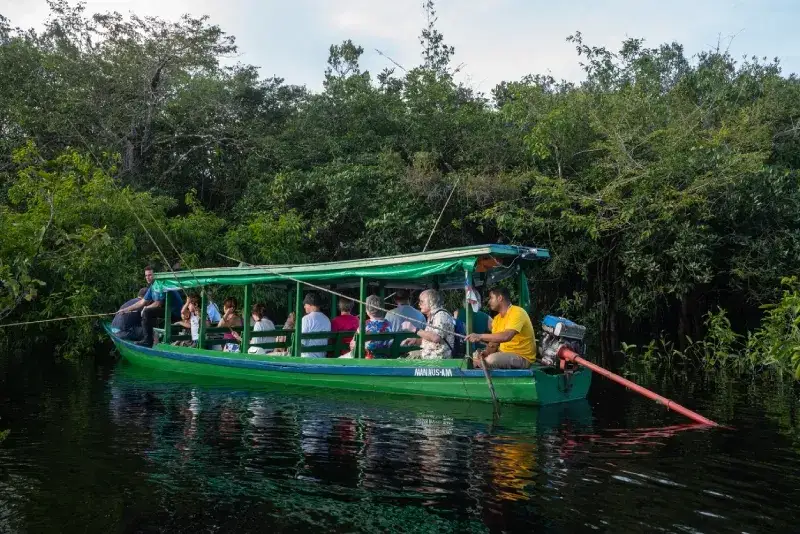
That scale of territory — nearly 6 million square kilometers of dense tropical cover — creates the conditions for a biological richness that staggers even seasoned naturalists. The Amazon holds roughly 40,000 plant species, 1,300 bird species, 3,000 types of fish, 430 mammals, and an estimated 2.5 million distinct insect species. Scientists place one in every ten known species on the planet within the Brazilian Amazon rainforest alone, a concentration so remarkable that researchers continue naming creatures no taxonomist has previously recorded.
Jaguars, sloths, monkeys, and other forest mammals
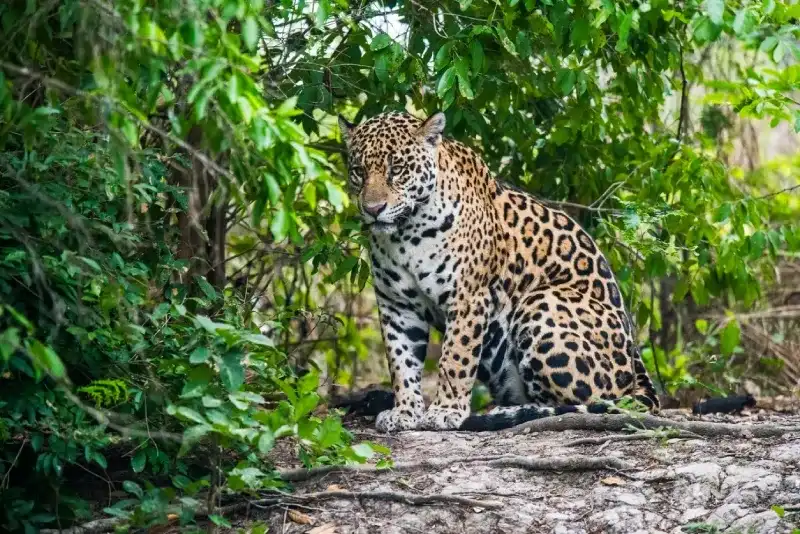
At the top of this food web sits Panthera onca — the jaguar. Powerfully built and deceptively versatile, this cat pursues more than 80 prey species, from turtles and caimans to capybaras and fish. Where most cats avoid water, the jaguar hunts directly inside rivers and flooded forest corridors, a behavioral trait that sets it apart from any other large predator in the Americas.
The black caiman holds equivalent authority in aquatic habitats, reaching up to six meters in length and claiming the title of largest predator in the entire Amazon basin. Against this, the sloth represents an entirely different strategy for survival — sleeping as many as 20 hours a day, suspending itself from branches for the majority of its life, and moving so slowly that algae colonize its fur. Capybaras, the world's largest rodents at 75 to 150 pounds, organize themselves into groups of up to 100, while squirrel monkeys travel in troops that typically range from 10 to 70 but have been recorded swelling to 300. Howler monkeys, meanwhile, project calls audible up to three miles through the canopy — tapirs, the forest's largest herbivores, complete this cast of mammals that has no equivalent anywhere else on the continent.
Macaws, harpy eagles, and other birds
More than 1,300 bird species inhabit the Amazon, 28 of which are found nowhere else on Earth — a figure that places this single ecosystem ahead of entire continental regions in avian diversity. Macaws form lifelong pair bonds, gather in flocks of 10 to 30, and have been documented living up to 60 years, while the harpy eagle, standing over a meter tall with a two-meter wingspan, subsists largely on sloths and monkeys, which together account for more than two-thirds of its diet.
Hummingbirds inhabit the opposite end of the scale — their hearts beat up to 1,260 times per minute while their wings complete 80 strokes every second. Toucans carry bills nearly matching their body length, and the prehistoric-looking hoatzin, with its clawed juvenile wings and fermentation-based digestion, rounds out a birdlife that makes this forest's canopy one of the most studied skylines in ornithology.
Pink river dolphins and freshwater fish
Beneath the river's surface, the boto — or Amazon river dolphin — reaches about 2.55 meters (8.4 feet) in length and 185 kilograms (408 pounds) in weight, earning it the distinction of being the largest freshwater dolphin on the planet. This species is now directly vulnerable to rising water temperatures: in September and October 2023, more than 200 river dolphins — most of them botos — died in Lake Tefé alone when water temperatures climbed to around 40°C (104°F), a mass mortality event that alarmed researchers tracking the pace of climatic shifts across the basin.
The pirarucu adds a different kind of scale to Amazon waters — a predatory fish growing close to three meters long, equipped with teeth lining both its mouth and its tongue. Piranhas and electric eels carry their own formidable reputations in the same channels, forming an underwater world as densely populated and competitive as the forest above.
Giant trees, climbing plants, and water lilies
An estimated 40,000 plant species occupy the Amazon, including around 16,000 tree species that together help regulate the global climate through carbon absorption and water cycling. The Brazil nut tree ascends 40 meters above the forest floor, while the giant waterlily extends leaves nearly three meters across — broad and buoyant enough to hold the weight of a small child. Lianas, the woody climbing vines lacing the canopy together, serve as elevated corridors for wildlife moving between trees, and the kapok — one of the tallest trees in this forest — drops its leaves each dry season to release seeds carried away by wind.
Who Lives in Brazil's Amazon Rainforest?
The forest, for all its biological spectacle, is also a human story — one that predates European contact by tens of thousands of years and continues today along every river bend and forest path.
Ancient settlements and Indigenous soil knowledge
Rainforest soils present an immediate problem for agriculture: they are naturally impoverished, their nutrients locked into living vegetation rather than the earth beneath.
Ancient Amazonians solved this with remarkable ingenuity, engineering a dark, fertile growing medium called terra preta from charcoal, ash, and organic waste such as fish bones and animal remains. Radiocarbon dating of samples from the Kuikuro Indigenous Territory places some of this soil at 5,000 years old, with the majority falling between 300 and 1,000 years of age. What makes this particularly striking is that communities such as the Kuikuro continue the practice today, accumulating cassava waste and ash into cultivated plots they call eegepe. Across the broader Brazilian Amazon, researchers have identified dark earth sites spanning a formation period of 500 to 8,700 years — evidence of agricultural knowledge so durable it outlasted empires.
Indigenous Peoples and their ties to the forest
Human habitation of the Amazon reaches back at least 11,000 to 12,000 years — the age of the oldest well-dated archaeological sites — and Indigenous presence has continued without interruption ever since. Today, roughly 1.5 million Indigenous people live across the Amazon basin, distributed among some 385 distinct groups. Within Brazil, Indigenous territories encompass over 300 million acres — around 22% of the Amazon.
A further count places 444 of Brazil's 721 recognized Indigenous territories inside the Amazon, accounting for more than 23% of the Brazilian Amazon rainforest. Groups such as the Yanomamo, Kayapo, and Wajapi carry within their oral traditions a detailed, generational understanding of plant properties, animal behavior, and forest cycles that no laboratory has yet fully catalogued.
River communities and forest-based livelihoods
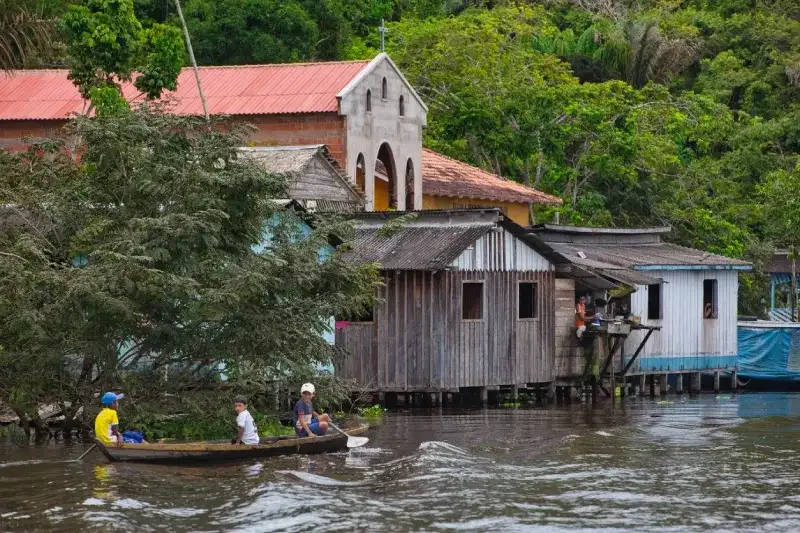
Away from the forest interior, the riverbanks sustain a different but equally intricate way of life. Communities known variously as caboclos, ribereños, or beiradeiros orient their calendars around the flood cycle — fishing when the waters rise, harvesting açaí, and cultivating manioc, beans, and bananas in the varzea floodplain, where soils refreshed by seasonal flooding produce crops faster than almost any dryland equivalent. When flooding arrives unpredictably, however, food shortages follow just as quickly.
Manaus and life in Amazon cities
Manaus tells a different kind of story altogether. Home to more than 2.18 million people as of 2019, this city carries the memory of an extraordinary economic episode: the rubber boom of 1890 to 1920, which briefly made Manaus one of the wealthiest cities on the South American continent. The fortune extracted from the forest funded the construction of the Teatro Amazonas opera house — a ten-million-dollar building that still stands as an unlikely monument to the age when Amazonian rubber moved global markets. The boom collapsed as suddenly as it had risen, but the city it built has never stopped growing.
The Amazon spans Brazil, Bolivia, Peru, Ecuador, Colombia, Venezuela, Guyana, and Suriname, plus French Guiana, a French overseas territory. About 60% of the rainforest lies in Brazil.
The Amazon shelters roughly 10% of Earth’s known species. Its wildlife includes pink river dolphins, jaguars, and harpy eagles, while giant water lilies can grow leaves nearly three meters wide.
Amazon trees release huge amounts of water vapor, helping bring rain to farms, cities, and ecosystems across South America. The forest also stores vast amounts of carbon, helping regulate the global climate.
No. Trees and decomposing organisms consume most of the oxygen the forest produces, leaving its net contribution close to zero. Its main global benefits are carbon storage, rainfall regulation, and biodiversity.
Cattle ranching is the leading driver of deforestation. Logging, mining, roads, drought, and fires also damage the forest. Protecting Indigenous land rights and conservation areas helps reduce forest loss.
Customize Your Dream Vacation!
Get in touch with our local experts for an unforgettable journey.
Plan Your TripWhy Does the Amazon Matter Beyond Brazil?
Weather systems do not respect political borders, and the Brazilian Amazon rainforest illustrates this principle with particular force. Farmers in Argentina, urban planners in Peru, and climate researchers across four continents all share a direct stake in the health of a forest most of them will never see.
How forest moisture helps bring rain to farms and cities
The mechanism behind this continental reach has a name: evapotranspiration. Each day, the Amazon's roughly 400 billion trees draw water from the soil and release close to 20 billion tons of it into the atmosphere — a phenomenon scientists have taken to calling "flying rivers". Winds then carry this moisture westward and southward, feeding rainfall across an area that supports roughly 670 million people in Latin America. Andean cities such as Quito and La Paz receive rainfall that begins, not as ocean vapor, but as water exhaled by Amazonian trees — and even Lima, which sees almost no rain of its own, depends on Andean rivers fed by that same moisture.
The scale of this contribution is difficult to overstate. The system accounts for up to 50% of regional rainfall, sustaining farmland and ecosystems like the Pantanal wetlands that would otherwise tip toward aridity. Approximately 75% of the moisture that falls as rain across the basin gets recycled back into the atmosphere, cycling through this process five or six times before the water finally reaches the Andes. Evapotranspiration alone is responsible for driving 25 to 35% of total rainfall across the basin — figures that place the forest's hydrological role well above what most people attribute to it.
How stored carbon affects the global climate
Carbon storage is where the Amazon's global influence becomes hardest to dismiss. The forest holds between 150 and 200 petagrams of carbon, a quantity equivalent to 15 to 20 years of total global CO2 emissions. Other measurements, accounting for both above- and below-ground reserves, place the figure at 123 billion tons. Combined with the net cooling effect produced by evapotranspiration, this stored carbon helps regulate climate patterns well beyond South America's own landmass.
The role of land stewardship here carries measurable weight. Forests under Indigenous management remove a net 340 million tons of CO2 annually. Forests outside Indigenous territories tell the opposite story — ongoing clearing has converted them into a net carbon source, releasing approximately 270 million tons of CO2 equivalent each year. The threshold scientists watch most closely sits at 20% deforestation: cross it, and models project the release of more than 90 billion tons of CO2, along with the conversion of vast forest stretches into savanna.
Why the Amazon is not the world's main oxygen source
The claim appears often enough to feel settled: the Amazon produces 20% of the world's oxygen, earning it the title of "the planet's lungs." The science does not support it. Researchers now place the Amazon's actual contribution at somewhere between 6% and 9% of the oxygen generated through photosynthesis across land and ocean combined. Trees draw on oxygen themselves through respiration, and the microbial communities breaking down dead plant matter consume much of what remains. The forest's net oxygen output, when all of this is accounted for, runs close to zero.
That correction, however, diminishes nothing about the Amazon's true significance. Its value to the planet rests on carbon storage, the regulation of continental rainfall, and the preservation of biological diversity found nowhere else on Earth — contributions that are, by any measure, far harder to replace than oxygen.
What Threatens the Amazon, and What Can Protect It?
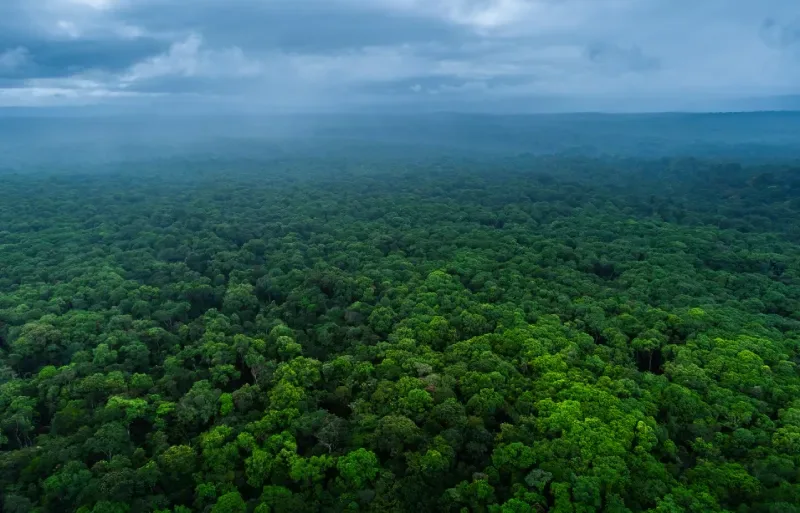
The same forest that steadies rainfall across a continent and holds centuries of Indigenous knowledge now confronts a convergence of pressures that individually would be serious enough — together, they warrant the attention of anyone who has followed this account this far.
Cattle ranching, soy production, and forest clearing
Cattle ranching stands as the single largest driver of Amazon deforestation, responsible for 80% of current forest clearing and releasing 340 million tons of carbon into the atmosphere every year. Brazil accounts for 88% of the region's entire cattle herd, a figure that reflects just how concentrated this pressure is within one country's borders. Over three decades, 780,000 square kilometers of forest have been stripped away, a loss that now contributes to nearly half of Brazil's total carbon emissions.
Roads, logging, mining, and damage to rivers
The damage does not stop at the forest's edge. Tree resilience deteriorates within 200 to 250 kilometers of roads, agricultural clearings, and human settlements, meaning the harm extends well beyond the visible cut line. Mining operations and road construction fragment ecosystems and contaminate river systems, compounding the degradation already set in motion by pasture expansion and soy cultivation.
How drought, heat, and fires reinforce each other
Three droughts, each described as "one-in-a-century" events, have struck the Amazon since 2000 — a frequency that itself signals something has shifted. Fire and drought operate in a cycle rather than in isolation: drought dries the vegetation, fire consumes it, and the loss of tree cover further reduces rainfall, making the next drought worse. Forests receiving less than 1,000mm of annual rainfall grow structurally unstable, while floodplain ecosystems face collapse once that threshold drops below 1,500mm.
What scientists mean by an Amazon tipping point
The term "tipping point" carries specific meaning here. Early models placed that threshold at 40% forest loss, but once climate change and fire are factored in, scientists now put it at 20 to 25%. Beyond it, the Amazon may undergo irreversible dieback, with vast tracts converting to dry savanna in a process that could not be halted even if all clearing stopped immediately. That threshold is not distant: roughly 17 to 20% of the original forest has already been cleared. More than three-quarters of the Amazon has already exhibited measurable loss of ecological resilience since the early 2000s, a finding that places the conversation well past theoretical warning and into documented trend.
Indigenous land rights, protected areas, and forest restoration
Against that trajectory, one pattern stands out with remarkable consistency. Indigenous territories and formally protected areas together cover 52% of the Amazon's remaining forest, yet account for only 5% of net forest loss — a ratio that reflects millennia of stewardship, not coincidence. Extending formal protections to an additional 63.4 million hectares could reduce deforestation by 20% before 2030, a figure that underscores how much conservation potential already exists, waiting to be recognised through policy rather than discovered through science.
How forest-friendly businesses and responsible tourism can help
Supply-chain agreements and satellite-backed monitoring programs have demonstrably curtailed deforestation tied to cattle and soy production, proving that economic activity and forest survival are not inherently opposed — provided the systems governing them hold.
Conclusion
What these facts reveal, taken together, is a system of extraordinary interdependence. The Amazon does not simply exist within South America — it actively sustains it, pulling moisture across mountain ranges, locking carbon beneath its canopy, and carrying within its soils thousands of years of human ingenuity that most of the world has only recently begun to study seriously.
The pressures bearing down on it are no less extraordinary. Cattle ranching, drought cycles, and fires do not act in isolation — they compound one another, nudging the forest incrementally toward a threshold from which recovery becomes far more uncertain. Scientists have been clear on this point for some time now.
Yet the record also shows that loss is not the only story. Indigenous territories and formally protected areas have held the line with a consistency that no other conservation measure has matched. Where land rights have been honored, the forest has largely held. That pattern is not coincidental — it reflects millennia of accumulated knowledge about how this ecosystem actually works.
The Amazon, then, is neither doomed nor invulnerable. Its fate sits somewhere between the two, shaped by decisions made in Brasília, in boardrooms, and at dining tables far removed from the river's edge. Understanding what this forest actually is — its true scale, its biological depth, its climate function — remains the most reliable starting point for any of those decisions.
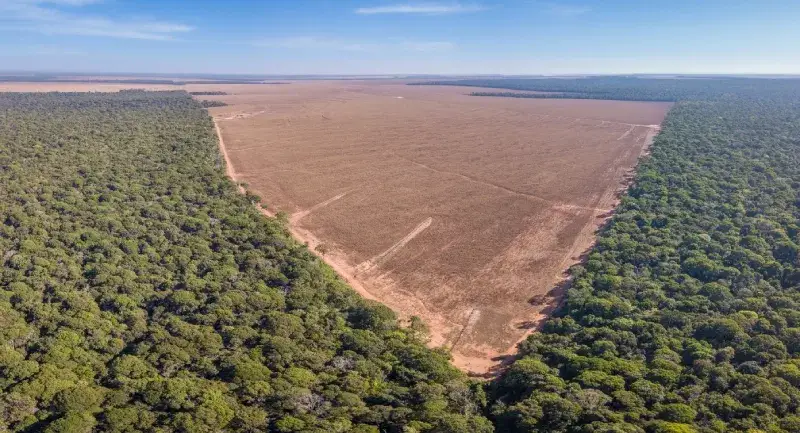
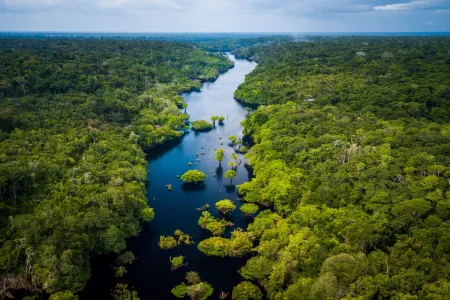
The size, wildlife, people, and climate role of Brazil’s Amazon rainforest, and the threats pushing it toward a tipping point.
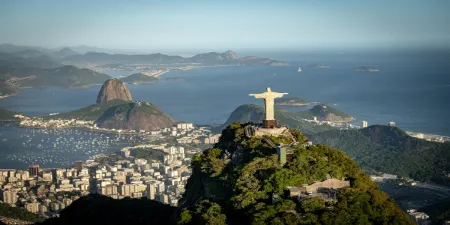
Known as the Marvelous City, Rio de Janeiro is where dramatic mountains meet golden beaches and samba spills into the streets. Stand beneath Christ the Redeemer atop Corcovado, ride the cable car up Sugarloaf Mountain, and soak up the sun on the iconic sands of Copacabana and Ipanema. From the rhythm of Carnival to lush rainforest trails just minutes from downtown, Rio blends natural beauty, vibrant culture, and irresistible energy into one unforgettable destination.
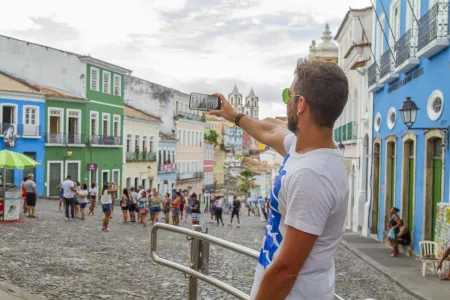
Salvador isn't just a Brazilian beach city. It's the heart of Afro-Brazilian culture, loud with drums and layered with history. Here's everything you want to know before your first visit.
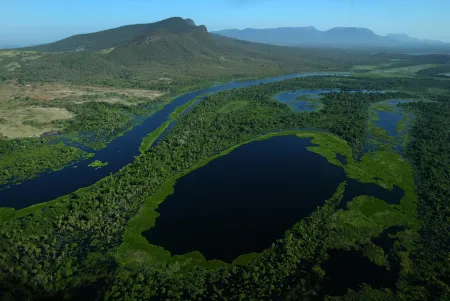
Brazil’s Pantanal is the world’s largest tropical wetland, where jaguars, giant otters, hyacinth macaws, and marsh deer are easier to spot than in the Amazon. This guide explains how seasonal floods shape the region, what life is like for local Pantaneiro families, and how to plan a responsible Pantanal tour.
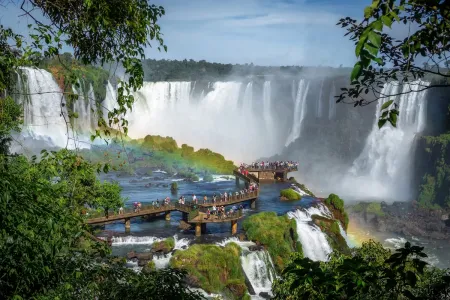
Iguazu Falls Brazil offers the most complete panoramic view of the falls, facing most of the 275 cascades from across the canyon. This insider’s guide covers how to get there, booking timed tickets, the best lookouts along the Waterfall Trail, and tips for timing, photos, and staying dry near Devil’s Throat.
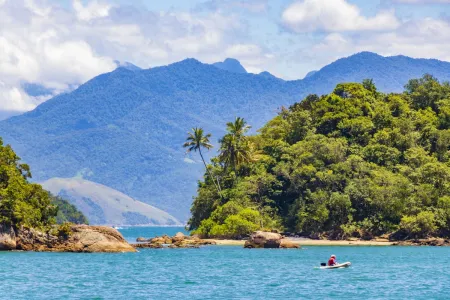
Ilha Grande is a car-free island off Brazil’s Costa Verde, with more than 100 beaches, rainforest trails, and a past as a prison colony. This guide covers how to get there from Rio or Paraty, where to stay, the best hikes and boat tours, and practical tips for a smooth, low-impact trip.
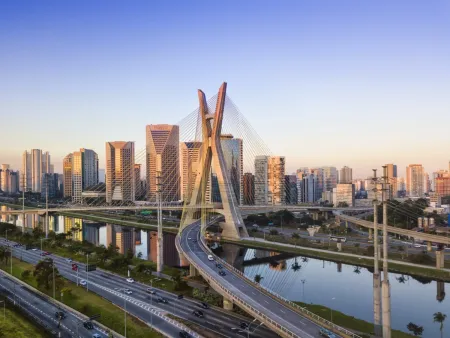
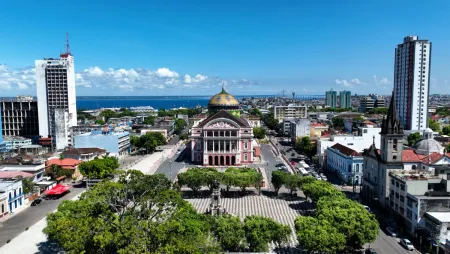
Manaus is where the Amazon begins. Discover its rubber-boom opera houses, the famous Meeting of the Waters, canopy towers, river beaches, and jungle lodges—everything you need to plan an unforgettable Amazon adventure
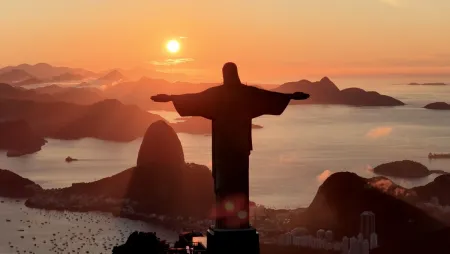
Christ the Redeemer stands 38 meters tall atop Corcovado Mountain, watching over Rio de Janeiro. This guide covers its facts, history, Art Deco design, symbolism, and everything you need to know before visiting one of the New Seven Wonders of the World.
