Tables of content
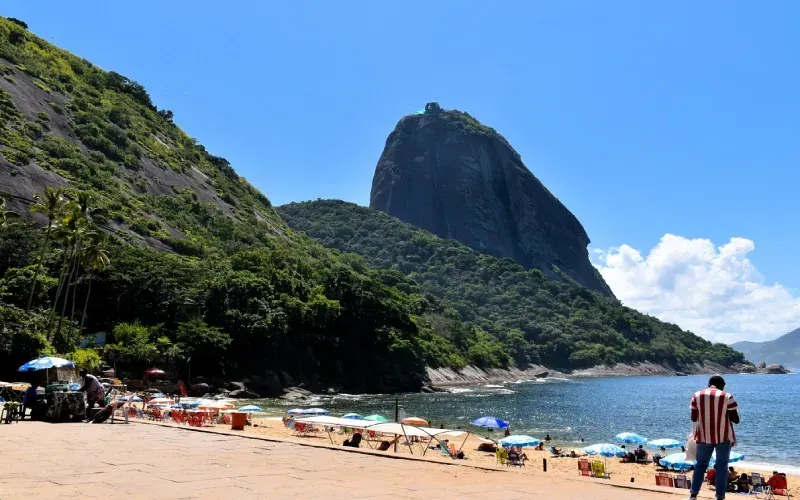
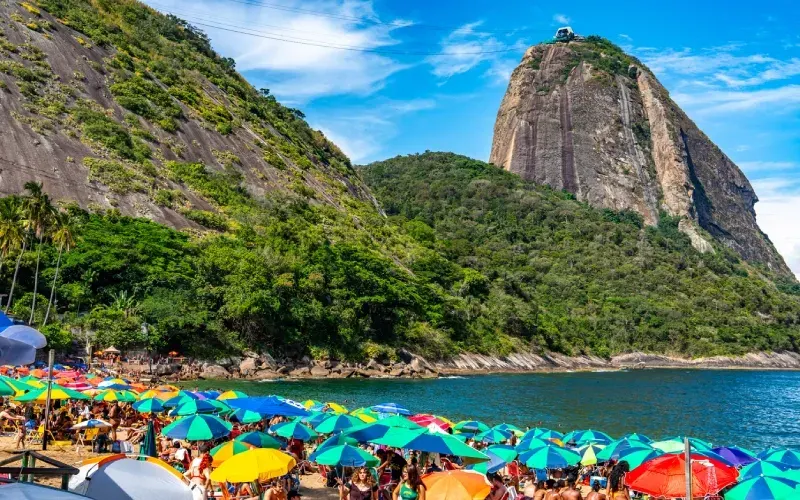
The peak occupies the entrance of Guanabara Bay, anchored within the Urca neighborhood at roughly 22°56'58"S 43°09'24"W. It belongs to a cluster of granite and quartz formations that rise almost vertically from the water's edge — an arrangement that gives Rio's coastline a drama that most coastal cities simply cannot match. The old fortress of São João sits at its base, and the cable car ascent begins at Praia Vermelha, climbing first to Urca Hill, which commands its own altitude of 220 m above the bay. Those two rounded silhouettes stacked against the water, so familiar from photographs, are the pairing of Urca and Sugarloaf seen together.
The name Pão de Açúcar traces back to commerce, not geology. Historian Vieira Fazenda documented how Portuguese merchants fastened the label during the height of Brazil's sugarcane export era, when refined sugar traveled in conical clay molds whose shape the mountain echoed with uncanny precision. French sailors on Jean de Léry's 1557 voyage had their own name for it — "Pot de Beurre" — and used the peak as the primary navigational reference for ships entering the bay. Charles Darwin recorded the same unmistakable conical profile when he sailed out of Rio on July 5, 1832. Over fifty peaks around the world now carry the sugarloaf designation, yet the monolith above Guanabara Bay remains the original measure against which all others are compared.
The geology that produced the dome is itself a story of deep time. Sugarloaf is built from augen gneiss — called Phacoid Gneiss locally — formed when a feldspar-rich granite underwent intense metamorphism during the collision phase of the Ribeira orogenic belt, approximately 560 million years ago in the Ediacaran period. Tropical rainfall across subsequent millennia dissolved the softer rock surrounding it, leaving the resistant gneiss exposed as the domed summit visible today, while vertical fractures dating to the Paleogene period sculpted the near-vertical north and south faces.
Formal protection arrived in stages. Brazil established the Sugarloaf Mountain and Urca Hill Natural Monument in 2006, consolidating a 2000 law that had already elevated Pão de Açúcar and Urca to the status of national monuments. UNESCO then folded both into a substantially grander designation in 2012, inscribing "Rio de Janeiro: Carioca Landscapes between the Mountain and the Sea" in recognition of the city's singular fusion of natural topography and cultural history. The inscribed area spans 7,248.78 hectares, with a buffer zone of 8,621.38 hectares reaching from the 1,021 m summit of Tijuca National Park across to the Copacabana shoreline — with Sugarloaf standing at the bay's entrance as its most visible anchor.
Want Sugarloaf, Corcovado and Copacabana in one seamless journey? Discover our tailor-made Brazil Trips & Vacations.
![Rio de Janeiro's famous Sugarloaf Mountain]()
The bondinho's story begins not at the summit but in a 1908 boardroom, where engineer Augusto Ramos persuaded Rio's high society — Eduardo Guinles and Raymundo Ottoni de Castro Maya among them — to fund an electric cable system up bare granite. What followed was less a construction project than a mountaineering expedition: more than 400 workers scaled the rock face with ropes and wooden planks to anchor the infrastructure, and several of those original planks remain visible on the slope to this day.
From the first cable car in 1912 to today
The cable car opened on October 27, 1912, ranking it only the third cableway ever completed in the world, behind earlier installations in Spain and Switzerland. Its original wooden cabins carried a fraction of today's passenger load, and the system ran largely unchanged for decades. The limits of that early engineering became apparent in 1951, when a snapped cable left 22 passengers stranded mid-air for ten hours — a crisis that mechanic Augusto Goncales resolved by climbing down the cable himself to coordinate the rescue.
A full overhaul came in 1972: a second cable was added, and new cabins pushed capacity from 22 to 75 passengers, later settled at 65 for comfort. The system was replaced outright in 2002 and upgraded again in 2008 as the centenary approached. Along the way it collected a cultural footnote — a 1979 action sequence in Moonraker filmed James Bond dangling from its cables above the bay. The cumulative count now stands at more than 37 million passengers, with roughly 2,500 boarding each day.
The first ride: Praia Vermelha to Morro da Urca
The journey opens at Vermelha Beach Station, where the first cabin departs toward Morro da Urca. This leg is deceptively short — 600 meters of cable traveled at 6 meters per second, gaining 220 meters of altitude in under three minutes.
Specs for this first stretch:
Morro da Urca holds more than a midpoint stop. A cafe, snack bar, restaurant, souvenir stands and a children's play area spread across the platform, giving passengers good reason to linger before boarding the second cabin.
The second ride: Morro da Urca to Sugarloaf
The upper leg covers 850 meters at a top speed of 10 meters per second — noticeably faster and steeper than the first. From the 220-meter platform at Morro da Urca, the cabin climbs to the full 396-meter summit, its glass enclosure offering an unobstructed sweep of Botafogo Bay as the angle sharpens toward the top station.
Both legs combined account for roughly 1,450 meters of cable — less than a ten-minute journey from base to summit. The upper section's gradient tends to register more strongly on passengers than the numbers suggest, particularly on a late afternoon run when the light off the water is at its most striking.
![Cable car at Sugarloaf mountain during sunset in Rio de Janeiro, Brazil]()
How much time should I allow for Sugarloaf Mountain?
Allow 2–3 hours for the cable cars and viewpoints. Plan on 3–4 hours if you also hike Morro da Urca and explore nearby Urca.
What should I wear when visiting Sugarloaf Mountain?
Wear comfortable clothing and walking shoes, especially if you plan to hike. Bring a light jacket because the summit can be cooler and windier than the base.
What is the easiest way to reach Sugarloaf Mountain in Rio?
Take the metro to Botafogo, then continue by taxi or bus to Praia Vermelha. From there, the cable car reaches Sugarloaf in two stages, stopping at Morro da Urca.
What should I avoid when planning a Sugarloaf visit?
Avoid leaving your descent until the last minute or attempting the summit climb without suitable equipment. Check cable car schedules and ticket rules before setting out.
When is the best time to visit Sugarloaf Mountain?
Mornings usually offer cooler temperatures and shorter queues. Late afternoon is ideal for golden-hour views and sunset, but expect larger crowds and longer waits afterward.
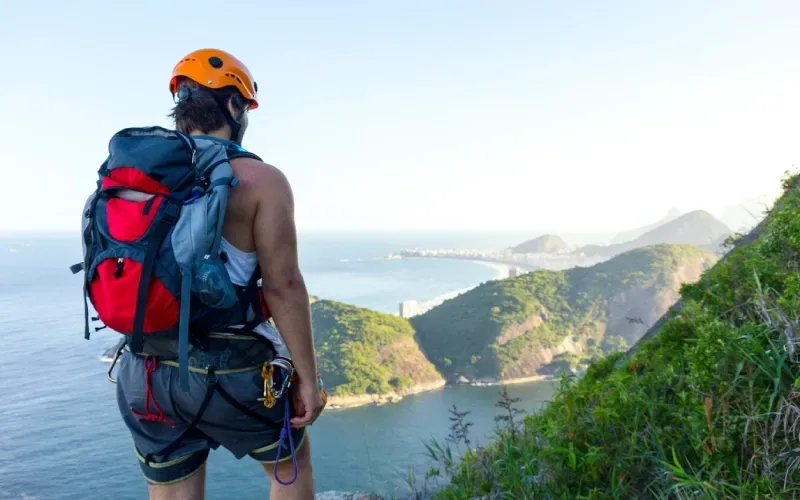
The cable car is not the only way up, and for a portion of the route, it is not even necessary. Sugarloaf Mountain Rio de Janeiro, offers a free trail to Morro da Urca and a set of guided climbing routes that bypass the bondinho entirely on the ascent — each with its own character, difficulty, and physical demands.
Hiking Morro da Urca: What the trail involves
The trail begins at Praia Vermelha, directly beside the cable car station, cutting upward through shaded Atlantic Forest for approximately 1.5 kilometers before arriving at 220 meters of elevation. Stairs are carved into the steeper sections of hillside, and most hikers complete the ascent in 45 to 60 minutes. AllTrails records the out-and-back distance at 2.4 miles with 731 feet of elevation gain, rating it moderate and estimating 1.5 to 2 hours for the round trip. The canopy overhead keeps the path cool, the terrain shifts between forested stretches and open rock, and the resident monkeys make occasional appearances without much warning.
Reaching the top on foot also carries a practical advantage: a second-stage-only cable car ticket, purchased at Morro da Urca, costs less than a full round-trip ticket bought at the base station.
Why reaching Sugarloaf on foot requires climbing
Past Morro da Urca, the character of the route changes entirely. The path to the Sugarloaf summit runs 2.2 kilometers one-way from the trailhead, rated strenuous, and takes roughly two hours to complete. What forces that rating is a single feature — Costão do Pão de Açúcar, a near-vertical rock face of about 20 meters with no route around it, graded 5a/V+/5.8. Fixed anchors are in place at the more demanding sections, and most people climb it with ropes and proper gear. Without equipment, the pitch becomes a free solo, which is precisely why this stretch stops being a hike and becomes a genuine technical climb.
Guided climbs: Fitness, heights and safety
The guided routes up the granite face cover a wide range of technical difficulty, structured to suit different levels of experience:
-
Via Costão or Via Morro da Babilônia (3rd degree, beginner): 3 to 5 hours, suited to first-timers with no prior climbing background.
-
Via Coringa (4th degree, intermediate): 4 to 6 hours, better matched to those with some experience on rock.
-
Via dos Italianos (5th/6th degree, advanced): 4 to 6 hours, intended for climbers with a solid technical foundation.
-
Via Ferrata: a fixed-cable route spanning 230 meters of climbing across seven sections of up to 30 meters each, with a roughly 2-kilometer approach hike of about one hour.
Guides provide harnesses, helmets, ropes, and climbing shoes. These routes are not suitable for pregnant travelers, anyone with a cardiac condition, or those with a pronounced fear of heights.
Planning your descent and checking cable car ticket rules
Most guided climbs include a cable car descent from the summit to Morro da Urca in the package price. At the turnstile, climbers simply state they ascended on foot; FEMERJ members descend at no charge with a membership card. Hikers preferring to avoid the cabin entirely can walk back to the base in roughly 45 minutes on select routes, though cable car refund rules are firm — confirm your descent arrangement before the climb begins.
![Mountain climber looking at view in Rio de Janeiro.]()
Customize Your Dream Vacation!
Get in touch with our local experts for an unforgettable journey.
Plan Your Trip
Settling on how you'll reach the summit is only part of the equation. The other part — tickets, schedules, transit routes, and what the site actually offers on arrival — determines whether the visit runs smoothly or not.
Ticket options, current prices and official booking
The standard cable car ticket, covering both stages of the ride, is priced at R$199 through the official site, with a half-price rate of R$99 available for children, students and seniors, and a skip-the-line Fast Pass option priced at R$285. Purchase directly through bondinho.com.br — third-party resale platforms routinely charge a premium for the identical experience.
Opening hours, last entry and last cable car
The park opens daily at 8:30 am. From Monday to Thursday it closes at 8 pm, with last boarding at 6:30 pm; from Friday to Sunday it closes at 9 pm, with last boarding at 7:30 pm. Cabins depart at roughly 20-minute intervals, each carrying up to 65 passengers.
Morning or sunset: Choosing your time to visit
The practical answer depends on what you're after. Sunset draws the heaviest crowds, compounded on weekends by a DJ event at Morro da Urca running from 5 pm to 6:30 pm. Descent queues pile up sharply after sundown, so holding your position until the city lights settle in frequently beats joining the rush. Mornings offer cooler temperatures, easier access to the rail and noticeably softer photographic light.
Weather, visibility and seasonal crowds
December through March is high season — warm, vivid and crowded. May through September brings thinner crowds and reliably clear skies, though isolated rain or passing fog can occasionally flatten the view. Sugarloaf's lower elevation, well beneath that of Corcovado, means it rarely disappears entirely into cloud cover.
Getting to Praia Vermelha by public transport or taxi
Galeão International Airport sits roughly 24 kilometers from the base, a drive of about 23 minutes without significant traffic. The metro reaches Botafogo station, from where a short taxi or bus ride — or a 30 to 40-minute walk — covers the remaining distance to Praia Vermelha. Bus lines 511 and 512 also serve stops near the entrance. Street parking near the base is scarce; booking tickets online in advance unlocks a discounted RIOSUL garage rate of R$20.00 for up to six hours.
Step-free access, facilities and what to bring
The Praia Vermelha entrance is fully step-free, with elevators and accessible restrooms at both Morro da Urca and the summit station. Ramps bridge the platform gap at each cable car stop, so wheelchair users ride both stages without any transfer. Lockers are available at Morro da Urca for a small fee — bags should stay compact. The summit runs noticeably cooler and windier than sea level, so a light jacket is worth carrying regardless of the temperature at the base. Set aside 2 to 3 hours to cover the full cable car experience without feeling rushed.
![]()
The summit delivers a panorama that few vantage points in the world can match without a mountain range behind them. Guanabara Bay and the Niterói coastline stretch to the east, Copacabana's arc curves to the south, and on a clear day, Christ the Redeemer stands plainly visible across the city's roofline. Botafogo's sheltered bay fills the foreground below, offering a closer and lower perspective than Corcovado provides — one that puts the water, not the skyline, at the center of the frame.
Photo spots and tips for shooting through cable car glass
Late afternoon pulls the richest color from both the granite and the bay, making golden hour a far more rewarding window than the flat midday light. Salt carried on the summit wind deposits a fine haze on glass and lenses within an hour of exposure, so a lens cloth kept accessible rather than buried in a bag makes a genuine difference. The railing along both platforms fills quickly in the final stretch before sunset — arriving on an earlier cabin and holding position beats jostling for space when the crowds peak.
Food stops and time to allow at each hill
Morro da Urca and the summit both carry cafes, bars and food counters, though pricing reflects the altitude rather than street-level Rio. The cable car stages alone justify two hours; adding the Atlantic Forest trail and a walk through the quiet Urca village below pushes that closer to three or four.
After your descent: Praia Vermelha and the Urca waterfront
Praia Vermelha sits directly at the base of the peninsula — calm, swimmable and unhurried in a way the summit never quite is. The Mureta da Urca seawall nearby draws locals every evening for a sunset that costs nothing and asks even less of you.
Conclusion
Few landmarks earn their reputation as honestly as Pão de Açúcar. The geology is extraordinary, the history behind the bondinho is genuinely remarkable, and the panorama from the summit — Guanabara Bay spreading wide, Corcovado visible in the distance, Copacabana curving away to the south — delivers precisely what six centuries of sailors, merchants and travelers have been noting since the 16th century.
What separates a good visit from a forgettable one comes down to preparation. Book tickets directly through the official site, decide early whether morning light or the golden hour suits your purpose better, and carry a jacket for a summit that sits windier than the streets below.
Sugarloaf is not simply a viewpoint. It is a geological record, a feat of early 20th-century engineering, and one of the more quietly layered landmarks in the world — all of it accessible within a few hours from almost anywhere in Rio.
![View of Rio de Janeiro from Sugarloaf Mountain, Brazil]()