
 Home
Rio Christ the Redeemer Facts: Everything About the Wonder of the World
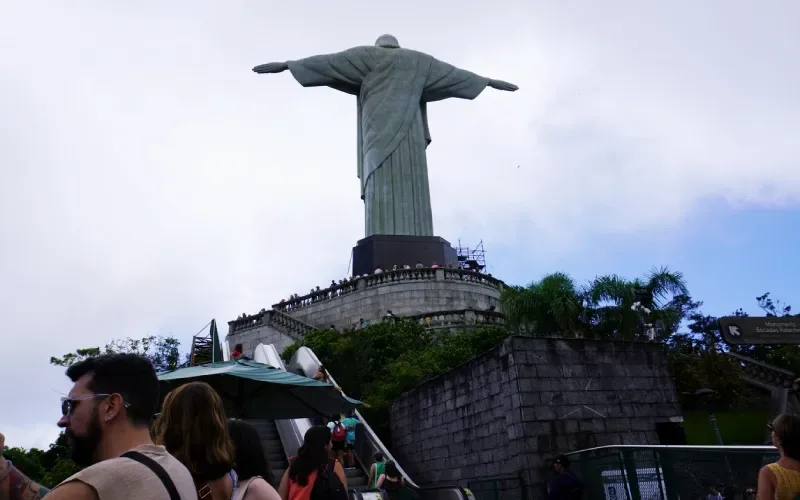
Rio’s Christ the Redeemer facts highlight a monument of remarkable scale. It stands 30 meters tall, its arms span 28 meters, and it weighs about 635 metric tons. The statue sits atop Corcovado Mountain and withstands winds of 250 km/h, along with several lightning strikes each year. More than 100 million people voted it one of the New Seven Wonders of the World in 2007. These Christ the Redeemer statue Brazil facts cover its Art Deco design and the engineering that keeps it standing today.

Table of content
1-Christ the Redeemer Facts: Location, Size and Style
2-How Christ the Redeemer Went From an Idea to a Statue
3-Why Christ the Redeemer Became a World Wonder
4-What It Takes to Protect the Statue
5-Visiting Christ the Redeemer: What to Know Before You Go
1-Christ the Redeemer Facts: Location, Size and Style
Christ the Redeemer's location and scale help explain why the monument stands out. Its dimensions reflect ambitious engineering and religious devotion.
Where it stands: Corcovado Mountain in Rio de Janeiro, Brazil
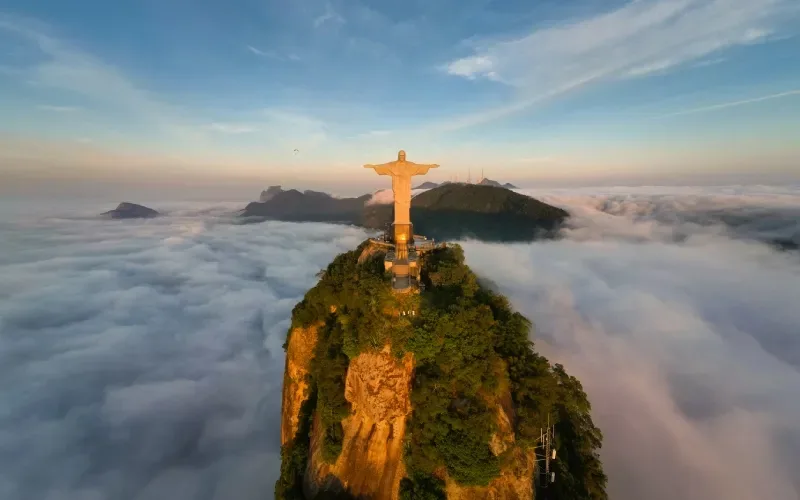
The statue crowns Corcovado Mountain's summit, 2,310 feet (704 meters) above sea level. Locals call it "Hunchback Mountain" because of its distinct shape. Visitors can see Rio's beaches, Sugarloaf Mountain, and Guanabara Bay from the summit.
Corcovado lies within Tijuca National Park, one of the planet's largest urban rainforests and a recognized UNESCO Biosphere Reserve. The forest provides more than a scenic setting. Its elevated position makes Christ the Redeemer visible from much of the city below.
How tall it is: Statue height, pedestal and arm span
The statue stands 30 meters (98 feet) tall. An 8-meter (26-foot) pedestal brings its total height to about 38 meters. Its arms extend 28 meters (92 feet) wide in a welcoming gesture.
A few more details are worth noting:
|
Feature |
Measurement |
|
Statue height (excluding pedestal) |
30 meters |
|
Pedestal height |
8 meters |
|
Arm span |
28 meters |
|
Head height |
3.75 meters |
|
Length of one hand |
3.20 meters |
|
Total weight |
635 metric tons |
Engineering records document these measurements. At 635 metric tons, the statue weighs about as much as 100 adult elephants balanced on a mountain peak.
Why it is the world's largest Art Deco statue
Christ the Redeemer holds the title of the world's largest Art Deco-style sculpture. Brazilian engineer Heitor da Silva Costa created the design with French sculptor Paul Landowski and French engineer Albert Caquot. Romanian artist Gheorghe Leonida sculpted the face and gave the monument its calm, recognizable expression.
The structure uses reinforced concrete and thousands of triangular soapstone tiles. Nearly six million tiles cover its surface. This soapstone veneer gives the statue a warm, textured appearance and protects the concrete core.
How its size compares with the Statue of Liberty
Christ the Redeemer appears much smaller beside the Statue of Liberty. Lady Liberty reaches 93 meters when her pedestal is included, making her nearly two and a half times taller than Rio's monument. Christ the Redeemer measures about two-thirds of the Statue of Liberty's height from base to torch.
Christ the Redeemer ranks below towering statues such as the Statue of Unity (240 meters) and the Spring Temple Buddha (153 meters). It is not even the tallest Jesus statue. Christ the Protector in Encantado, Brazil, stands about 20 feet taller, while Poland's Christ the King and Indonesia's Jesus Buntu Burake hold contested claims to the title of tallest Jesus statue worldwide. Rio's version stands apart because of its setting, symbolism, and global recognition.

2-How Christ the Redeemer Went From an Idea to a Statue
Getting this statue from a sketch on paper to a towering monument took nearly 70 years of starts, stops, and stubborn faith. Here's how the experience unfolded.
The first proposal in the 1850s and why it stalled
A priest named Pedro Maria Boss first proposed the idea in the mid-1850s. He suggested a religious monument atop Corcovado to honor Princess Isabel, Emperor Pedro II's daughter. Nobody approved it. Brazil became a republic in 1889, and the new separation of church and state ended the idea entirely. Cardinal Dom Joaquim Arcoverde tried to revive it in 1912. He hoped to show that the Catholic Church still mattered in Brazilian life, but the proposal again went nowhere.
The Catholic campaign and donations that funded the project
The idea finally caught fire in 1920 and 1921 after the Catholic Circle of Rio and the Roman Catholic archdiocese pushed a new proposal. They launched "Semana do Monumento," or Monument Week, to collect signatures and donations. Brazilian Catholics funded almost the entire project themselves. They acted in part out of fear that society was losing its religious footing.
The artists and engineers behind the statue
Citizens petitioned President Epitácio Pessoa, and he granted permission in 1922. A design competition followed. Brazilian engineer Heitor da Silva Costa won and worked with artist Carlos Oswald. French sculptor Paul Landowski later joined the project to shape the head and hands. French engineer Albert Caquot designed the internal structure. Romanian sculptor Gheorghe Leonida, who trained in Bucharest and Italy, carved the face. The work required great precision.
Why the original cross-and-globe design changed
Silva Costa's first sketches showed Christ holding a cross in one hand and a globe in the other. People mocked the design and called it "Christ with a ball". Oswald is credited with proposing the standing pose with arms spread wide, which was meant to symbolize peace.
The 1922 foundation stone, main building work and 1931 opening
Workers laid the foundation stone on April 4, 1922, to mark Brazil's independence centennial, although the final design was not yet set. Construction began around 1925 or 1926 and continued for about five years. The whole process took nine years and cost roughly USD 250,000. The statue opened to the public on October 12, 1931. The date coincided with the feast day of Our Lady of Aparecida, Brazil's patron saint.
How concrete, soapstone and the Corcovado railway made it possible
Engineers chose reinforced concrete instead of steel in part because it cost less. They also feared that a metal frame could be dismantled during wartime. The design had to withstand winds of up to 250 kilometers per hour. Concrete for the base came from Limhamn, Sweden. Silva Costa covered the concrete with nearly six million triangular soapstone tiles. Builders chose the material because it was durable and workable. Volunteers hand-glued the tiles onto mesh. Some reportedly wrote loved ones' names on the backs before attaching them. The Corcovado cogwheel railway, originally built for tourists, carried every material and worker up the mountain.
It stands on Corcovado Mountain in Rio de Janeiro, measures 30 meters tall without its pedestal, and is the world’s largest Art Deco statue.
Its striking design, mountaintop setting, and symbolism helped win worldwide support in the public vote for the New Seven Wonders of the World.
It was named one of the New Seven Wonders of the World on July 7, 2007, following a global voting campaign.
The statue is struck about three to five times a year on average, though some estimates are higher. Lightning has damaged its fingers and head, prompting repairs and additional lightning protection.
No. The internal stairs and access hatches are reserved for maintenance crews. Visitors can enjoy the viewing platform and visit the chapel at the statue’s base.
3-Why Christ the Redeemer Became a World Wonder
Once the statue was complete atop Corcovado, its meaning began to unfold to the people who saw it each day. Its design carried powerful symbolism, and the global recognition it gained decades later turned a religious monument into something people around the world see as their own.
What the open arms and Sacred Heart mean
Carlos Oswald's redesign replaced the original cross-and-globe concept with outstretched arms. That change transformed the statue's message. The pose creates the shape of a cross and feels open and welcoming instead of stern or distant.
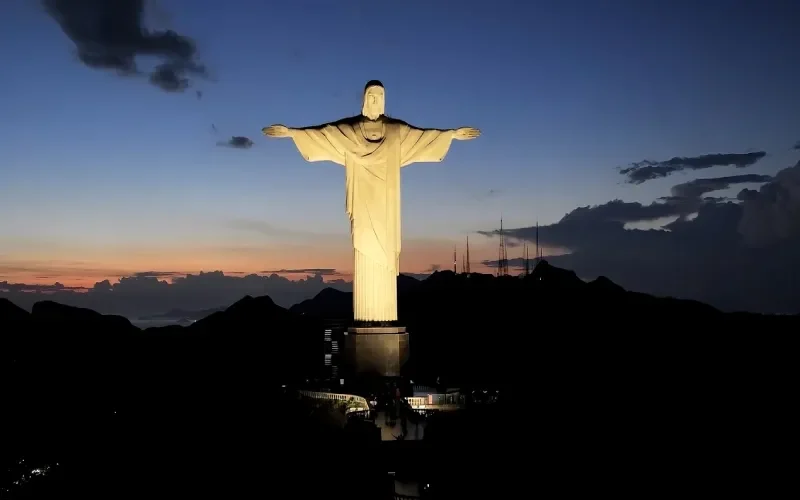
People often miss a small detail at first glance. A discreet heart sits just above the mantle and measures 1.30 meters across. It represents the Sacred Heart of Jesus, a Catholic symbol of Jesus's love and compassion for humanity. This is the only part of the monument built into the structure itself rather than added as surface decoration.
How the 2007 New Seven Wonders vote worked
Swiss-Canadian filmmaker Bernard Weber launched the New7Wonders campaign in 2000. He wanted ordinary people, rather than historians or committees, to decide which monuments deserved recognition as modern wonders. Organizers began with about 200 candidate sites. Experts reduced the list to 77, then selected 21 finalists.
Brazil launched an aggressive campaign called "Vote no Cristo." Telecom companies waived fees for voting texts and calls, while corporate sponsors such as Banco Bradesco and Rede Globo funded the campaign. A plane also flew over Rio with a banner that read "4916 VOTE FOR CHRIST". Around 10 million Brazilians had voted by early July.
The results were announced in Lisbon on July 7, 2007, after more than 100 million votes were cast worldwide. Christ the Redeemer joined six other sites: the Great Wall of China, Petra, Machu Picchu, Chichén Itzá, the Colosseum, and the Taj Mahal. Critics questioned the poll's methodology because voters could cast repeat votes, and UNESCO distanced itself from the process. Public enthusiasm remained strong.
How the statue became a symbol of Rio and Brazil
Rio de Janeiro became the first city in the world to use an image of Jesus Christ as its main symbol. The government formally transferred 477 square meters of land atop Corcovado to the Archdiocese of São Sebastião in 1934. This placed responsibility for the monument's upkeep in the Church's hands.
The transfer meant more than paperwork. It linked the statue's future to the institution that had funded its construction decades earlier and established Christ the Redeemer as both a religious landmark and a civic emblem known across Brazil.
Customize Your Dream Vacation!
Get in touch with our local experts for an unforgettable journey.
Plan Your Trip4-What It Takes to Protect the Statue
The statue's status as a national symbol comes at a cost. Its exposed position on a mountaintop leaves it vulnerable to nature's harshest conditions. Keeping Christ the Redeemer intact requires regular work, specialized materials, and some luck with the weather.
How lightning and harsh weather damage the monument
Corcovado's peak rises 700 meters above Rio and sits directly in the path of frequent electrical storms. Brazil's National Institute for Space Research estimates that lightning strikes the statue three to five times a year on average. Some estimates are higher, reaching about 10 strikes each year.
The damage follows a pattern. The summit's rocky ground has high resistance, which slows the lightning current's path to the earth. The current then seeks another route, often traveling over the statue's surface and gradually chipping away at its fingers, hands, and head.
A storm in January 2014 caused serious damage. Lightning broke the right thumb, damaged the right middle finger, and hit part of the head. Officials later confirmed that the storm had one of Brazil's highest recorded lightning-strike counts since monitoring began in 1999.
What major repairs and lightning rods help protect
Repairs after the 2014 storm lasted about four months, but the statue remained open to visitors throughout the work. Workers used the Church's existing soapstone reserve, which matched the material used in the original construction, to repair the damaged sections.
The 2014 repair was not the first major restoration. The statue underwent a USD 4 million restoration in 2010 to address erosion on its face and hands. Officials added more lightning rods after the 2014 damage to reduce the risk of future strikes. Spikes along the arms and head already form part of the monument's lightning-protection system.
Why matching the original soapstone is getting harder
Each repair requires soapstone that matches the nearly six million original tiles covering the statue. The Church keeps a reserve of matching stone for this purpose. That supply shrinks with every repair, making it harder for restoration crews to maintain a consistent surface. Mismatched patches would stand out against the decades-old stone that Rio's climate has already weathered.
5-Visiting Christ the Redeemer: What to Know Before You Go
Getting up Corcovado means choosing between the train, an official van, or hiking on your own. Your choice shapes the day well before you reach the statue.
Train, official van or hike: Choosing your route
The Corcovado train follows a 3.8-kilometer cogwheel track up the mountain and has carried passengers since 1884. Official vans leave from Copacabana, Largo do Machado, and the Paineiras Visitor Center. Visitors who prefer to walk can take the free Parque Lage trail, which takes about four hours. The gate closes to climbers at 3 pm. A shorter route from Paineiras opened in December 2024 and covers 1.15 kilometers in about 45 minutes.
Tickets and opening hours: What to check before booking
|
Route |
Adult Price |
|
Train |
BRL 134 (~USD 26) |
|
Van (Copacabana/Largo do Machado) |
BRL 132 |
|
Van (Paineiras) |
BRL 87 |
|
Hiker entry |
BRL 58 |
The monument is open daily from 8 am to 6 pm. Last admission is around 5 pm.
Best times for clear views and smaller crowds
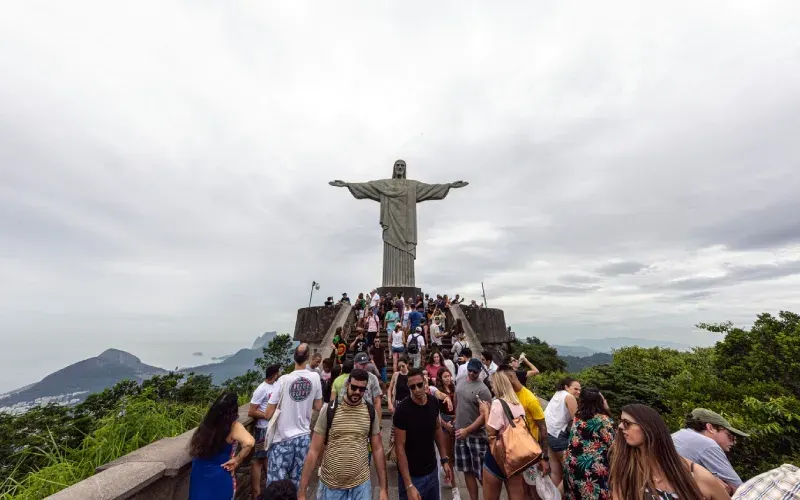
May to September usually offers the driest weather, with 42 to 45 mm of rain each month. Wetter months receive 130 to 137 mm. Take the first train or arrive after 4 pm to avoid the largest crowds. December, January, February, and July are the busiest months. New Year's Day 2025 alone brought in 20,000 visitors.
Steps, lifts and escalators: Access to the viewing platform
A 220-step stone staircase links the train station to the platform, although lifts and escalators handle most of the ascent. Construction work through May 2027 will replace the escalators with inclined elevators. The changes cut capacity in half and leave visitors with an 80-step section to climb.
The chapel and city views: What you can see at the top
The Chapel of Our Lady Aparecida stands at the statue's base and holds mass at 11 am and 3 pm on weekdays. The platform overlooks Sugarloaf Mountain, Guanabara Bay, and Maracanã Stadium.
Why the statue's inner stairs are closed to visitors
Inside the statue, 12 platforms connect through steel stairs that lead to hatches in the arms and head. Maintenance crews alone can use them.
Conclusion
Christ the Redeemer shows how faith and engineering, supported by public will, can create something lasting. The statue’s decades-long trip from concept to completion and its lightning-scarred arms atop Corcovado tell a story of resilience. Millions of votes and decades of devotion built its global reputation.
Whether you are drawn to its Art Deco design, symbolism, or the view from its platform, the statue offers more than a photo opportunity. Clear skies and quieter hours will show you why this monument still engages the world.
The size, wildlife, people, and climate role of Brazil’s Amazon rainforest, and the threats pushing it toward a tipping point.

Known as the Marvelous City, Rio de Janeiro is where dramatic mountains meet golden beaches and samba spills into the streets. Stand beneath Christ the Redeemer atop Corcovado, ride the cable car up Sugarloaf Mountain, and soak up the sun on the iconic sands of Copacabana and Ipanema. From the rhythm of Carnival to lush rainforest trails just minutes from downtown, Rio blends natural beauty, vibrant culture, and irresistible energy into one unforgettable destination.

Salvador isn't just a Brazilian beach city. It's the heart of Afro-Brazilian culture, loud with drums and layered with history. Here's everything you want to know before your first visit.
Brazil’s Pantanal is the world’s largest tropical wetland, where jaguars, giant otters, hyacinth macaws, and marsh deer are easier to spot than in the Amazon. This guide explains how seasonal floods shape the region, what life is like for local Pantaneiro families, and how to plan a responsible Pantanal tour.

Iguazu Falls Brazil offers the most complete panoramic view of the falls, facing most of the 275 cascades from across the canyon. This insider’s guide covers how to get there, booking timed tickets, the best lookouts along the Waterfall Trail, and tips for timing, photos, and staying dry near Devil’s Throat.

Ilha Grande is a car-free island off Brazil’s Costa Verde, with more than 100 beaches, rainforest trails, and a past as a prison colony. This guide covers how to get there from Rio or Paraty, where to stay, the best hikes and boat tours, and practical tips for a smooth, low-impact trip.

Manaus is where the Amazon begins. Discover its rubber-boom opera houses, the famous Meeting of the Waters, canopy towers, river beaches, and jungle lodges—everything you need to plan an unforgettable Amazon adventure

Christ the Redeemer stands 38 meters tall atop Corcovado Mountain, watching over Rio de Janeiro. This guide covers its facts, history, Art Deco design, symbolism, and everything you need to know before visiting one of the New Seven Wonders of the World.
