
 Home
Home
Article Indexes:
#A Quick Look Back: The History of Sheki
Tucked into the foothills of the Greater Caucasus Mountains, Sheki (also spelled Shaki) is the kind of place that quietly steals the show on any trip through Azerbaijan. It's a city where cobblestone streets wind past centuries-old caravanserais, where sunlight pours through colorful stained-glass windows without a single nail or drop of glue holding them together, and where the pace of life still feels shaped by its Silk Road past. If Baku is Azerbaijan's modern face, Sheki is its living memory.
Let's take a conversational walk through everything worth knowing about Sheki — its history, quick facts, top attractions, local food, transportation options, and the best time to plan your visit.
#A Quick Look Back: The History of Sheki
Sheki's roots stretch back thousands of years, and its location made it a natural stop along the historic Silk Road trade routes connecting the Caucasus with Persia, the Ottoman Empire, and beyond. <cite index="13-1">Walking through Sheki's Old Town, you'll find caravanserais, houses, and narrow cobblestone streets that recall the town's history as a trading hub</cite>. For centuries, merchants passed through carrying silk, spices, and goods, and the city grew wealthy on the trade — Sheki in particular became renowned for its silk production, a craft still celebrated in the region today.
In the 18th century, Sheki became the seat of the independent Sheki Khanate, and it was during this era that the city's most iconic landmark, the Sheki Khan's Palace, was built as a summer residence for the ruling khans. <cite index="17-1">The Old City, known as "Yukhari Bash," is home to notable structures such as the Sheki Fortress, which dates back to the 15th century</cite>, and much of this historic core has survived remarkably intact. In recognition of its architectural and cultural significance, the historic center of Sheki, along with the Khan's Palace, was inscribed as a UNESCO World Heritage Site — cementing its status as one of the best-preserved traditional towns in the Caucasus region.
#Quick Facts About Sheki
- Country: Azerbaijan
- Region: Sheki-Zaqatala, northwestern Azerbaijan
- Setting: Foothills of the Greater Caucasus Mountains
- UNESCO Status: Historic Centre of Sheki with the Khan's Palace, a UNESCO World Heritage Site
- Known For: Sheki Khan's Palace, shebeke stained-glass windows, Silk Road caravanserais, and traditional Azerbaijani sweets
- Distance from Baku: Roughly 300 km, about a 4–5 hour drive
- Local Specialty: Sheki halva, a rich, layered dessert famous throughout Azerbaijan
#Top Attractions in Sheki
Sheki's compact historic core makes it an easy city to explore on foot, with most major sights clustered within or near the old fortress walls.
1. Sheki Khan's Palace
The Sheki Khan's Palace is, without question, the city's star attraction and one of the most beautiful buildings in the entire South Caucasus. Built as the summer residence of the Sheki Khans, this palace is a masterpiece of 18th-century architecture, world-famous for its colorful stained-glass windows, detailed wall paintings, and harmonious design</cite>. What makes the palace so extraordinary is that its dazzling shebeke windows — intricate stained-glass lattices — were assembled entirely without nails or glue, using only interlocking wood and colored glass, a technique passed down through generations of local craftsmen.
The palace is a fascinating blend of Persian, Turkish, and Azerbaijani architectural styles</cite>, and every interior wall is covered in richly painted murals depicting hunting scenes, floral patterns, and geometric designs. Ancillary buildings on the grounds house the Khan Museum, which displays artefacts from the period</cite>, giving visitors a fuller picture of court life during the khanate era. Because natural light plays such a key role in how the shebeke windows look, visiting earlier in the day tends to offer the most vivid, magical effect.
2. Sheki Old City (Yukhari Bash)
Stepping into Sheki's Old City feels like walking straight into the pages of a history book. The cobblestone streets, ancient buildings, and historic landmarks create an atmosphere of timeless beauty</cite>, with red-tiled roofs, traditional stone houses, and centuries-old caravanserais lining the narrow lanes. This entire district is protected as part of Sheki's UNESCO World Heritage designation, and it's easily one of the most atmospheric places to simply wander without a fixed itinerary.
Scattered throughout the Old City are artisan workshops where you can watch craftsmen at work on shebeke windows, silk weaving, and traditional copperwork — trades that have been practiced in Sheki for generations. Shops selling local crafts and textiles line many of the streets</cite>, making the Old City a great place to pick up an authentic, handmade souvenir directly from its maker.

Sheki is a historic Silk Road city in Azerbaijan, famous for the Khan's Palace, stained-glass shebeke windows, and its UNESCO-listed Old City.
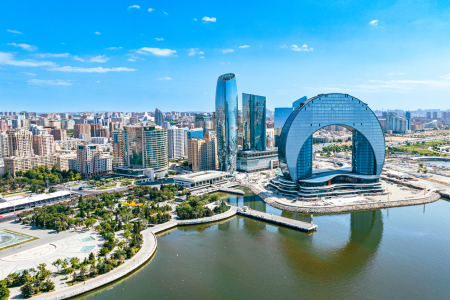
Baku is Azerbaijan's Caspian capital — a walled medieval Old City beneath the Flame Towers, where Silk Road heritage meets bold modern architecture.