
 Home
HomeBuenos Aires Attractions: Your Essential Guide to the City's Best Spots
Few cities wear their contradictions as gracefully as Buenos Aires. French-style mansions sit alongside ochre-painted tenements, ornate opera houses share streets with open-air tango stages, and a cemetery — with 4,691 marble mausoleums — ranks among the city's most visited destinations. The Argentine capital earned its "Paris of South America" reputation honestly: through decades of grand architectural ambition, cultural obsession, and a distinct identity that borrowed from Europe yet remained unmistakably its own. Here, the world's widest street cuts through a checkerboard of historic barrios, the oldest café in the city has welcomed poets and Nobel laureates since 1858, and a single bookstore draws over a million visitors a year. What follows is a thorough account of the landmarks, neighborhoods, cultural institutions, and local rituals that make Buenos Aires one of the most layered and compelling cities in the world.
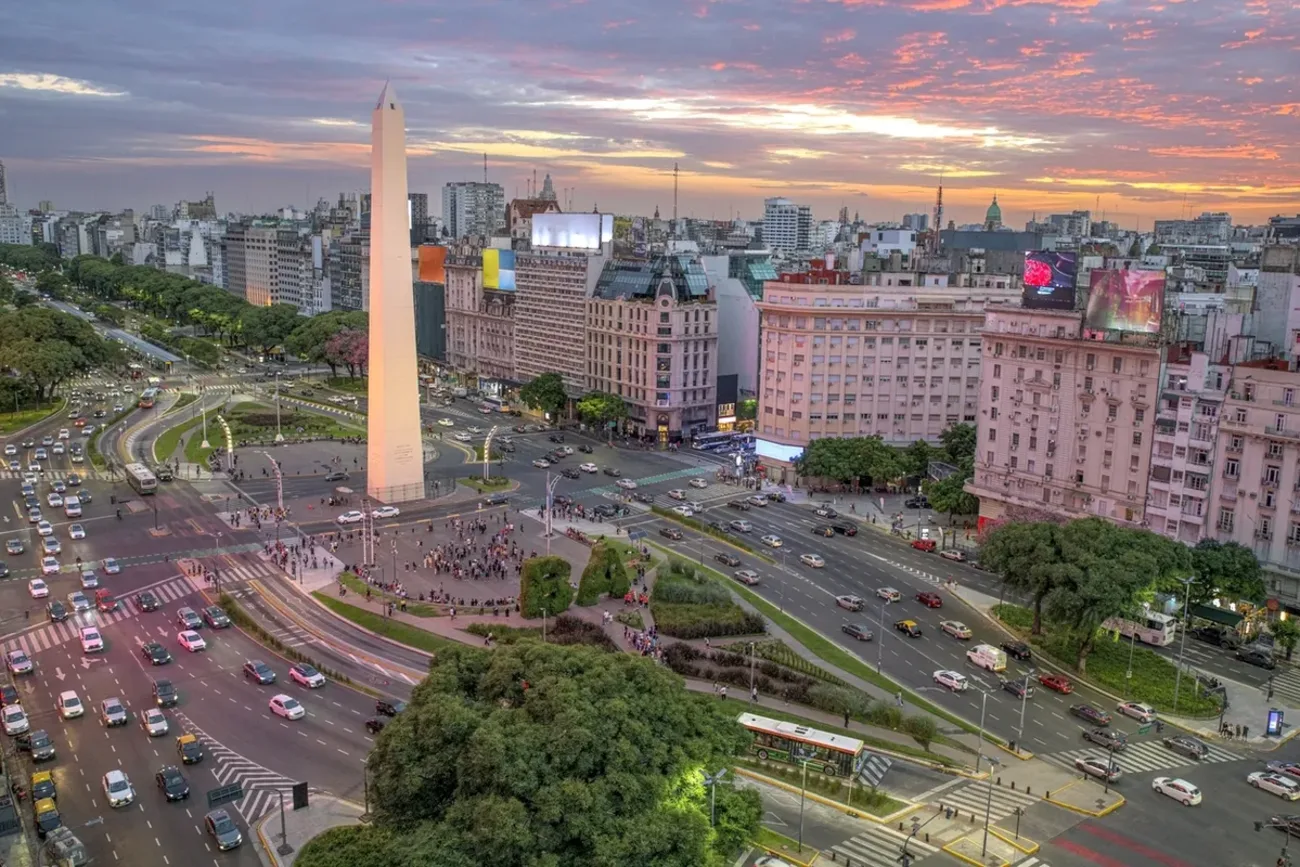
Iconic Landmarks
Casa Rosada: The Pink Presidential Palace
Few government buildings carry as much political weight as the rose-colored palace anchoring the eastern end of Plaza de Mayo. The site predates Argentine independence entirely — Spanish governors and viceroys administered the colony from this precise location before 1816. President Bartolomé Mitre reoccupied the structure in 1862, cementing its role as the seat of executive power, and his successor Domingo Faustino Sarmiento ordered the façade painted pink, a choice that has endured ever since.
The balcony is the building's most charged space — the very platform from which Juan and Evita Perón addressed enormous crowds during the late 1940s and early 1950s. Visitors can access it today, free of charge, on Saturdays through guided tours that require reservation via the official website. A valid photo ID, such as a passport, is mandatory for entry.
Around the back, the Casa Rosada Museum occupies the site of the original colonial fort. Its permanent collection traces Argentine history from the colonial period through to the present day. The museum runs Wednesday through Sunday, 10 am to 6 pm, with no admission fee.
The Obelisk and Plaza de la República
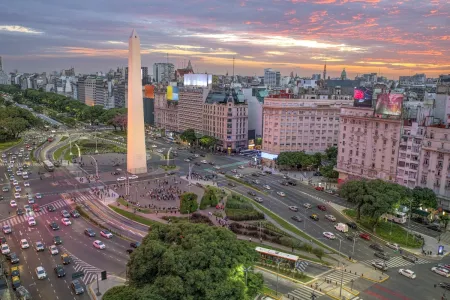
The numbers surrounding the Obelisk's construction remain genuinely remarkable: 157 workers, 680 cubic meters of reinforced concrete, and just 31 days to complete a structure that stands 67.5 meters tall. German company G.E.O.P.E. erected the monument at the intersection of Avenida 9 de Julio and Avenida Corrientes in 1936 to commemorate the quadricentennial of the city's first foundation.
Seven landings interrupt the interior staircase, which climbs 206 steps before reaching four narrow windows at the summit. The ground beneath it holds additional historical significance — this is where Argentina's national flag was first raised in Buenos Aires.
Avenida 9 de Julio: The World's Widest Street
A single measurement defines this avenue above all else: roughly 140 meters across, including its side streets (110 meters for the main roadway), wide enough to span an entire city block within Buenos Aires' rigid checkerboard grid. The 3-kilometer stretch runs from Retiro in the north down to Constitución station in the south, cutting through the city with an authority that makes every other boulevard feel narrow by comparison.
The plans first appeared in 1888, yet decades of resistance from property owners and residents delayed construction until 1935. The inaugural section opened October 12, 1937, with the remainder of the avenue completed through the 1960s — a nearly century-long journey from drafting table to finished boulevard.
Teatro Colón: A House Built for Sound
National Geographic places Teatro Colón among the ten finest opera houses on earth, and the acoustic science supports the distinction. A survey of leading international opera directors ranked the house first for operatic acoustics and second globally for concert performance — a verdict that speaks to the precision of its design rather than mere institutional prestige.
Three architects shaped the building: Francesco Tamburini, Vittorio Meano, and Jules Dormal, who together produced an Italian-style structure furnished to match the finest European standards of the era. The theater's inaugural performance on May 25, 1908 — Verdi's Aida — came after twenty years of construction. Daily guided tours of 50 minutes run in Spanish, English, and Portuguese.
Recoleta Cemetery and Evita's Tomb
Próspero Catelin's 1822 design for Recoleta Cemetery functions less like a burial ground and more like a compressed city: shaded avenues, intersecting walkways, and vertical marble mausoleums stacked tightly together across 5.5 hectares. Of the 4,691 above-ground vaults contained within, 94 have been declared National Historical Monuments.
Eva Perón's story did not end with her death in 1952 — her body only arrived at Recoleta in 1976, twenty-four years later. The Duarte family mausoleum that holds her coffin is protected by a steel door manufactured by a company that ordinarily built bank vaults. The coffin itself rests five meters below ground, accessible only through two separate trapdoors. The cemetery admits visitors daily between 9 am and 5 pm; entry is free for Argentine residents, while foreign visitors pay an admission fee.
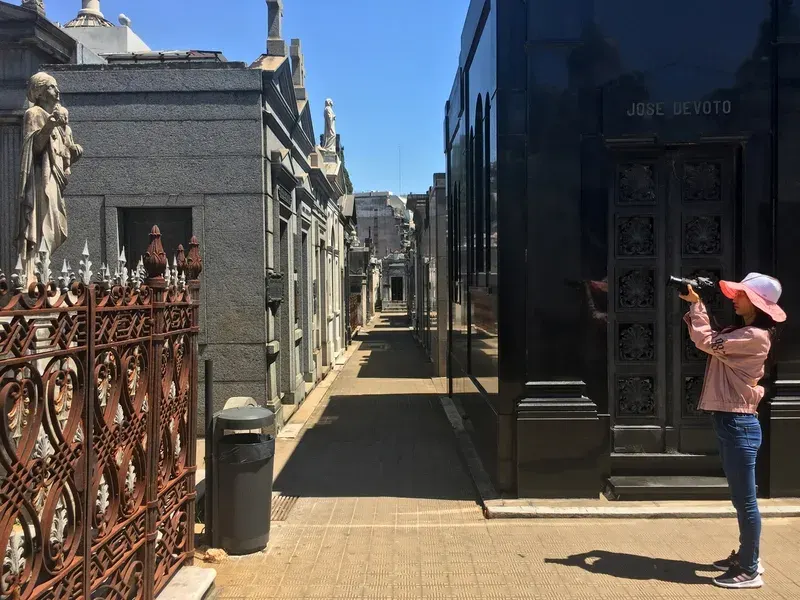
The essential landmarks include Casa Rosada (the pink presidential palace), the 67.5-meter-tall Obelisk at Plaza de la República, Teatro Colón (one of the world's top ten opera houses), and Recoleta Cemetery with its 4,691 ornate mausoleums. Don't miss walking along Avenida 9 de Julio, the world's widest street, at around 140 meters wide.
San Telmo offers cobblestone streets and Sunday antique markets, while La Boca features the colorful El Caminito street museum. Palermo Soho is perfect for boutique shopping and specialty coffee, Palermo Hollywood has the city's best dining scene, and Puerto Madero showcases modern waterfront development with elegant restaurants.
Watching a professional tango show at venues like Señor Tango or El Viejo Almacén is essential. Visit MALBA Museum for Latin American art, explore El Ateneo Grand Splendid (named the world's most beautiful bookstore), take tango lessons at a traditional milonga, and learn about Eva Perón at Museo Evita.
Try Argentine steak at traditional parrillas like Don Julio, visit Café Tortoni (the city's oldest café from 1858), sample choripán street food with chimichurri sauce, taste dulce de leche in alfajores cookies, and experience Buenos Aires' unique pizza culture with thick pizza al molde served with fainá.
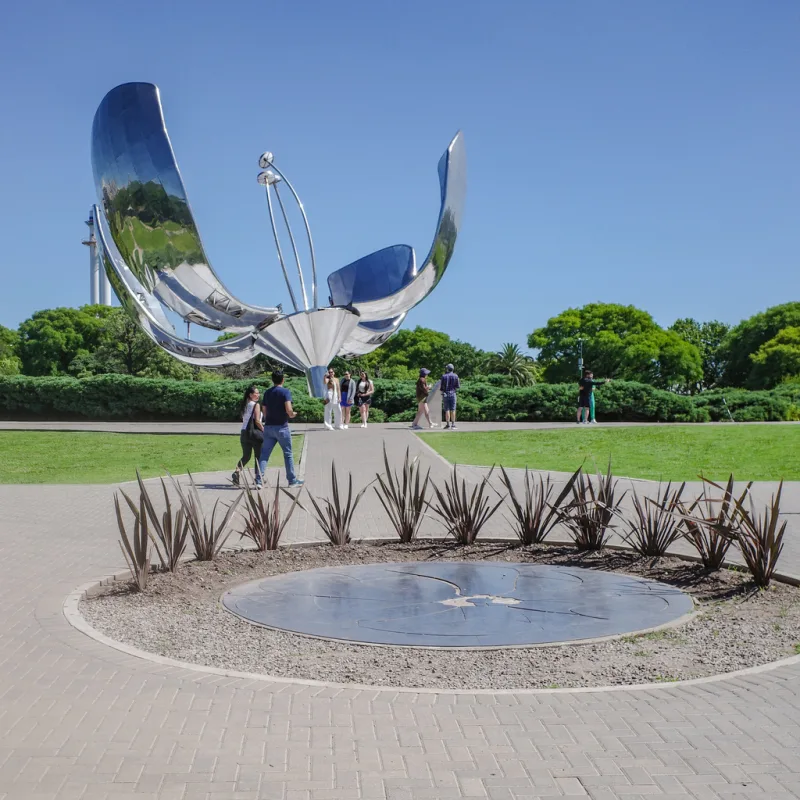
Explore the 400-hectare Bosques de Palermo with its rose garden and Japanese Gardens, browse the San Telmo Sunday Market with 270 vendor stands, see the 23-meter Floralis Genérica sculpture with petals that open and close daily, and visit the Costanera Sur Ecological Reserve with 340 bird species.
Neighborhoods Worth Exploring
San Telmo: Antiques and Sunday Markets
San Telmo holds the distinction of being Buenos Aires' oldest neighborhood, its colonial buildings and narrow cobblestone streets largely intact despite the city's relentless appetite for reinvention. The indoor San Telmo Market, which opened in February 1897 to serve the waves of European immigrants then settling in the city, remains a working landmark rather than a relic. Italian architect Juan Antonio Buschiazzo gave the structure its defining character: metal columns and beams, sheet metal and glass roofing, and a sweeping central dome that floods the interior with diffused light.
Sundays belong entirely to the Feria de San Telmo. Since 1970, the market has claimed Calle Defensa and Plaza Dorrego, every Sunday from 10 am to 5 pm, with around 270 stalls drawing upwards of 10,000 visitors — a figure that speaks to the fair's enduring pull. Antique dealers, street performers, and curiosity hunters fill the surrounding streets, including Pasaje San Lorenzo, where, at Nº 380, Casa Mínima stands as the city’s narrowest house: a mere 2.5 meters wide, built in the early 19th century.
La Boca and El Caminito's Colorful Streets
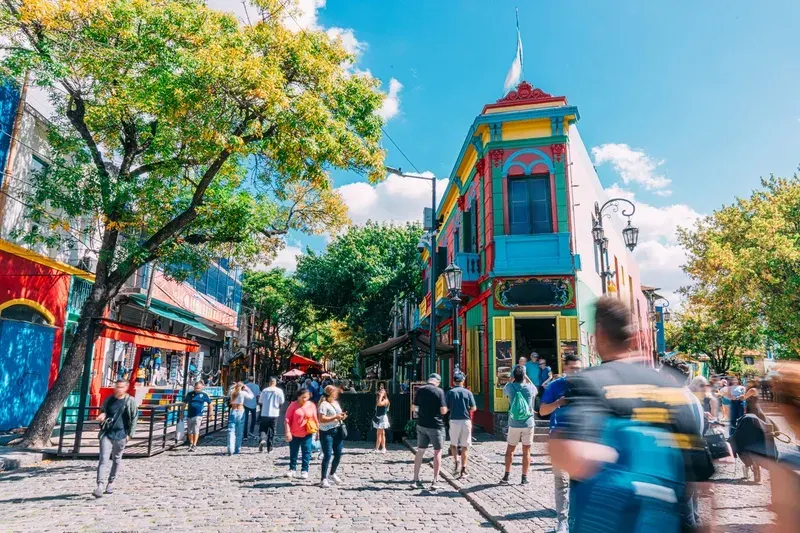
The story of El Caminito is, at its core, a story of resourcefulness. Shipyard workers in La Boca built their homes from leftover dockyard materials — sheet metal, timber offcuts — and painted them with surplus ship paint, mixing whatever colors remained since no single shade was available in sufficient quantity. The result was a 150-meter pedestrian street of clashing, jubilant color that functions today as an open-air museum. Artist Benito Quinquela Martín formalized this aesthetic in the 1950s, repainting the facades in vivid tones and erecting a makeshift performance stage that drew tango dancers to the street.
The route itself follows the path of an old stream that once fed into the Riachuelo River, later absorbed into a rail corridor that ceased operations in 1928. That closed railway became the canvas. Today, tango performers dance between market stalls selling handicrafts and souvenirs — though prices here run notably higher than elsewhere in the city.
Palermo Soho and Palermo Hollywood
Palermo divides neatly into two distinct personalities. Palermo Soho anchors itself around Plaza Serrano, bounded by Honduras, El Salvador, and Gurruchaga streets, where independent Argentine designers occupy boutique storefronts and weekend markets fill the square from midday well into evening. Handmade jewelry, leather goods, and vintage pieces change hands across its stalls while, within ten blocks in any direction, the highest concentration of specialty coffee shops in Buenos Aires serves a clientele that takes its café culture seriously.
Palermo Hollywood, by contrast, owes its name to the television and radio studios that moved into the area during the 1990s. The creative industry traffic shaped its hospitality scene accordingly: roughly 20 square blocks now contain the city's densest collection of restaurants and bars, ranging from traditional wood-fired parrillas to Asian fusion kitchens.
Puerto Madero's Waterfront District
Puerto Madero's transformation during the 1990s stands as one of the more dramatic urban reversals in South American history. Derelict port warehouses along the Río de la Plata received an influx of local and foreign capital, emerging as a district of restaurants, offices, and residences with property values that now exceed those of the city's second-most expensive neighborhood by a factor of two. The sixteen original red brick warehouses, built at the turn of the 20th century, survive in this new configuration, repurposed into restaurants, luxury offices, and a private university.
Spanish architect Santiago Calatrava contributed the Puente de la Mujer — a pedestrian bridge engineered to rotate 90 degrees on its axis, clearing the waterway for passing vessels. Every street in the district carries a woman's name, a distinction that sets Puerto Madero apart from every other barrio in the capital.
Recoleta's Elegant Architecture
The 1871 yellow fever epidemic reshaped Buenos Aires more decisively than any city planning decree. As the disease swept through the southern parishes, the city's wealthy families fled northward, resettling in Recoleta and proceeding to rebuild their social world there in French limestone and wrought iron. The neighborhood's character was codified by Mayor Torcuato de Alvear's 1885 master plan, which embraced French-inspired architecture, with many buildings designed by French architects and built with imported European materials — an approach that accounts for the uncanny coherence of the streetscape. Alvear Avenue concentrates the most distinguished examples: Palacio Duhau, the Apostolic Nunciature, and the former Ortiz Basualdo Palace, now home to the French Embassy. The neighborhood's "Le Petit Paris" reputation was never merely aspirational — it was, quite literally, built to specification.
Cultural Experiences in Buenos Aires
Watch a Professional Tango Show
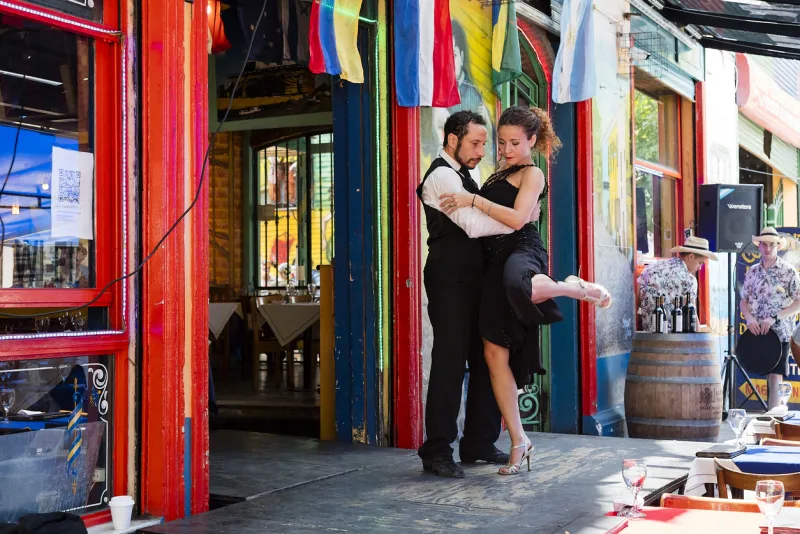
Tango in Buenos Aires exists on a spectrum — from grand theatrical spectacle to something far more private and unpolished. Señor Tango anchors the theatrical end of that spectrum. The largest show venue in the city, it holds up to 1,500 guests across three levels of vaulted ceilings and red quebracho wood floors, with a circular rotating stage engineered so that no seat offers a poor sightline. More than 40 performers trace tango's arc from its origins to its contemporary forms. Dinner service begins at 7:30 PM, with the show following at 9:00 PM.
El Viejo Almacén in San Telmo offers something considerably more contained. The dark wood interior places the stage just steps from viewers, creating a closeness that larger venues cannot replicate. Entry runs USD 70–90 for the show alone, while dinner packages reach USD 120–150 per person. The most economical professional option sits beneath Café Tortoni itself — one-hour performances run at 6 PM and 8 PM for USD 25–35 in the café's underground room.
Visit MALBA Museum
Eduardo F. Costantini founded MALBA in 2001 with 223 works drawn from his personal collection — pieces by Frida Kahlo, Diego Rivera, and Antonio Berni among them. That founding donation anchored a collection that has since grown dramatically — including the 2025 acquisition of the 1,233-work Daros Latinamerica Collection — placing MALBA among the world's most significant repositories of Latin American art. More than a million visitors pass through its doors each year.
The museum occupies Figueroa Alcorta Avenue in Palermo, served by buses 10, 37, 67, 102, 124, and 130. Hours run Wednesday through Monday, noon to 8 PM, with Wednesday opening at 11 AM — and admission on Wednesdays carries a reduced rate.
El Ateneo Grand Splendid Bookstore
The building on Santa Fe Avenue began its life in 1919 as Teatro Gran Splendid, where Carlos Gardel and the tango legends of his generation performed beneath a frescoed ceiling painted by Italian artist Nazareno Orlandi. Architects Peró and Torres Armengol furnished the interior with gilded balconies and marble columns — architectural decisions made for a theater, not a bookstore, which is precisely what makes the space so arresting today. The conversion happened in 2000, and National Geographic declared it the world's most beautiful bookstore in 2019.
The former stage now operates as a café. The surrounding floors hold approximately 120,000 books. That the venue sold over 700,000 books in a single year — 2007 — while simultaneously drawing more than a million visitors annually, suggests that most visitors come as much to stand inside the building as to browse its shelves.
Tango Lessons at a Milonga
A milonga bears no resemblance to a ticketed tango show. These are social dance gatherings where porteños practice, not perform — and the distinctions between the two run deep. Entry costs USD 5–10, and most venues run introductory classes before the social dancing begins. La Viruta in Palermo accepts dancers at every level. Confitería Ideal stages its milonga nights in an early 20th-century interior of marble columns and hanging chandeliers.
The codes governing a milonga are precise. Invitations happen through the cabeceo — a subtle nod of the head — and dancers circulate the floor in a specific direction. Certain venues enforce formal dress and require proper dance shoes. These are not arbitrary affectations; they are the accumulated conventions of a century-old social ritual.
Museo Evita
The building at Lafinur 2988 in Palermo held the Hogar de Tránsito #2 — a shelter for women and children acquired by the Eva Perón Foundation in 1948. On July 26, 2002, exactly fifty years after Eva Perón's death, it reopened as a museum dedicated to her life.
The collection draws its power from specificity. Alongside gala dresses by Christian Dior and Argentine designer Paco Jamandreu, the museum holds her personal documents and her national identity card — the first ever issued to a woman in Argentina. The museum opens Tuesday through Sunday, 11 AM to 7 PM, with a café and restaurant occupying the interior patio.
Customize Your Dream Vacation!
Get in touch with our local experts for an unforgettable journey.
Plan Your TripFood, Cafés, and Local Flavors
Argentine Steak at Traditional Parrillas
The parrilla — Argentina's traditional open-flame steakhouse — operates on a philosophy of deliberate restraint. Beef arrives seasoned with nothing beyond coarse salt before meeting the grill, and sides are ordered separately, as cuts stand alone on the menu. Don Julio, a Palermo institution, has collected some of the most distinguished accolades a restaurant can earn: best steakhouse in the world, best restaurant in Latin America, and a Michelin star. Its kitchen serves organic tomatoes and provoleta, a grilled provolone that caramelizes at the edges, alongside prime cuts of bife de chorizo (sirloin), ojo de bife (ribeye), and entraña (skirt steak). Fogon Asado takes a more theatrical approach — a nine-course tasting menu prepared entirely over open fire, served to a limited number of diners seated around the kitchen itself.
Café Tortoni: Historic Café Culture
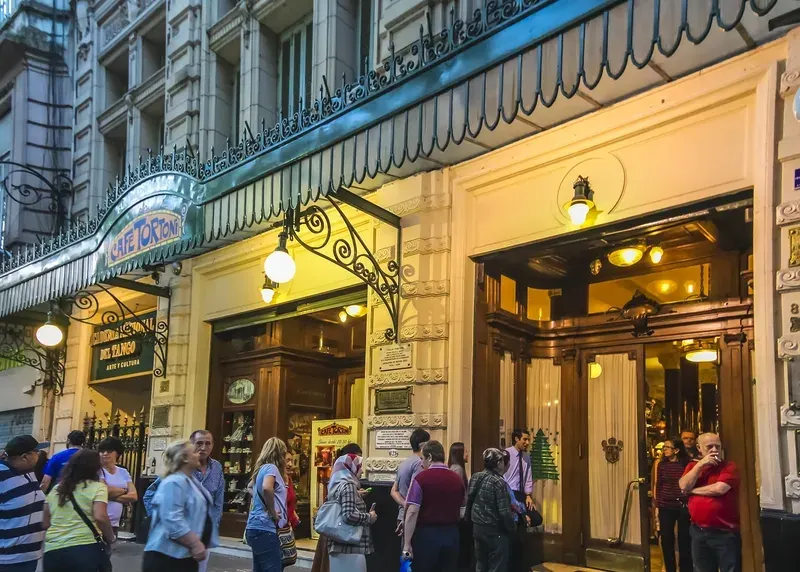
Café Tortoni has occupied 825 Avenida de Mayo since 1858, making it the oldest café in the city. Its name was borrowed from a Parisian establishment on Boulevard des Italiens — a fitting tribute, given that Buenos Aires spent much of the late 19th century consciously modeling itself on the French capital. Albert Einstein, Jorge Luis Borges, and Carlos Gardel all passed through its doors. The main floor retains its original character: marble surfaces, stained-glass windows, and Tiffany lighting that has changed little across more than a century and a half. The basement hosts jazz and tango performances most evenings. The café opens daily from 8 am to 9 pm.
Choripán and Street Food
Choripán — chorizo sausage split into a bread roll and dressed with chimichurri — functions as Argentina's unofficial street food, consumed at soccer grounds, concerts, and asados alike, typically as a prelude to the main meat. The numbers are difficult to ignore: Argentines eat approximately 500 million choripanes per year. The Costanera Sur area, beside the Ecological Reserve, concentrates some of the city's most reliable stands, where the sausages are grilled to order and served without ceremony.
Dulce de Leche and Alfajores
Dulce de leche — a thick, deeply caramelized cream produced by slowly reducing milk and sugar — appears across virtually every dessert in Buenos Aires. The alfajor puts it to perhaps its most recognizable use: two rounds of crumbling shortbread sandwiched around a generous filling, then typically coated in chocolate. Havanna and Cachafaz are the names most associated with the form, and both maintain shops across the city as well as airport outposts for last-minute purchases.
Buenos Aires Pizza Scene
Argentina holds a peculiar distinction among pizza-loving nations — the highest number of pizzerias per inhabitant in the world. Buenos Aires alone consumed an estimated 14 million pizzas in 2015. The local style, pizza al molde, bears little resemblance to its Italian ancestor: the dough rises to at least two centimeters, dense and spongy, topped with an abundant layer of cheese. Porteños eat it alongside fainá, a chickpea flour pancake that sits directly on top of the slice, and, unlike most of the world, approach the whole arrangement with a fork and knife.
Parks, Markets, and Off-the-Beaten-Path Spots
Bosques de Palermo and Japanese Gardens
President Nicolás Avellaneda inaugurated Parque Tres de Febrero in 1875 — a project championed by his predecessor, Domingo Faustino Sarmiento — bequeathing Buenos Aires a 400-hectare expanse of lakes, woodland, and cultivated gardens that still functions as the city's most generous green retreat. The Rosedal de Palermo alone contains more than 18,000 roses drawn from 93 distinct species, arranged across manicured beds that bloom with particular intensity through spring and early summer. Across the full park, some 12,000 trees — eucalyptus and native ombúes among them — shade the footpaths and the two lakes where pedalos drift on weekends.
Adjacent to the park, the Buenos Aires Japanese Gardens rank among the largest of their kind outside Japan. Crown Prince Akihito and Princess Michiko inaugurated the 2-hectare site during their official state visit in 1967, lending the gardens a ceremonial distinction that few public parks in the city can claim. The central lake connects across two traditional crossings — the Divine Bridge and the Truncated Bridge — with sakura, katsura, and azalea framing the water's edge through each season.
San Telmo Sunday Market
Each Sunday, 270 vendor stands fill Plaza Dorrego from 10 am to 5 pm, drawing upwards of 10,000 visitors to one of the most enduring street markets in the city. Antiques, silverware, vintage photographs, and Argentine folk crafts circulate through the stalls, making the Feria de San Telmo as much an exercise in social anthropology as it is in browsing.
Floralis Genérica Sculpture
Architect Eduardo Catalano conceived and built this 23-meter, 18-ton stainless steel and aluminum flower in 2002, donating it to the city and installing it at Plaza de las Naciones Unidas. Its six petals follow a precise daily rhythm — opening at 8am and folding shut at sunset — giving the sculpture a quality that feels almost biological rather than mechanical.
Costanera Sur Ecological Reserve
What makes the Costanera Sur Ecological Reserve particularly remarkable is its location: 350 hectares of wetland and grassland sitting directly alongside one of South America's most densely populated capitals. Declared a nature reserve in 1986, the site shelters up to 340 bird species alongside more than 2,000 species of flora and fauna — a biological density that few urban reserves anywhere in the world can match.
Conclusion
Buenos Aires does not reveal itself all at once. The city operates in layers — the grand civic monuments along Avenida 9 de Julio, the weathered cobblestones of San Telmo, the gilded balconies of a bookstore that was once a theater, the fortified vault five meters underground where Eva Perón finally rests. Each layer belongs to a different chapter of the same story, and the city makes no effort to reconcile them. That tension, between the European and the Argentine, the monumental and the intimate, the historic and the fiercely contemporary, is precisely what gives Buenos Aires its character.
The landmarks and institutions covered here offer a starting point, not a complete account. A milonga on a Wednesday night, a choripán eaten standing at a Costanera Sur food stand, a slow walk through Recoleta's marble avenues at dusk — these moments sit outside any guide yet belong entirely to the city. Buenos Aires has been accumulating history, architecture, and cultural obsession for centuries. The most a visitor can do is pay attention.
What makes Buenos Aires the “Paris of South America”? Discover why as you walk the world’s widest avenue, explore the colorful Caminito, catch a midnight milonga, and uncover the city’s best-kept secrets.
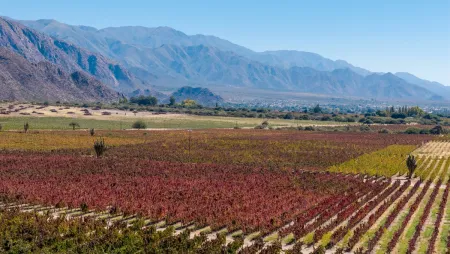
Cafayate is famous for its wine, but the real magic lies beyond the vineyards. Watch sunrise paint the sand dunes pink and gold, hike through red canyons to hidden waterfalls, and wander colonial villages where time stands still. This guide shows you the side of Cafayate most visitors never see.