 Home
Home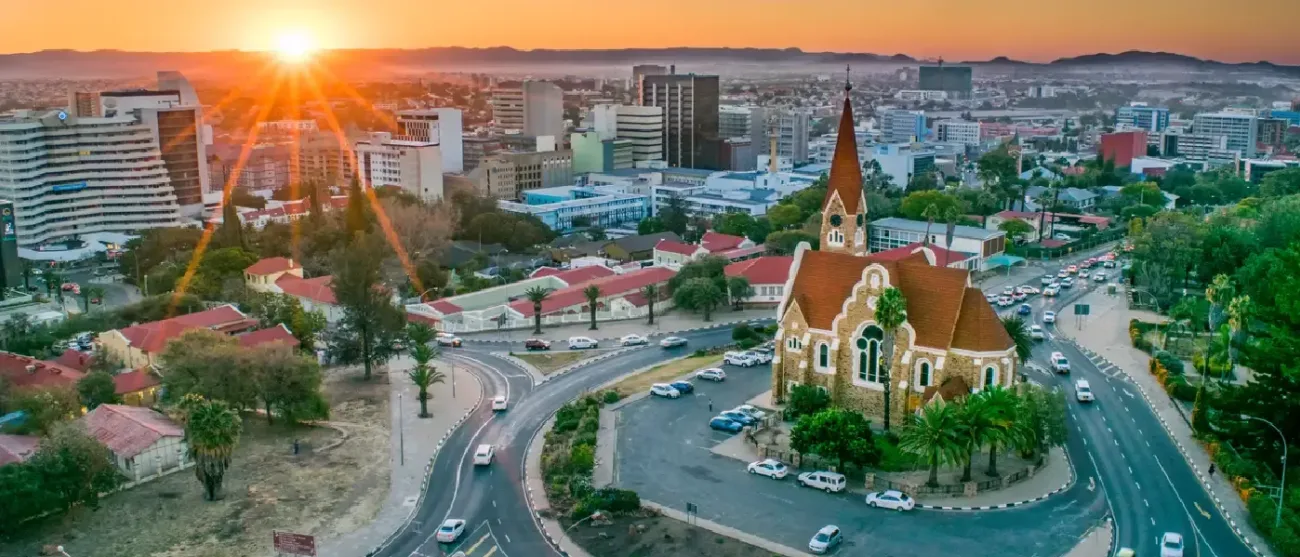
Perched at 1,650 metres above sea level in a bowl of rolling hills, Windhoek is one of Africa's most unexpected capitals. Namibia's largest city is compact, remarkably clean, and unusually easy to navigate, a place where Lutheran church spires stand beside glass office towers, and where the aroma of grilled kapana beef drifts through markets a short drive from fine-dining restaurants.
Home to roughly 537,000 residents and growing at over 3% a year, Windhoek is Namibia's political, economic and cultural centre. It sits almost exactly in the geographic middle of the country, sheltered by the Eros Mountains to the north and the Auas Mountains to the south, a natural amphitheatre that moderates the desert heat and shields the city from the harshest winds.
For most travellers, Windhoek is also the gateway. Nearly every Namibian safari, self-drive road trip or desert expedition begins here, which makes understanding the city worth far more than a rushed airport transfer.
History of Windhoek: From Hot Springs to National Capital
Ancient Origins
Long before European settlement, the San people inhabited the surrounding highlands. The area was known as Aigams, "hot water" in Khoekhoegowab, and Otjomuise, "place of steam" in Otjiherero. Both refer to the hot springs that made this valley a vital watering point in a punishing landscape. Water, not politics, is why a city exists here at all.
The Orlam and Early Settlement
Around 1840, Orlam leader Jonker Afrikaner established a settlement at the springs, building a stone church large enough for 500 worshippers that doubled as a school. The town grew quickly, then collapsed just as fast. Escalating conflict between the Nama and Herero peoples devastated the settlement, and by 1873 almost nothing of it remained.
German Colonial Era (1890–1915)
In 1884, the territory became German South West Africa. In 1890, Major Curt von François formally refounded Windhoek and began building the Alte Feste (Old Fortress), which still stands today. The name “Windhoek” is commonly believed to mean “windy corner” in Afrikaans, though some historians link it to the Winterhoek mountains in South Africa.
This era shaped Windhoek’s architecture, including Christuskirche, the three hillside castles, Heinitzburg, Sanderburg, and Schwerinsburg, and the Tintenpalast (“Ink Palace”).
South African Rule and Independence
South African forces occupied Windhoek in 1915, beginning 75 years of administration under which apartheid laws were imposed. Namibia gained independence on 21 March 1990, transforming Windhoek into the capital of a sovereign nation. Infrastructure developed, suburbs expanded, and the city took on its modern character. The Independence Memorial Museum, opened in 2014, traces Namibia’s history from pre-colonial times through the liberation struggle.
Top Attractions in Windhoek
Historic Landmarks
- Christuskirche (Christ Church): Windhoek's most photographed landmark. Consecrated in 1910, this neo-Gothic and Art Nouveau Lutheran church was built from local sandstone and glows amber at sunrise and sunset.
- Independence Memorial Museum: A striking modern building with multi-floor exhibits on colonialism, resistance and the liberation struggle. The rooftop restaurant offers the best panoramic view in the city.
- Alte Feste: The 1890 German fortress and Windhoek's oldest surviving building.
- Tintenpalast & Parliament Gardens: Namibia's seat of government, surrounded by manicured public gardens filled with bougainvillea and jacaranda.
- Heinitzburg Castle: A hilltop castle built in 1914, now a boutique hotel with sweeping views over the valley.
Customize Your Dream Vacation!
Get in touch with our local experts for an unforgettable journey.
Plan Your TripCulture, Markets & Neighbourhoods
- Post Street Mall: A pedestrian shopping street hosting the Gibeon Meteorite Exhibition, a display of 33 meteorite fragments over four billion years old, recovered from southern Namibia.
- Namibia Craft Centre: The best single stop for authentic crafts: Herero dolls, San jewellery, Kavango woodcarving and Karakul wool textiles.
- National Art Gallery of Namibia: Contemporary and historical Namibian art in a purpose-built downtown space.
- Katutura: Visit Single Quarters Market to try kapana, Namibia's flame-grilled street beef. Choose an operator that employs and reinvests in local residents.
- Klein Windhoek & Am Weinberg: Leafy, upmarket districts with wine bars, boutique hotels and the city's best restaurants.
- Penduka: A women's craft cooperative on Goreangab Dam supporting artisans with disabilities.
Nature & Wildlife Near the City
- Daan Viljoen Game Reserve (24 km west): Walk unguided among zebra, oryx, kudu and giraffe, with 200+ bird species and marked hiking trails.
- National Botanical Garden: Namibia's endemic desert flora, including the extraordinary welwitschia.
- Avis Dam & Hofmeyer Walk: Popular local hiking and birding routes right at the city edge.
- N/a'an ku sê Wildlife Sanctuary: Conservation-focused sanctuary caring for rescued carnivores and primates.
Best Time to Visit Windhoek
Windhoek enjoys a hot semi-arid climate with over 300 sunny days a year and consistently low humidity.
| Season | Months | Weather | Best For |
|---|---|---|---|
| Dry / Winter | May – October | 20–25°C days, 5–10°C nights | Safari, hiking, sightseeing |
| Shoulder | April & November | Mostly dry | Fewer crowds, greener landscapes |
| Wet / Summer | December – March | 30–35°C days, afternoon storms | Birdwatching, lush scenery, lower rates |
May to October is the best time to visit Windhoek and Namibia overall. Skies are cloudless, gravel roads are reliable, mosquito risk is minimal, and wildlife concentrates around waterholes if you are continuing north to Etosha. Pack genuine layers, the altitude means winter nights can drop close to freezing even when days are pleasantly mild.
Key events: Independence Day (21 March), Windhoek Karneval/WIKA (April), and Windhoek Oktoberfest (October).
May to October, during the cool, dry winter season. Days are sunny and mild, and conditions are ideal for onward safari travel.
Food, Drink & Nightlife in Windhoek
- Namibian cuisine is a genuine fusion of German, South African and indigenous traditions, and Windhoek is where all three meet most visibly.
- Kapana: Grilled beef strips served with chilli-peanut spice at Single Quarters. The city's essential food experience.
- Game meat: Oryx, kudu, springbok and zebra fillets appear on most menus, usually sourced from sustainable farms.
- Joe's Beerhouse: The city's most famous restaurant; quirky, loud, packed with travellers and consistently good.
- Am Weinberg & Klein Windhoek: Upmarket dining, wine bars, rooftop lounges and the strongest café culture in Namibia.
- Windhoek Lager: Brewed to the German Reinheitsgebot purity law since 1920 and a genuine national icon.
- Craft coffee and bakeries: German-style brötchen, apple strudel and a growing specialty roasting scene.
Nightlife is relaxed rather than frenetic: live music around Independence Avenue, rooftop sundowners, and a strong weekend braai culture.
Economy & City Life
Windhoek generates a large share of Namibia's GDP and headquarters the country's mining, finance, fishing and tourism sectors. Uranium, diamonds and Karakul pelts underpin much of the national economy, while the city has built a growing retail and services base around malls such as Maerua and The Grove.
The population is strikingly diverse: Ovambo, Herero, Damara, Nama, San, Kavango, Basters and German- and Afrikaans-speaking Namibians all live here. That mix shows up in the languages heard on Independence Avenue and in Herero women's Victorian-era dresses.
Rapid rural-to-urban migration is the defining pressure of the moment, driving informal settlement growth on the northern fringes and shaping national debate on housing and water security.
Kapana (grilled street beef), game meats like oryx and kudu, German-influenced baked goods, and Windhoek Lager.
Practical Travel Information
- Airport: Hosea Kutako International Airport (WDH), 45 km east of the city, about 45 minutes by road. Eros Airport handles domestic and charter flights.
- Currency: Namibian Dollar (NAD), pegged 1:1 to the South African Rand, ZAR is accepted everywhere, though NAD is not accepted in South Africa.
- Language: English is the sole official language; Afrikaans, German, Oshiwambo, Otjiherero and Khoekhoegowab are widely spoken.
- Getting around: Renting a car is strongly recommended, especially for onward travel. Shared taxis are inexpensive; ride-hailing apps operate within the city.
- Safety: The city centre is safe by day. Avoid walking alone after dark, keep valuables out of sight, and use hotel-arranged transport at night.
- Health: Windhoek is malaria-free. Northern Namibia requires prophylaxis, consult your doctor.
- Time zone: GMT+2 (CAT). Driving: on the left.
Windhoek as a Gateway
| Destination | Distance | Drive Time |
|
Swakopmund |
~360 km |
4 hours |
| Sossusvlei | ~350 km | 5 hours |
|
Etosha National Park |
~450 km |
5 hours |
|
Fish River Canyon |
~750 km |
8 hours |
Most travellers spend 2–3 days in Windhoek before heading out, enough to see the city, recover from a long flight, stock up and collect a rental vehicle. Book 4×4 hire well ahead in peak season.
About 450 km, roughly a 5-hour drive north on good tarred roads.
Ready to explore the capital of Namibia? From the spires of Christuskirche to the waterholes of Etosha, Windhoek is where your Namibian story begins. Browse our Namibia safari tours and Windhoek city tours today.
FAQS
Yes. While compact, Windhoek offers rich colonial and liberation history, excellent restaurants, quality craft shopping and wildlife reserves within 30 minutes of downtown. It is also the essential launch point for any Namibia tour.
Two to three days covers the main attractions comfortably. Add a day if you want a township tour or a wildlife sanctuary visit.
Generally yes, it is one of Africa's safer capitals. Use standard urban precautions: avoid walking alone at night, don't display valuables, and use trusted transport after dark.
Many nationalities can obtain a visa on arrival or apply through Namibia's e-visa system. Requirements change, always verify with the nearest Namibian embassy before travelling.
The city centre is very walkable, with Christuskirche, Alte Feste, Tintenpalast and Post Street Mall all within a few blocks. Outer suburbs require a vehicle.
English is the official language and widely spoken, alongside Afrikaans, German, Oshiwambo, Otjiherero and Khoekhoegowab.