
 Home
Home
The Valley Temple of Khafre is one of the most impressive and best-preserved Ancient Egyptian temples, standing proudly on the Giza Plateau beside the legendary Great Sphinx. Blending extraordinary craftsmanship with deep spiritual symbolism, this temple offers visitors a rare opportunity to step inside a structure that has remained almost intact for over 4,500 years.
As part of Khafre’s grand funerary complex—alongside his pyramid, mortuary temple, causeway, and the Sphinx—this remarkable site continues to be a major highlight for travelers exploring Cairo attractions or anyone seeking a closer look at ancient Egyptian engineering, ritual practices, and cosmic design.
What Is the Valley Temple of Khafre?
The Valley Temple of Khafre, often called the Giza Valley Temple or Khafre Temple, dates back to around 2570 BCE during Egypt’s 4th Dynasty. The temple once served as the starting point for the pharaoh’s journey into the afterlife, acting as a ceremonial gateway where key rituals were performed before the king’s body was transported to the pyramid for final burial.
What makes this temple extraordinary is not only its religious significance but also how exceptionally well it has survived. Built with massive limestone blocks and clad in polished granite, the Valley Temple remains one of the most intact structures in all of ancient Egypt.
Where Is the Valley Temple of Khafre Located?
The temple sits on the eastern side of the Giza Plateau, just a few steps away from the Great Sphinx and connected directly to the Pyramid of Khafre by a long, covered causeway.
Location within the Giza Pyramid Complex
- The Valley Temple marks the lowest point of Khafre’s funerary complex.
- It links directly to the Mortuary Temple near the pyramid via a paved causeway.
- The site is roughly 30 minutes from Downtown Cairo, making it easy to reach for local and international visitors.
Connection to the Great Sphinx
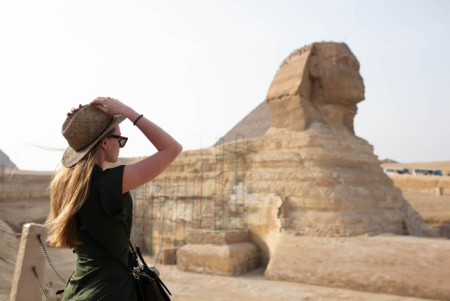
One of the most fascinating features of the Valley Temple is its tight connection to the Great Sphinx. Only a few meters separate the two structures, and both align with the same ceremonial causeway.
The Sphinx’s position—gazing east toward the rising sun—mirrors the temple’s cosmic orientation, hinting at a shared spiritual purpose.
Connection to the Ancient Nile
In ancient times, the Nile’s floodwaters reached the base of the Valley Temple.
This allowed boats to transport the pharaoh’s body from Memphis directly to the temple for purification rituals, making the site both symbolically and practically essential.
Why This Site Was Chosen
Khafre’s architects selected this location with precision:
- Easy access via the Nile for royal funerary processions
- Perfect alignment with the Sphinx, the sun, and celestial bodies
- A limestone hill remaining from quarrying works provided the base for sculpting the Sphinx itself
The result was a unified architectural and spiritual landscape unlike any other.
Why the Valley Temple of Khafre Was Built
As with many Ancient Egyptian temples, the Valley Temple served both practical and sacred functions. It was the pharaoh’s gateway into eternity.
Role in the Funerary Process
The temple was the first station in Khafre’s funerary journey. Upon arrival:
- Priests welcomed the body and began preliminary embalming.
- Purification rituals used oils, incense, and resins believed to hold spiritual power.
- Rituals prepared the king for his transformation into a divine being.
From here, the body traveled along the causeway to the Mortuary Temple beside the pyramid.
The “Opening of the Mouth” Ceremony
One of the most important rituals performed in the Valley Temple Giza was the Opening of the Mouth.
This ceremony restored the senses of the deceased pharaoh—sight, speech, breath—ensuring he could function in the afterlife.
Priests used specialized tools, symbolic incantations, and precise gestures to “awaken” the king spiritually.
Beliefs About the Afterlife
Ancient Egyptians believed the soul required:
- Purification
- Reanimation
- Guidance to pass safely through the underworld (duat)
The Valley Temple was designed to support this spiritual transformation and symbolize the pharaoh’s rising again with the sun god Ra.
Customize Your Dream Vacation!
Get in touch with our local experts for an unforgettable journey.
Plan Your Trip
Inside the Valley Temple: Architecture and Design
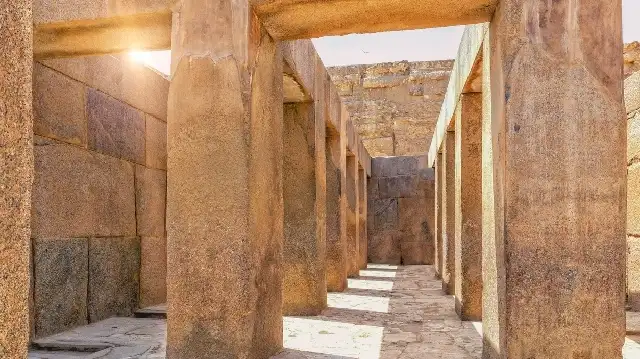
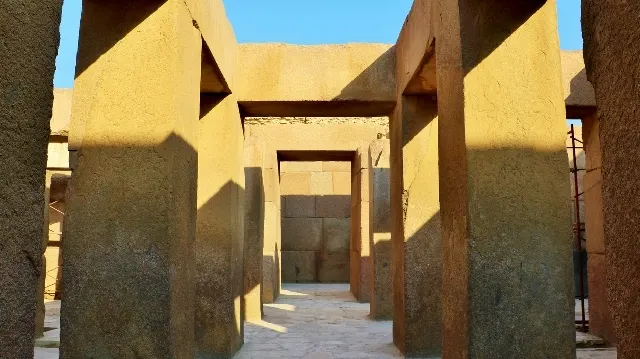
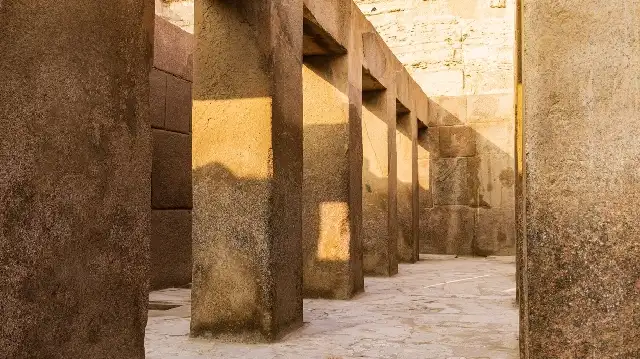
Visitors today are often amazed by how incredibly preserved the interiors are. The design reflects the highest level of Old Kingdom engineering.
T-Shaped Main Hall
The temple’s main hall forms a distinctive T-shape, a signature element of Khafre’s design.
Here, visitors will find:
- 16 massive red granite pillars
- An alabaster floor that once reflected torchlight
- A central area where purification rituals were performed
The space is both solemn and majestic, offering a quiet atmosphere that contrasts with the open desert outside.
Materials Used
The Valley Temple showcases the Egyptians’ mastery of stonework:
- Core structure: white limestone
- Interior walls: polished pink Aswan granite
- Floor: smooth alabaster
- Exterior facade: fine Tura limestone
Blocks weighing over 100 tons were fitted with such precision that even today, the joints between stones are barely visible.
Statues of Khafre
The temple originally held 23 statues of King Khafre, carved from diorite, granite, and alabaster.
These statues stood in niches along the walls, illuminated by natural light.
Only one statue survives today—the famous diorite statue of Khafre with Horus behind his head—now displayed in the Egyptian Museum in Cairo.
Ancient Lighting System
One of the temple’s most fascinating innovations is its ancient “mood lighting” system:
Narrow slits between the walls and ceiling allowed sunlight to enter
- Beams of light highlighted the statues dramatically
- The effect created a sacred, glowing atmosphere inside the temple
This system shows a deep understanding of light, architecture, and spiritual symbolism.
Astronomical Alignment
Khafre’s temple is carefully aligned with celestial movements:
- Orientation toward the rising sun
- Corridors positioned to track astronomical events
- Symbolic connection to the daily rebirth of Ra
These elements reflect the Egyptians’ advanced knowledge of astronomy and its importance in royal rituals.
History and Rediscovery
Burial and Preservation
For millennia, the Valley Temple remained buried under layers of desert sand.
Ironically, this preserved it far better than many other ancient structures.
19th-Century Discovery
French Egyptologist Auguste Mariette rediscovered the temple in 1852.
His excavations revealed:
- The alabaster floor
- The enormous granite pillars
- The perfectly cut stonework
- The famous diorite statue of Khafre (found in 1858)
The discovery astonished the archaeological world and proved the exceptional preservation of Old Kingdom architecture.
Why the Valley Temple of Khafre Still Matters
The temple is more than stone and architecture—it is a living testament to Egyptian ingenuity.
Its significance lies in:
- Exceptional preservation
- Innovative engineering
- Cosmic alignment
- Deep spiritual symbolism
- Its key role in the pharaoh’s journey to eternity
More than 4,500 years later, it continues to inspire visitors and scholars alike.
What Visitors Can See Today
Today, the Valley Temple of Khafre remains one of the top Cairo attractions for history enthusiasts.
Visitors can explore:
- The original T-shaped hall
- Granite pillars and polished walls
- Niches where Khafre’s statues once stood
- Alabaster floors marked by statue bases
- A direct view of the Great Sphinx
The temple’s quiet interior provides a peaceful contrast to the bustling plateau outside.
Visitor Information
- Location: Eastern Giza Plateau, beside the Great Sphinx
- Included in: Giza Plateau general ticket
- Best time to visit: early morning or late afternoon
- Tips: comfortable shoes, water, sun protection, and—if possible—a guided tour for deeper insights
Most travelers combine the Valley Temple with visits to:
- Khafre’s Pyramid
- The Great Sphinx
- Khufu’s Pyramid
- The Sphinx Temple
Nearby Attractions
The Valley Temple of Khafre is situated in one of the world’s most renowned archaeological zones. Nearby highlights include:
- Great Sphinx of Giza – Standing just a few meters away
- Pyramid of Khafre – The second-largest pyramid in Egypt
- Pyramid of Khufu – The Great Pyramid, one of the Seven Wonders of the Ancient World
- Solar Boat Museum – Home to Khufu’s ancient funerary ship
- Giza Visitor Center – Offering exhibits, information, and panoramic views
- Local camel stables – Popular for scenic rides around the plateau
Many travelers also combine their visit with a Nile cruise departure from Cairo or an extended tour through Egypt’s other archaeological wonders.
The Valley Temple of Khafre stands as one of the most extraordinary and best-preserved examples of Ancient Egyptian temples. From its massive granite pillars and alabaster floors to its cosmic alignment and sophisticated lighting system, the temple offers a rare window into ancient engineering and spiritual beliefs.
For any traveler exploring Cairo attractions or seeking to understand the deeper meaning behind the Giza complex, the Valley Temple Giza is an unforgettable highlight—one that beautifully blends architectural precision with profound religious purpose.
Explore the Valley Temple of Khafre, one of Giza’s most perfectly preserved ancient temples, where rituals, granite pillars, and cosmic design tell the story of a pharaoh’s journey to eternity.
This is just one chapter of Egypt’s immense story—extend your experience with an Egypt tour and uncover the pyramids, the Sphinx, and countless other ancient sites.
The Valley Temple functioned as the ceremonial entry point for Khafre’s funerary rituals, where purification, embalming, and the Opening of the Mouth ceremony were performed before the king’s body was transported to his pyramid.
The Valley Temple is over 4,500 years old, dating back to Egypt’s 4th Dynasty around 2570 BCE.
The temple sits on the eastern side of the Giza Plateau, adjacent to the Great Sphinx and linked to the Pyramid of Khafre via an ancient causeway.
The site had direct access to the ancient Nile for funeral boats, a perfect alignment with the Sphinx and the rising sun, and a limestone base formed during quarrying.
Visitors can easily explore the Great Sphinx, Pyramid of Khafre, Great Pyramid of Khufu, Sphinx Temple, and the Giza Visitor Center, all within walking distance.
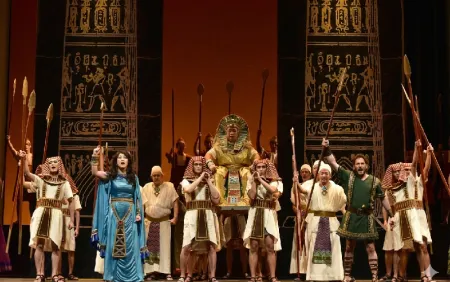
Opera Aida premiered in Cairo 1871, telling a timeless love story in ancient Egypt. Performed at Pyramids & temples, Verdi's masterpiece captivates audiences.
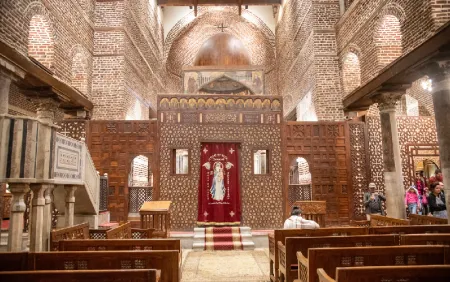
Saints Sergius and Bacchus Church were built to be dedicated to two Martyrs (Sergius and Bacchusand) traditionally believed to have been built on the spot where the Holy Family rested at the end of their journey into Egypt.
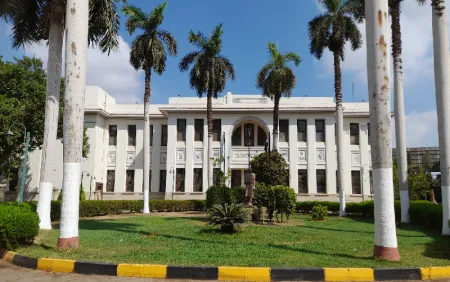
Cairo's Agricultural Museum, established 1938, features 7 halls showcasing 7,000 years of Egyptian farming history and ancient agricultural artifacts.
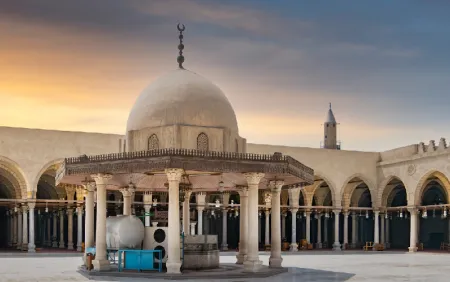
Fustat, founded 641 CE, was Egypt's first Islamic capital with 200,000 residents. This Silk Road trade hub beneath Old Cairo was deliberately destroyed in 1168.
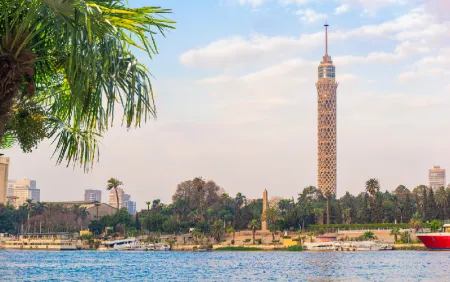
Cairo Tower's 187m lotus design offers 360° views & rotating restaurant. Discover hidden terrace & local secrets for Egypt's iconic landmark built 1956-1961.

Explore Birqash Camel Market in Cairo, where tradition and culture meet. Witness camel trading, local life, and a unique Egyptian market experience.

El Mosky is Cairo's authentic medieval marketplace from Ayyubid era. Serves locals with genuine prices, traditional crafts & spices. Metro accessible.
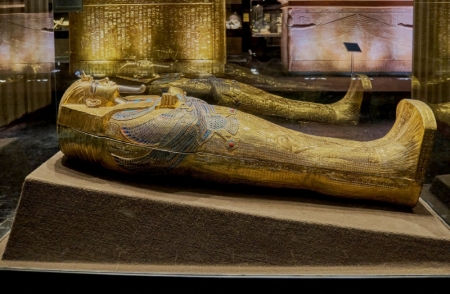
Learn about King Tutankhamun treasures and explore the secrets of his tomb, royal rituals, and preserved artifacts.
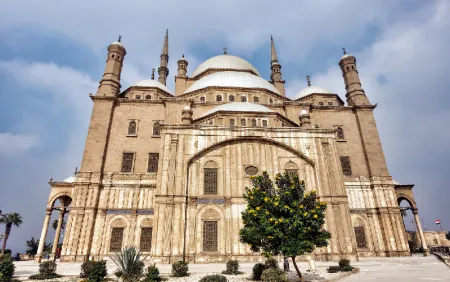
The Mohamed Ali Mosque is an Ottoman masterpiece built 1832-1857 inside Cairo Citadel. Called the Alabaster Mosque for its distinctive walls, it features a 52-meter central dome.
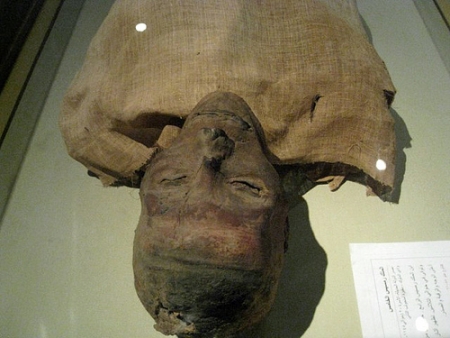
Egyptian mummies at Cairo's museums include 22 royal pharaohs moved in 2021 to NMEC. Features Tutankhamun, Hatshepsut, Seti I and 4,300-year-old preservation techniques.
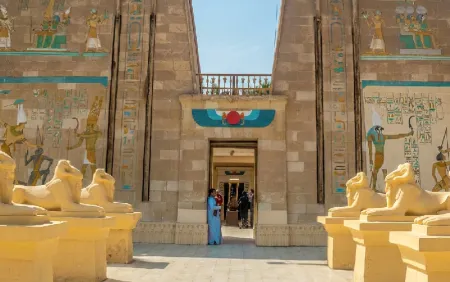
Pharaonic Village in Cairo, founded 1984, is a 30-acre living museum with 12 museums, King Tut's tomb replica & live ancient Egyptian demonstrations.
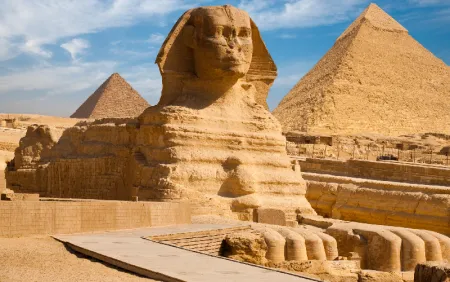
Great Sphinx of Giza, carved 2500 BCE, measures 73m long and 20m high. Contains three tunnels, hidden chambers & traces of red, blue & yellow paint.
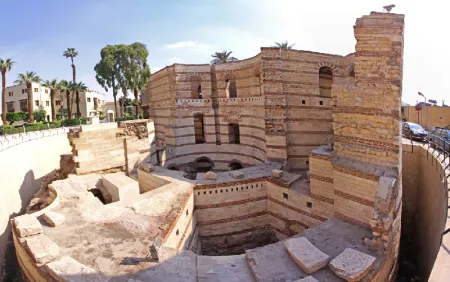
Babylon Fortress in Old Cairo, built 300 AD by Diocletian, features 10m Roman towers, Coptic churches, Ben Ezra Synagogue & museum with 16,000 artifacts.
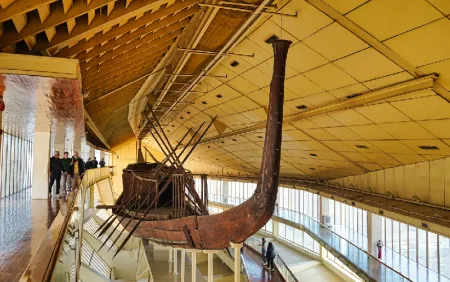
The Khufu Ship is a 4,600-year-old solar boat measuring 43.4 meters long. Built without nails using mortise-and-tenon joints, it's displayed at Grand Egyptian Museum.
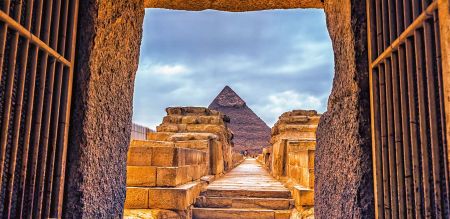
Experience the Valley Temple of Khafre like never before. Explore its purpose, design, and must-see highlights—read the full guide now!