 Home
HomeAmoura Dahabiya Nile Cruise
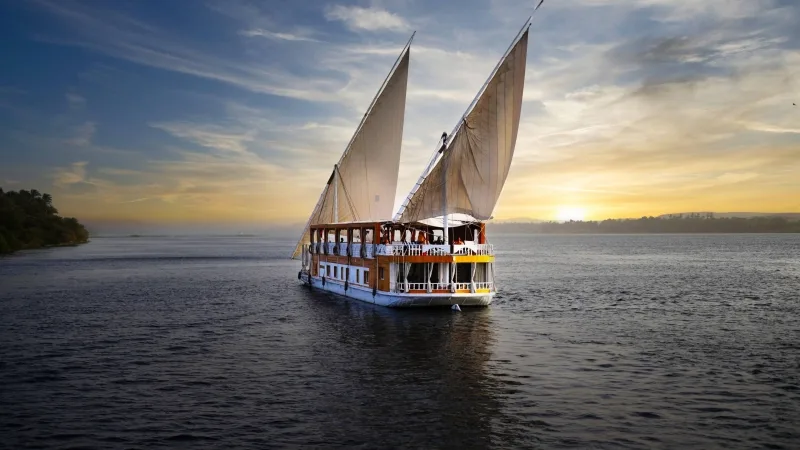
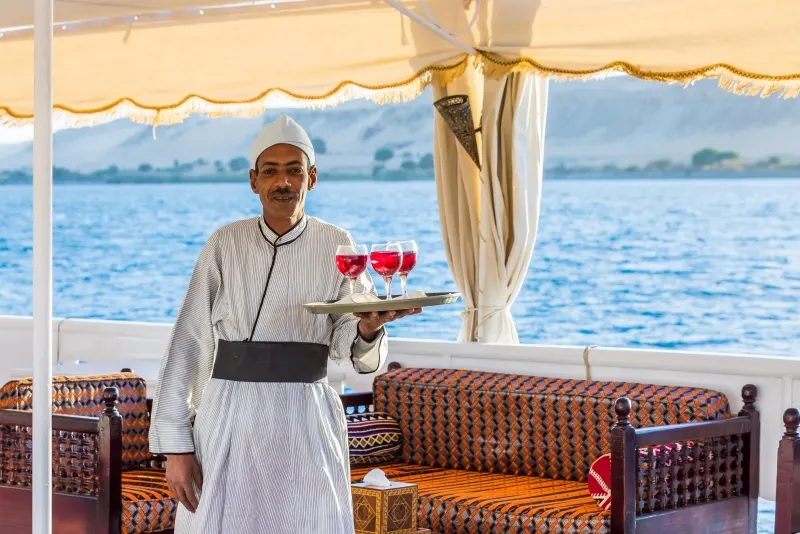
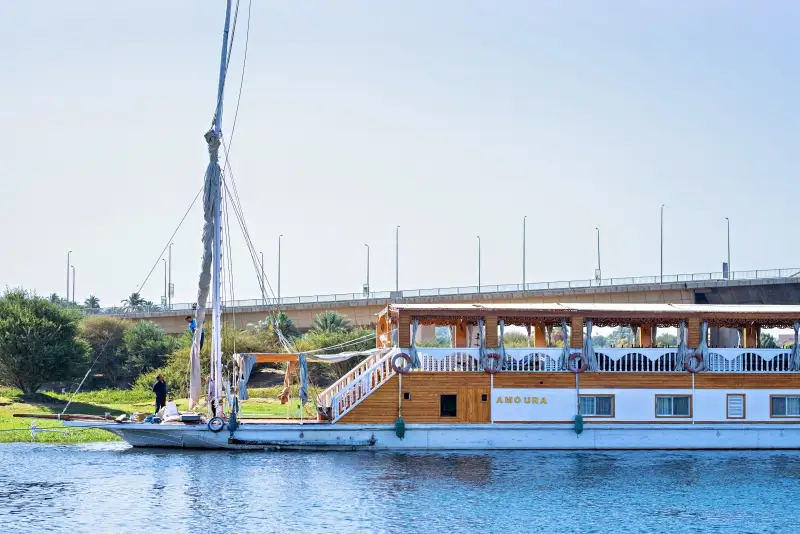


Most people who visit Egypt see the Nile from the bank. A smaller number see it from a cruise ship deck. A very few get to actually live on it — waking up moored to a quiet island, eating lunch while the current moves past, going ashore wherever the river offers something worth seeing. The Amoura is for that third group.
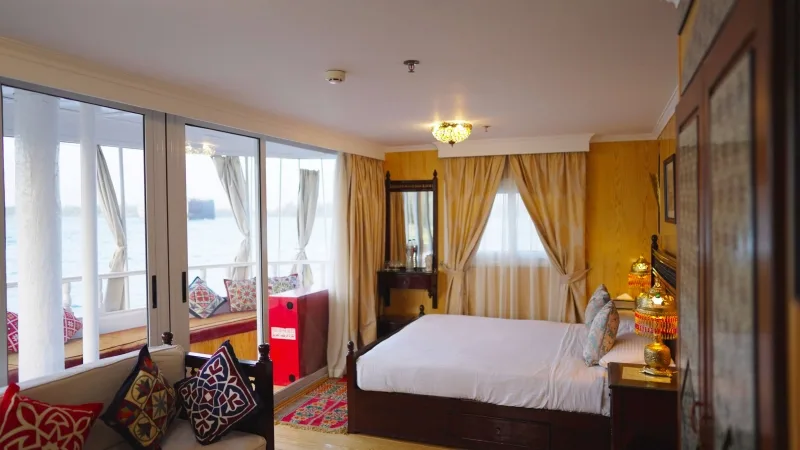
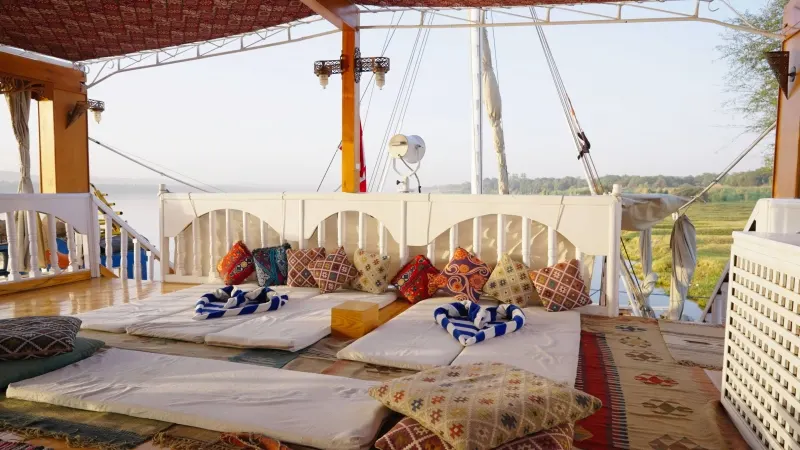
A luxurious river yacht carrying just 9 guests across 8 cabins and one private-terrace suite, the Amoura sails between Aswan and Esna on routes that stop at sandstone quarry temples, Nubian island villages, and riverside anchorages that motor cruise ships pass without slowing down. The cabins are generous at 13 square meters each, with large panoramic windows that frame the Nile like a painting. The sundeck is where most of the day happens — meals, tea, conversation, watching Egypt drift by at the pace the river sets.
What to Expect
- Vessel type: Luxury river yacht dahabiya with accompanying motorboat for calm-wind days
- Capacity: Maximum 9 guests — 8 cabins plus 1 private-terrace suite
- Guide: English-speaking Egyptologist on every excursion
- Meals: Full board throughout — all breakfasts, lunches, and dinners included
- Inclusions: All entrance fees and ground transfers covered
- Routes: 4-day Aswan to Esna / 4-day Esna to Aswan / 5-day round trips
- Departures: Every Friday from Aswan / Every Monday from Esna
On Board
- Cabins & Suite: 8 double cabins (approx. 13 sqm each) with twin or large bed and Egyptian cotton linen. 1 suite (approx. 21 sqm) with large bed and private terrace. All cabins and the suite feature large panoramic windows with unobstructed Nile views, private bath with shower and hairdryer, international telephone, safe box, satellite TV and DVD player, room service, and laundry service.
- Common Areas: Sun deck with oriental seating area, main lounge and dining area, water filter throughout, 24-hour electricity supply, 220V voltage.
- Services: Internet access, accompanying motorboat for windless days, room service, laundry service and housekeeping.
Frequently Asked Questions
What makes the Amoura different from other dahabiyas on the Memphis Tours website?
The Amoura is one of the most private dahabiya experiences available — a maximum of 9 guests on a vessel with 8 cabins and 1 suite means the boat never feels crowded. Where the Nuun and Nuut dahabiyas carry up to 12 guests and offer a slightly more social experience, the Amoura is better suited to travelers who want maximum space, quiet, and flexibility. It also sails on a fixed weekly schedule rather than selected dates, making it easier to fit into a planned itinerary.
What sites do you visit on the Amoura?
Depending on your chosen itinerary, sites include Kom Ombo Temple, Gebel el Silsila and the Temple of Horemheb, Edfu Temple, El Kab village and rock-cut tombs, Philae Temple, and the Unfinished Obelisk. Longer itineraries also include Fawaza Island, Beshir Island anchorages, and optional excursions to Abu Simbel and Luxor's West Bank.
How is the Amoura route different from a standard Nile cruise?
Standard motor cruises run between Aswan and Luxor and stop at the same four or five temples on every departure. The Amoura sails between Aswan and Esna on routes that include Gebel el Silsila, El Kab, and island anchorages that no motor cruise visits. The pace is different too — days on the Amoura are shaped by the river, not a printed schedule.
What is the best time of year to sail?
October through April is the most comfortable for sightseeing, with cooler temperatures and more reliable winds for sailing. May through September is hotter but quieter on the river. The Amoura sails year-round on its fixed weekly schedule.
Is the Amoura suitable for couples or solo travelers?
Yes — the single suite with a private terrace is particularly well suited to couples who want additional space and privacy. Solo travelers book individual cabins, and with a maximum of 9 guests on board the atmosphere is always intimate rather than social.
How do I secure my cabin?
A deposit of 50% secures your cabin and all included services. The remaining balance can be paid up to two days before arrival or in cash on arrival.
Ready to experience the Nile at its own pace? Send us your dates and we'll handle the rest.
→ Get My Free Quote
- Meet and assist service upon arrival & departure
- Assistance of our personal during your stay and excursions
- All transfers by a modern air-conditioned deluxe vehicle
- Accommodation on board 5 star Dahabiya on full board basis
- All Nile Cruise excursions as mentioned in the itinerary
- Entrance fees to all sights between Luxor and Aswan
- Egyptologist guide during your excursions
- All service charges and taxes
- Any extras not mentioned in the itinerary
- Tipping Kitty
** NB: The Nile Boat departure is dependent on booking at least 2 double cabins or 4 participants to guarantee sailing.
The Amoura departs Aswan at 1pm with a maximum of 9 guests on board — a number small enough that the crew outnumbers the passengers. Lunch is served as you sail north, the city of Aswan falling away behind the stern and the open river taking its place. The first afternoon stop is Kom Ombo, where the temple catches the late sun from its promontory above the water.
- Embarkation in Aswan (13:00)
- Lunch on board while sailing to Kom Ombo
- Guided visit to Kom Ombo Temple — dedicated to Sobek and Horus the Elder
- Dinner on board
- Overnight near Beshir Island
Kom Ombo is the Nile's most river-facing temple — built at a bend where boats from both north and south would have seen it simultaneously, it served as a landmark, a waypoint, and a place of worship for anyone traveling the river. Its dedication to two gods required the architects to build everything twice: two entrances, two hypostyle halls, two sanctuaries, two of everything running in parallel down the length of the building. It is the only temple of its kind in Egypt. The late afternoon light at 5pm turns the carved stone columns gold — one of the most photogenic moments on the entire Nile.
Overnight: Near Beshir Island
Meals: Lunch, Dinner
Please note: scheduled timings may be adjusted due to navigational or environmental factors.
Today is the day that defines the Amoura experience. No motor cruise ship stops at Gebel el Silsila. No coach tour includes it. The Amoura does — and going ashore here, into the ancient quarries where the stone for Egypt's greatest temples was cut, is one of those rare travel moments that feels entirely removed from the tourist circuit.
- Early sailing with breakfast on board (07:00)
- Visit Gebel el Silsila and the sandstone quarries (09:00)
- Sail toward Fawaza Island (11:00)
- Lunch on board while sailing
- Afternoon tea with the sunset while sailing (17:00)
- Dinner on board
- Overnight near Fawaza Island (18:00)
At Gebel el Silsila the Nile reaches its narrowest point between Aswan and Luxor — the sandstone cliffs crowd in from both banks and the river feels enclosed, ancient, still. The quarry faces still bear the geometry of ancient extraction: channels cut in parallel lines, blocks removed in sections, the marks of wooden wedges used to split the stone still visible in some places. Workers' graffiti — names, prayers, records of days worked — survive alongside the tool marks. The rock-cut Temple of Horemheb, carved directly into the cliff and rarely visited, contains painted reliefs dedicated to eight Nile gods in a state of preservation that surprises most guests who find it. Afternoon tea served on the Amoura's sundeck as the light turns amber over Fawaza Island is the perfect end to the day.
Overnight: Near Fawaza Island
Meals: Breakfast, Lunch, Dinner
Please note: scheduled timings may be adjusted due to navigational or environmental factors.
Two sites, two completely different scales of ancient Egypt. Edfu is enormous, state-sponsored, and overwhelmingly well preserved. El Kab is intimate, provincial, and almost entirely off the tourist map. Together they make for one of the most satisfying single days of sightseeing on the Nile.
- Breakfast on board while sailing to Edfu (09:00)
- Guided visit to Edfu Temple
- Sail to El Kab village (11:00)
- Lunch on board (13:00)
- Visit El Kab temple and rock-cut tombs (14:30)
- Dinner on board
- Overnight in Esna (20:00)
Edfu Temple's state of preservation is almost disorienting — the roof is largely intact, the inner chambers are roofed and dark in the way ancient Egyptian sacred spaces were designed to be, and the granite naos at the temple's heart still stands where the priests of Horus left it. It is the closest thing in Egypt to experiencing an ancient temple as a functioning sacred space rather than a ruin. El Kab, a short sail north, is the opposite kind of discovery: a site of enormous historical importance that almost no visitor reaches. The ancient walled city is one of Egypt's earliest settlements, and the rock-cut tombs above it contain biographical texts from the 18th Dynasty that describe campaigns, court appointments, and personal honors in a voice that feels startlingly human across three and a half thousand years.
Overnight: In Esna
Meals: Breakfast, Lunch, Dinner
Please note: scheduled timings may be adjusted due to navigational or environmental factors.
Final breakfast on the Amoura as the river traffic of Esna wakes up around you. Then check-out and transfer to your next destination. Three nights on the river, three days of sites that most Egypt itineraries never reach. We hope this has been the kind of trip you'll talk about for a long time — and we can't wait to welcome you back.
- Breakfast on board
- Disembark and transfer to your next destination
- Meals: Breakfast
Your Amoura journey ends in Esna — ask us about combining with Luxor's West Bank or extending to Cairo.
→ Talk to Our Egypt Travel Experts
Aswan at midday — and the Amoura is moored and waiting. With only 9 guests on board, there is no check-in queue, no briefing room, no waiting. You step on board, find your cabin, and lunch is served as the dahabiya pulls away from the bank and points north. The afternoon belongs to the river. By early evening you tie up near the calm shore of Beshir Island, with Kom Ombo Temple visited as the sun descends behind the western cliffs.
- Embarkation and lunch on board
- Set sail toward Kom Ombo (14:00)
- Guided visit to Kom Ombo Temple — dedicated to Horus and Sobek (17:00)
- Dinner on board (20:00)
- Overnight near Beshir Island
Kom Ombo's setting is everything on a dahabiya visit — you arrive from the water, the way ancient Egyptians would have, approaching the temple from the river rather than from a parking lot. The temple itself is the only double sanctuary in Egypt, its entire floor plan duplicated side by side for two gods: Sobek the crocodile god on the south side, Horus the Elder on the north. Every hall, corridor, and inner chamber exists in parallel. Ancient crocodile mummies found near the site — votive offerings to Sobek — are displayed in a small riverside museum.
Overnight: Near Beshir Island
Meals: Lunch, Dinner
Please note: scheduled timings may be adjusted due to navigational or environmental factors.
The Amoura leaves Beshir Island at 8am, breakfast already on the table as the river opens ahead. Edfu by mid-morning, a temple visit, then an afternoon sailing north toward Esna. No rushing, no waiting for other groups — just the river moving under the hull and the Nile valley passing on both sides.
- Breakfast on board (07:00)
- Sail to Edfu (08:00)
- Guided visit to the Temple of Horus at Edfu (11:00)
- Continue sailing toward Esna (13:00)
- Lunch on board
- Dinner on board
- Overnight in Esna (18:00)
Edfu Temple was buried under the accumulated silt and sand of centuries — the rooftops of the modern town of Edfu once sat directly above its hidden chambers. Excavation in the 19th century revealed a temple in extraordinary condition: roofed inner chambers, carved wall reliefs still showing traces of color, a granite naos — the innermost sanctuary where the cult statue of Horus was kept — still standing exactly where it was placed more than 2,000 years ago. Because so little of it was exposed to weather or human interference during those centuries underground, Edfu gives a clearer, more complete picture of ancient Egyptian sacred architecture than almost any other site in the country.
Overnight: In Esna
Meals: Breakfast, Lunch, Dinner
Please note: scheduled timings may be adjusted due to navigational or environmental factors.
A morning defined by the lock. The Esna Lock brings every vessel on this stretch of the Nile through a single gated passage, raising or lowering the water level between the upper and lower river sections. Watching this from the deck of a dahabiya — close to the water, close to the lock walls, with the town of Esna visible just beyond — is one of those simple, memorable experiences that doesn't appear in any guidebook.
- Breakfast on board (07:00)
- Cross the Esna Lock while having lunch on board (07:00)
- Sail toward Luxor (14:00)
- Dinner on board
- Overnight in Luxor
After the lock, the afternoon sail to Luxor unfolds across one of the most historically layered stretches of the Nile — the flood plain on both sides has been continuously cultivated for more than 5,000 years, and the West Bank cliffs that appear on the horizon as you approach Luxor are the same cliffs that contain the Valley of the Kings. Arriving in Luxor by river, as the ancient Egyptians and the 19th century travelers before you did, gives the city a different kind of weight.
Overnight: In Luxor
Meals: Breakfast, Lunch, Dinner
Please note: scheduled timings may be adjusted due to navigational or environmental factors.
Breakfast on the Nile with Luxor on the bank. Then check-out and the end of your Amoura journey — though the version of Egypt you've seen from the river tends to stay with you considerably longer than the trip itself. We hope this has been everything you imagined, and we can't wait to welcome you back.
- Final breakfast on board
- Disembark and transfer to your next destination
- Meals: Breakfast
Your journey ends in Luxor — ask us about visiting the Valley of the Kings, Karnak Temple, or combining with Cairo and the Pyramids.
→ Talk to Our Egypt Travel Experts
The southbound journey begins at the Luxor West Bank before noon. After boarding and a welcome lunch on deck, you set sail toward Esna — the city and its ancient monuments receding behind you as the open Nile takes over. The Esna Lock is crossed late in the evening, the dahabiya descending slowly through the passage as the lock gates close around it.
- Check-in at Luxor West Bank before noon (12:00)
- Sail toward Esna with lunch on board (13:00–14:00)
- Cross the Esna Lock (21:00)
- Dinner on board
- Overnight in Esna
Passing through the Esna Lock after dark is one of the unexpectedly memorable moments of the southbound journey. The water drops around the hull, the lock walls tower above the deck, and the ancient temple of Esna — visible just beyond the embankment — sits in its excavated pit below the level of the modern town, a reminder of how deeply time has buried the ancient world along this stretch of the Nile.
Overnight: In Esna
Meals: Lunch, Dinner
Please note: scheduled timings may be adjusted due to navigational or environmental factors.
A 5am start on the river, breakfast at sunrise, and then one of the most varied days of the journey: an ancient walled city, one of Egypt's finest temples, an afternoon drifting past a landscape of sugar cane and date palms, and a BBQ dinner on a Nile island as the sun sets over the western desert.
- Early morning sailing (05:00)
- Breakfast on board (07:00)
- Visit El Kab city and rock-cut tombs from the New Kingdom (09:00)
- Sail to Edfu (10:30)
- Lunch on board (13:00)
- Guided visit to Edfu Temple (14:30)
- Afternoon sailing past riverside villages, sugar cane fields, banana and date palms
- BBQ dinner anchored near Ramadi Island at sunset (18:00)
- Overnight near Ramadi Island
El Kab's vast mud-brick enclosure walls enclose a site that was inhabited from before the pharaonic period through the Roman era — one of the longest continuously occupied places in Egyptian history. The New Kingdom rock-cut tombs carved into the cliffs above the ancient city contain painted biographical texts from officials who served under Ahmose I, the pharaoh who reunified Egypt after the Hyksos occupation. Reading these texts — even in translation, through your Egyptologist's explanations — gives a sense of individual human lives that the grand temple reliefs rarely provide. Edfu Temple, the afternoon visit, is the most completely preserved of all Egypt's ancient monuments, its scale and condition making it the most powerful single temple experience on the entire river.
Overnight: Near Ramadi Island
Meals: Breakfast, Lunch, Dinner
Please note: scheduled timings may be adjusted due to navigational or environmental factors.
The third day is where the Amoura's route separates entirely from anything a motor cruise offers. Gebel el Silsila — the ancient sandstone quarry site where the building material for most of Upper Egypt's temples was extracted — is accessible only to small vessels that can tie up alongside the cliff face. The Amoura is one of them.
- Early sailing with breakfast on board (08:00)
- Relaxed morning sailing
- Lunch on board
- Go ashore at Gebel el Silsila — Pharaonic quarries and Temple of Horemheb (14:00)
- Sail toward Beshir Island (18:00)
- Overnight near Beshir Island
Gebel el Silsila — "Mountain of the Chain," named for a chain once stretched across the Nile here to control river traffic — is the narrowest point on the Nile between Aswan and Luxor. The quarry walls rise sheer from the water, their surfaces marked with the tools, names, and records of workers who cut stone here across thousands of years. The rock-cut Temple of Horemheb, carved into the face of the cliff during the New Kingdom, is small, quiet, and remarkably well preserved — its painted reliefs depicting eight Nile deities still carry color in the sheltered recesses of the rock. Standing in it, with the Nile visible through the temple entrance and the quarry walls on either side, is an experience available to almost no one on a standard Egypt itinerary.
Overnight: Near Beshir Island
Meals: Breakfast, Lunch, Dinner
Please note: scheduled timings may be adjusted due to navigational or environmental factors.
An early departure from Beshir Island, Kom Ombo by morning, and then the final long sail south to Aswan. The Amoura arrives in Aswan in the afternoon — the granite outcrops of the First Cataract announcing the city ahead, the Nubian villages on the west bank painted in the colors that make Aswan unlike anywhere else in Egypt.
- Sail to Kom Ombo (07:00)
- Breakfast on board (08:00)
- Guided visit to Kom Ombo Temple — the only double temple in Egypt
- Lunch on board and proceed toward Aswan
- Sail to Aswan East Bank (around 14:00)
- Dinner on board
- Overnight in Aswan
Kom Ombo Temple, seen from the river on the final approach, sits at the water's edge in a way that makes the ancient Egyptians' choice of location immediately understandable — it commands the Nile at a bend, visible from both directions, a landmark for river travelers for thousands of years. Its interior is the only double sacred space in Egyptian architecture: Haroeris and Sobek sharing a single precinct, each with their own entrance, halls, and innermost sanctuary, each with their own priesthood and cult. The bilateral symmetry, when you walk through it, is both architecturally fascinating and unexpectedly moving.
Overnight: In Aswan
Meals: Breakfast, Lunch, Dinner
Please note: scheduled timings may be adjusted due to navigational or environmental factors.
A final morning on the Nile. Breakfast on deck as Aswan stirs on the banks around you, then check-out and transfer to Aswan airport or the railway station. Four nights on the river, four days of Egypt beyond the tourist trail. We hope this journey has been everything you came here for — and we can't wait to welcome you back.
- Breakfast on board
- Disembark and transfer to your next destination
- Meals: Breakfast
Your Amoura journey ends in Aswan — ask us about adding Abu Simbel, Philae Temple, or a full Cairo and Pyramids extension.
→ Talk to Our Egypt Travel Experts
- 8 double cabins (ca. 13 sqm) with twin or large bed,
- 1 Suite (ca. 21 sqm) with large bed, private terrace,
- Each cabin is measuring 13sqm, has a large bed or twin beds with Egyptian cotton
- Large window with a great view of the Nile in the privacy of their room.
- All cabins have large, panoramic windows
- All cabins are air-conditioned
- Private bath/shower with hair dryer
- Room service
- International Telephone
- Safe box
- Laundry service & housekeeping
- Accompanying motorboat to pull it in case wind is calm
- Sun Deck
- Satellite-TV, DVD player
- Oriental seating area
- Internet access.
- Water filter
- Voltage 220. 24 hrs electric power supply
- Accompanying motorboat to pull it in case wind is cal
Summer Rates: from May to September
Winter Rates: From October to April
Our Travelers Testimonials
See how we’ve made every journey exceptional — straight from those who’ve traveled with us.

1737 Reviews